

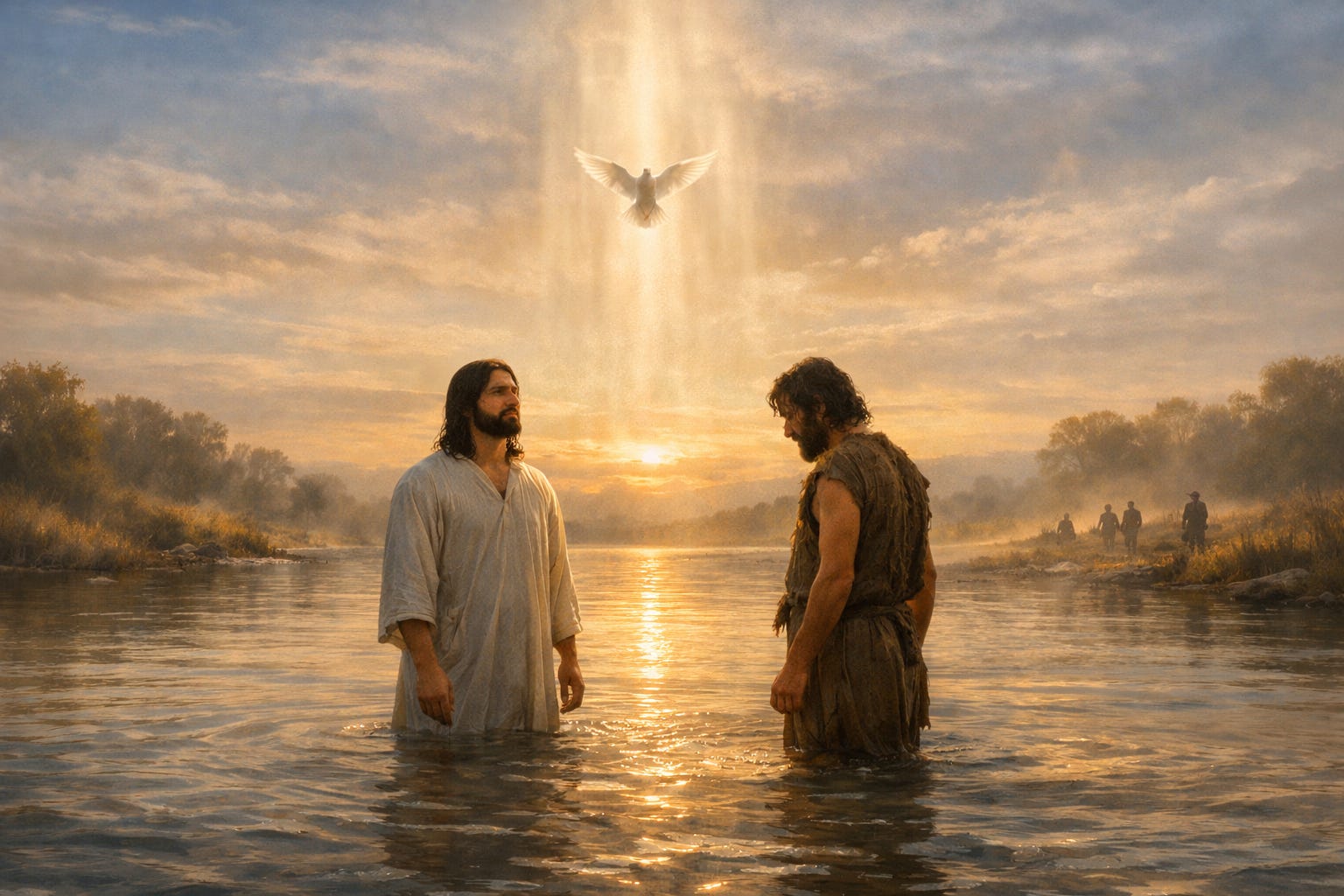
Matthew 3:13–17 sits at a hinge in Matthew’s story. The wilderness preacher has already named the crisis and the hope: the kingdom is near; the crooked must be made straight; trees that bear no fruit will not stand; a “stronger one” is coming who will baptize “with the Holy Spirit and with fire” (Matt 3:1–12). Then, with almost startling plainness, Matthew writes: “Then Jesus went from Galilee to the Jordan River to be baptized by John” (NLT). The shift matters. Until now, John has been the central voice; suddenly Jesus steps forward, not onto a stage, but into a river.
Geography here is theology. The Jordan is not a random body of water. It is a boundary river in Israel’s memory: the place where Joshua led Israel through into the land (Josh 3–4), the place of crossings and new beginnings. To stand at the Jordan is to stand at a threshold. Matthew’s Jesus comes “from Galilee” down into Judea’s wilderness orbit, toward John’s baptismal movement at the river, where repentance and expectancy have gathered the crowds. The setting is stripped of ornament: water, wilderness, and a prophet who refuses to flatter the religious establishment.
Liturgically, the church has long paired this Gospel with Isaiah’s servant song language (Isa 42:1–9), because Matthew’s baptism scene functions as a public unveiling: the Spirit descends; the Father speaks; the Son is named. The Revised Common Lectionary explicitly anchors Baptism of the Lord (Year A) to Matthew 3:13–17 in Epiphany, emphasizing “revelation” as much as “ritual.”
What makes the scene so potent is the tension Matthew refuses to resolve too quickly. John protests: the river should flow the other way. He is baptizing the repentant; Jesus, by implication, does not belong in that line. Yet Jesus insists: “It should be done, for we must carry out all that God requires” (NLT). The Greek behind that line includes Matthew’s thick vocabulary of “fulfillment” and “righteousness” (plērōsai… dikaiosynēn), words that, in Matthew, are never merely private morality. They are covenant-faithfulness brought to completion, God’s will embodied in the world.
When Jesus rises from the water, Matthew stacks signs of apocalypse-in-the-best-sense: “the heavens were opened,” the Spirit descends “like a dove,” and a voice declares Jesus as the beloved Son. In other words, the Jordan becomes a doorway between worlds. The river is ordinary; what happens there is not.
Audience Analysis
Most modern listeners do not struggle to imagine water; they struggle to imagine being seen. We live in an age of curated identity and ambient evaluation: performance reviews, social metrics, quiet comparison, and the subtle fear that the truest thing about us is what we have not yet fixed. Even within the church, baptism can be reduced to either (a) a sentimental family milestone or (b) a doctrinal debate we endure rather than a moment of lived revelation.
In that cultural air, Matthew 3:13–17 speaks to three common inner conditions:
The ache of “not enough.” John’s protest mirrors ours: “I need… and you come to me?” Many carry a low-grade conviction that they must become cleaner, stronger, more consistent, more disciplined before God will draw near.
Confusion about righteousness. “Do what God requires” can land as pressure—another ladder, another demand—unless Matthew’s meaning is heard: righteousness as God’s covenant faithfulness arriving in embodied form, not a self-salvation project.
A longing for an opened heaven in an often-closed world. People want assurance that God is not distant, that the spiritual world is not sealed behind glass, that their lives are not locked in mere coping. The question underneath many questions is: Is God pleased to be with us, or merely willing to tolerate us?
This text meets those pressures without scolding. Jesus does not stand on the bank correcting the crowds for being messy. He steps into their place. And then the voice from heaven names him beloved—before a sermon is preached, before a miracle is performed in Matthew’s narrative. That order matters for an anxious audience: belovedness precedes achievement.
Exegetical Exploration
Matthew 3:13 — Jesus arrives “to be baptized”
Matthew’s “Then” (Tote) links Jesus’ arrival to John’s wilderness ministry. Jesus “comes” (paraginetai) from Galilee to the Jordan “toward John” for the purpose clause “to be baptized” (tou baptisthēnai) by him. The grammar slows us down: this is intentional movement, not an accident.
Baptizō in this setting is immersion language tied to washing, repentance, and readiness. John’s baptism is not yet Christian baptism “in the name of Jesus”; it is a prophetic sign-act calling Israel to turn back to God in view of coming judgment and coming kingdom.
Matthew 3:14 — John’s resistance
John “was preventing him” (diēkōluen) — an imperfect tense that implies continued resistance: John keeps trying to stop it. The protest is relational and theological: “I have need to be baptized by you, and you come to me?” John recognizes an asymmetry. Matthew has already shown John distinguishing his water baptism from the Coming One’s Spirit baptism (3:11). Now he confronts that difference in the flesh.
Matthew 3:15 — “Permit it now… fulfill all righteousness”
Jesus answers: Aphes arti — “Allow it now / let it be for now.” The “now” (arti) is not dismissal; it signals timing in salvation history. Then: “for thus it is fitting/proper (prepon) for us to fulfill (plērōsai) all righteousness (pasan dikaiosynēn).”
Key terms:
prepon (“fitting, appropriate”): Jesus frames the act as congruent with God’s design, not as a concession to optics.
plērōsai (“to fill up, bring to completion”): Matthew frequently uses fulfillment language for Scripture and divine purpose; here it is applied to an action Jesus chooses.
dikaiosynē (“righteousness”): In Matthew, righteousness is larger than private virtue. It is God’s will enacted—covenant faithfulness embodied among God’s people (cf. Matt 5–6). Scholarly discussion often notes that this phrase is best read in a salvation-historical/prophetic sense, not as Jesus seeking personal moral improvement.
John then “permits” him (tote aphiēsin auton). John yields to Jesus’ framing: the baptism is part of God’s righteous purpose.
Matthew 3:16 — Up from the water; heavens opened; Spirit descends
“After being baptized, Jesus immediately went up from the water” — Matthew’s “immediately” (euthys) adds urgency: this is inauguration, not delay. Then Matthew’s “behold” (idou) introduces revelation: “the heavens were opened” (aneōichthēsan) and “he saw the Spirit of God descending like a dove and coming upon him.”
Notes:
“Heavens opened” signals apocalyptic unveiling—access, disclosure, divine initiative.
“Spirit of God” language echoes Genesis and prophetic empowerment.
“Like a dove” (hōsei peristeran) is simile: Matthew describes the manner of descent (gentle, visible), not necessarily that the Spirit was a dove.
Matthew 3:17 — The voice: beloved Son; divine pleasure
“And behold, a voice from the heavens” identifies Jesus: “This is my Son, the beloved, in whom I am well pleased.” Matthew’s wording strongly evokes Israel’s Scripture: Psalm 2’s royal son language and Isaiah 42’s servant language converge here, framing Jesus as both King and Servant.
This matters because it defines Jesus’ mission from the start: not domination, but servant-kingship; not spectacle, but faithful obedience; not self-protection, but redemptive solidarity.
Semiotic Illumination
Matthew loads this short scene with symbols that operate like a living grammar—ancient signs that still speak if we learn to read them.
1) The River as Threshold (Jordan). In Israel’s story, the Jordan is where wandering becomes inheritance, where a people pass through water into calling (Josh 3–4). So when Jesus enters the Jordan, it is more than “a religious moment.” It is a sign: the new Joshua (Jesus’ Hebrew name-echo) steps into the boundary place where God brings people through.
2) Water as Identification, not merely purification. John’s baptism is a repentance-sign. Jesus does not enter because he is dirty; he enters because he is joining. He stands where sinners stand. The sign says: He will save by solidarity. This is how “righteousness” gets “fulfilled” in Matthew: God’s faithful purpose is not shouted from a distance but enacted from within.
3) Opened Heavens as Divine Access. “The heavens were opened” is the Bible’s way of saying the world is not sealed. God is not locked away. In prophetic imagination, the torn/open heaven is the longing of Isaiah-like prayer: that God would come near with visible saving presence (cf. Isa 64:1). Matthew presents that longing answered at the river: heaven opens over Jesus—and, by extension, over the work he is beginning.
4) The Dove as New-Creation and Peace sign. The dove can echo multiple scriptural memories at once: creation’s Spirit hovering, flood’s dove signaling a world made safe again, and prophetic imagery of gentleness and divine presence. Matthew’s point is not to build a zoology of the Spirit but to say: the Spirit’s descent is not violent coercion. It is gentle authority—God’s life resting on the Son.
5) The Voice as Public Naming (Son + Servant). A voice from heaven is a sign of heavenly court testimony: identity is declared, not achieved. And the content fuses two Old Testament trajectories: Psalm 2 (royal Son) and Isaiah 42 (servant in whom God delights). The semiotic punch is this: Jesus’ kingship will look like servanthood; his authority will be expressed as healing fidelity, not crushing dominance.
Central symbol to carry forward: Open Heavens over Ordinary Water — the moment when God’s pleasure and presence break into a common place because Jesus steps into the line.
The Big Idea
At the Jordan, Jesus steps into our place so the heavens can open over ours.
Supporting theological claims (kept tightly tied to the text):
The gospel begins with Jesus’ humility, not our improvement. Before we “carry out all God requires,” Jesus carries out what God requires for us—the faithful Son taking his place among the unfaithful to begin a rescue from the inside.
The Trinity is not an abstract doctrine here; it is a lived revelation. The Son stands in water, the Spirit descends, the Father speaks pleasure. This is not God recruiting us into anxiety; it is God revealing divine communion as the source of our salvation and adoption.
Jesus’ mission is defined as servant-king mission from the start. The voice’s scriptural echoes (Psalm 2 + Isaiah 42) declare both authority and gentleness: the kingdom comes through the Servant who will bear burdens, not add them.
“Righteousness” is covenant-faithfulness reaching completion. This is not Jesus trying to get better; it is Jesus aligning fully with the Father’s saving plan—an obedient trajectory that will carry from water to wilderness to cross to resurrection.
Practical theological consequence: If God’s pleasure rests on the Son at the beginning, then Christian life is lived from belovedness, not for belovedness.