

Text
For the Second Sunday in Lent (Year A), the Revised Common Lectionary appoints John 3:1–17 as the Gospel reading. The church hears this text while already walking the Lenten road: a season not of religious performance, but of truth-telling—where God’s mercy meets us underneath our curated selves.
John places this encounter early in Jesus’ public ministry, in the wake of public controversy and public fascination. Immediately beforehand, Jesus is in Jerusalem for Passover, surrounded by “signs” and stirred expectations; many are impressed, but John hints that enthusiasm is not the same thing as transformation. Nicodemus steps out of that public swirl into a private conversation—one that reads like a hinge between surface religion and Spirit-birthed life.
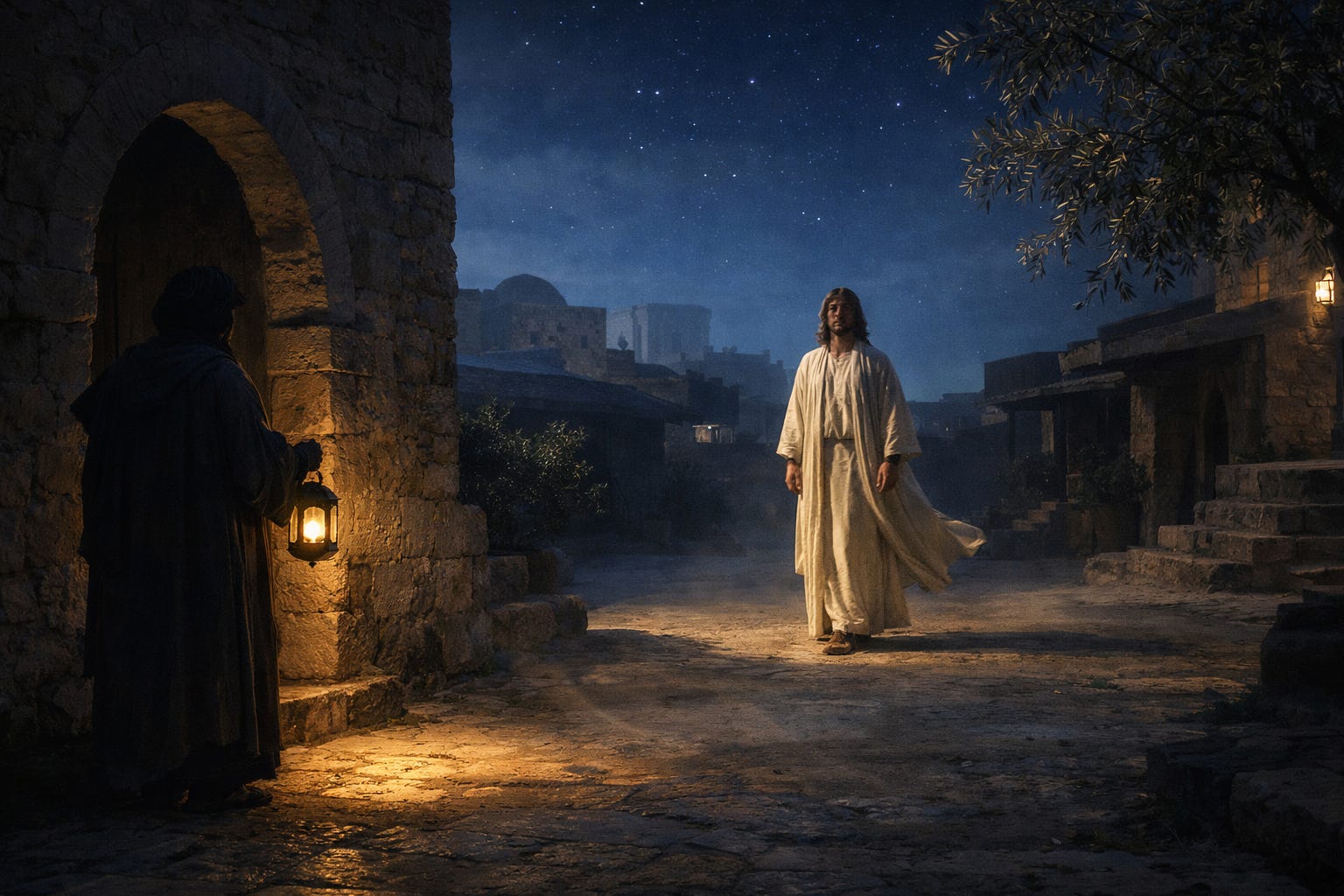
Nicodemus is introduced with layered identity markers: he is a Pharisee (a movement serious about Torah fidelity and Israel’s holiness), and he is called a “ruler” among the Jews—language many interpreters take to suggest a leadership role connected to the ruling council. He comes “by night.” In John, night is never only a time of day. It can be secrecy, caution, fear of exposure; it can also be symbol—partial sight, incomplete understanding, a life still learning how to step into light. Working Preacher notes how the darkness here is not merely threat; it is “darkness disturbed” by the strange brightness of Jesus.
Nicodemus addresses Jesus with respect—“Rabbi”—and speaks in the plural: “we know.” Whether that “we” signals colleagues, a cautious delegation, or simply the language of a representative leader, it places Nicodemus at the intersection of personal curiosity and institutional concern. He is not arriving empty-handed; he brings credentials, category systems, and interpretive habits. His opening premise is also revealing: he wants to locate Jesus by observable evidence—signs that can be measured, analyzed, defended.
Jesus answers by shifting the conversation from evidence to birth, from analysis to origin, from human ascent to divine descent. The heart of the passage is not a debate about what Nicodemus can prove; it is an invitation into what Nicodemus cannot engineer: a life that begins “from above,” generated by the Spirit like wind—real, powerful, but not controllable. The lectionary’s ending at verse 17 keeps the accent on grace: God’s motive is love; God’s movement is giving; God’s intent is not condemnation but rescue.
In Lent, that is bracingly good news: the gospel does not begin with our willpower climbing toward God, but with God’s Spirit giving new beginning to people who come in the night.
Audience
Most contemporary congregations carry a quiet Nicodemus-shaped burden: the pressure to be competent, to be explainable, to stay in control. Even when faith is sincere, it often lives with a background hum of anxiety—What if I am missing something? What if I cannot change? What if God is disappointed? Many people are fluent in religious vocabulary but unfamiliar with spiritual rebirth as lived reality.
In this cultural moment, “signs” still matter. We ask for outcomes. We want metrics. We want predictable steps. We want spirituality that functions like a dashboard—progress bars for holiness, clear cause-and-effect for prayer, certainty that reduces risk. And when that kind of certainty is not available, many retreat into “night”: private questions, silent doubts, carefully managed appearances.
Lent intensifies these pressures because it asks us to practice restraint and honesty. Yet restraint without new birth becomes mere self-improvement, and honesty without grace becomes despair. John 3 speaks directly into this tension: it refuses both shallow optimism (“just do better”) and harsh condemnation (“you’re hopeless”). It names the real need—transformation at the level of origin—and then names the real gift—God’s love moving toward the world.
Spiritually, many listeners are also exhausted by polarized religious speech. They long for a gospel that is both truthful and non-polemical: clarity without cruelty, conviction without contempt. John 3 provides that tone when preached faithfully: Jesus is direct with Nicodemus, but not dismissive; he is confrontational, but fundamentally invitational.
Emotionally, this text reaches people who feel stuck: habits they cannot break, shame they cannot wash off, grief that has rearranged their inner world, cynicism that has calcified into identity. Nicodemus is a reminder that high status does not eliminate spiritual hunger; it often hides it. And the night visit reminds us that many come toward God quietly before they can come publicly.
Exegetical Exploration
3:1–2 — Nicodemus and the language of “signs.”
Nicodemus approaches as a teacher approaching another teacher, and he frames Jesus through what he can observe: “signs.” John’s Gospel uses signs as pointers—never ends in themselves. Working Preacher highlights how Nicodemus can recognize signs yet still misunderstand what they signify.
3:3 — “Born ἄνωθεν (anōthen).”
Jesus begins with “Amen, amen” (a solemn emphasis) and introduces the necessity of being born anōthen. The crucial point: anōthen can mean “again/anew” and also “from above.” The ambiguity is not a bug; it is part of the text’s force. Even major translations flag this. Jesus is not primarily insisting on repetition (another round of natural birth) but on origin: a life sourced in God, not merely in flesh.
3:4 — Nicodemus’ literalism.
Nicodemus hears “again” and imagines biological impossibility. John frequently shows misunderstanding as the doorway into deeper revelation; the misunderstanding exposes the limits of purely natural categories.
3:5 — “Born of water and Spirit.”
Interpretations vary (baptism, natural birth imagery, purification rites), but a strong biblical backdrop is the promise of cleansing water and Spirit-driven new heart in prophets like Ezekiel 36. The point is not ritual technique; it is God’s renewing action—washing and re-creating from within.
3:6–7 — Flesh and Spirit.
Jesus draws a clean distinction: flesh produces flesh; Spirit produces spirit. The new birth is not moral polishing; it is the emergence of a new kind of life.
3:8 — Wind/Spirit wordplay (πνεῦμα / pneuma).
In Greek, pneuma can mean wind or spirit. The NET Bible note makes this explicit. Jesus leverages the double meaning: you cannot see wind itself, but you can see its effects; you cannot control its direction, but you can hear its sound. So it is with Spirit-generated life: real, experiential, undeniable—yet not domesticated.
3:9–10 — “You are the teacher of Israel…”
Jesus presses Nicodemus: the Hebrew Scriptures already carry the grammar of new heart, new spirit, divine renewal. Nicodemus’ problem is not lack of intelligence; it is a limited imagination for God’s re-creative work.
3:11–13 — Earthly and heavenly things; descent.
Jesus speaks as one who comes from God. The movement is downward before it is upward: revelation is gift, not human achievement.
3:14–15 — The lifted serpent and the lifted Son (ὑψόω / hypsoō).
Jesus links his coming “lifting up” to Numbers 21: the serpent raised so that those afflicted could look and live. John uses “lifted up” with a paradoxical resonance—crucifixion and exaltation interwoven.
3:16–17 — Love, giving, rescue.
God’s love is directed toward “the world” (κόσμος / kosmos)—a term John can use to name both the creation God loves and the system that resists God. The “only/unique Son” language (μονογενής / monogenēs) is often best understood as “one-of-a-kind/unique,” emphasizing singularity rather than implying God “created” the Son. The mission is stated plainly: not condemnation, but salvation.
Semiotics
Night
In John, night can signify hiddenness and partial sight, yet also the mercy of a private meeting where honest questions can be spoken. Working Preacher’s framing—darkness disturbed by light—captures the semiotic tension. Modern parallel: the “night” of anxiety, secrecy, performative strength, and unspoken doubt.
Birth “from above” (anōthen)
Birth is identity-level change, not behavior-level adjustment. “From above” locates the origin in God’s initiative. Modern parallel: not “turn over a new leaf,” but receiving a new root system.
Water and Spirit
Water signifies cleansing and renewal; Spirit signifies divine agency and new heart. Ezekiel’s promise of cleansing water and new Spirit provides a deep Old Testament resonance. Modern parallel: the longing not merely to be forgiven but to be remade.
Wind/Spirit (pneuma)
Wind is invisible yet unmistakable. The semiotic power is that reality is known by effect: movement in trees, pressure on sails, sound in the air. The NET note anchors the wordplay. Modern parallel: Spirit-birthed life is discerned by fruit—new desires, new freedom, new courage—not by religious noise.
Lifted serpent / lifted Son
The bronze serpent is a symbol that holds judgment and mercy in one frame: the people face the sign of their affliction, and God heals through looking. John’s “lifting up” gathers crucifixion and exaltation into one act of saving glory. Modern parallel: salvation is not achieved by denial or self-defense, but by turning our gaze toward the crucified-and-glorified Christ.
World (kosmos)
Not a tiny religious enclave—God’s love moves toward the whole created order, including the places we fear are beyond redeeming. That is the scandal and the hope.
Big Idea
Central Image: The Midnight Wind
Nicodemus comes at night, and Jesus speaks of the wind. The gospel here is the Spirit moving through our midnight—unseen, unmanageable, yet utterly real—birthing a life “from above” as we lift our eyes to the lifted Son.
Big Idea:
When you come to Jesus in the night, he does not hand you a better religious technique—he gives you a new beginning. The Spirit moves like a midnight wind, and the lifted Son becomes the saving gaze that brings you into the light.
Supporting insights:
The kingdom is not accessed by status, knowledge, or control—only by new birth.
The Spirit’s work is real but not programmable; it is received, not manufactured.
The cross is not merely an event to explain; it is a person to look toward—God’s love made visible for the world’s healing.