

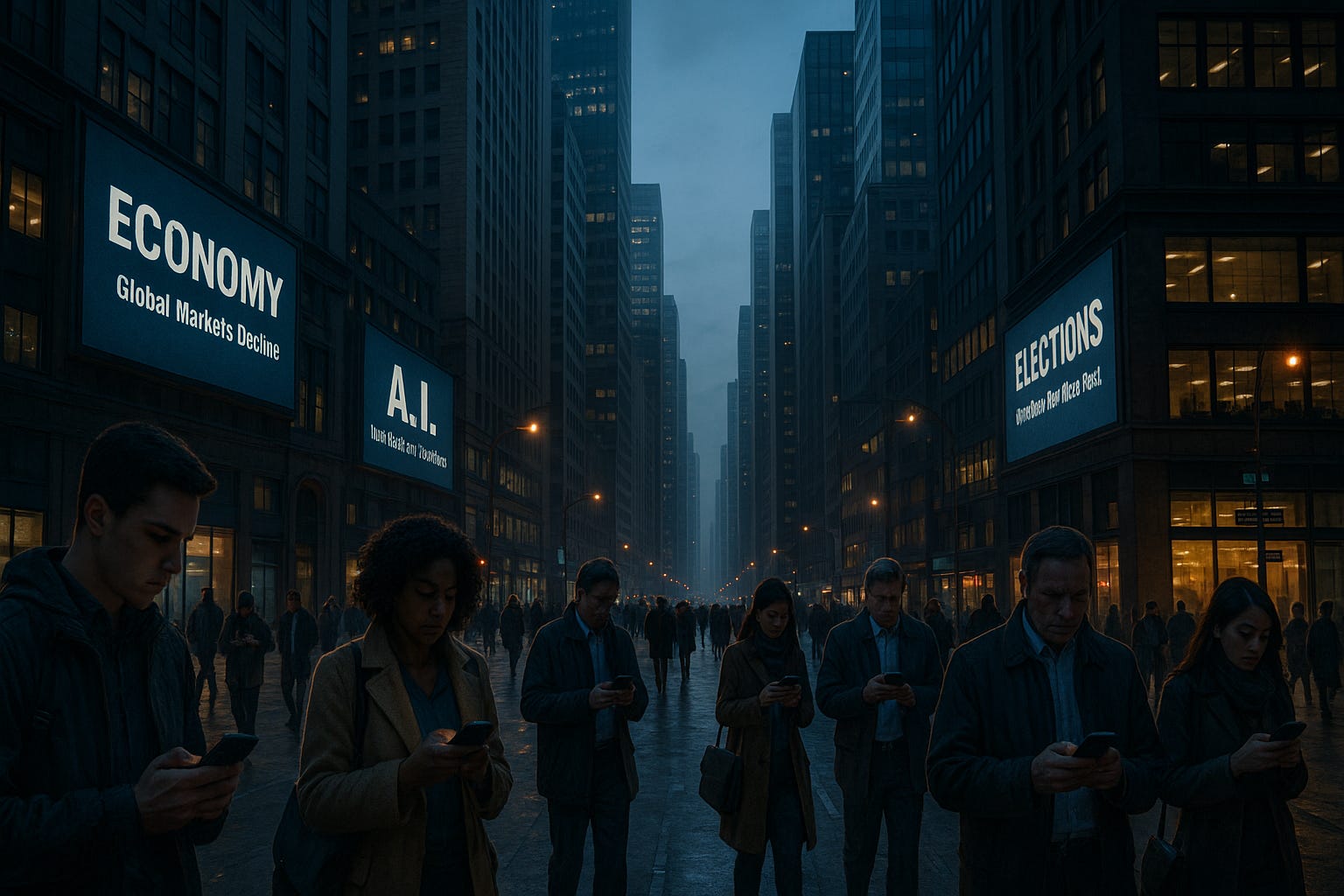
A Morning In Late 2025
You wake up, reach for your phone, and meet the same pattern.
Markets wobble. A headline warns about new tariffs. Another tracks a war that drags on without a clear end. A think tank warns about artificial intelligence and job loss. A local story covers extreme weather and rebuilding costs. A friend shares a thread about elections, disinformation, and “democracy on the brink.”
None of this feels abstract. Groceries cost more than two years ago. Rent or mortgage payments press harder. Health costs rise. Work feels less secure. Family group texts carry quiet questions about layoffs, college costs, retirement, and whether children will experience a more stable future than their parents did. Anxiety does not stay online. It tracks into staff meetings, pastoral visits, and Sunday conversations in the hallway.
The data behind these feelings shows the same pattern. A global Ipsos tracking survey reports that cost of living and inflation remain top worries across many countries, even as concern eased slightly through late 2024 (Ipsos). Gallup finds that in early 2025, about six in ten Americans say they worry “a great deal” about the economy, with similar levels of concern about health care costs, inflation, federal spending, and Social Security (Gallup.com). Pew Research reports that inflation and the inability of political parties to work together sit near the top of the United States problem list (Pew Research Center).
Global studies show that concern about conflict, climate, technology risks, and democracy has climbed as well. The World Economic Forum’s 2025 Global Risks Report names state-based armed conflict as the most urgent short term threat according to global leaders, along with extreme weather, environmental strain, and information risks (World Economic Forum).
The fear is not only “out there.” Chapman University’s 2025 survey on American fears reports that corrupt government officials remain the top fear for the tenth straight year, followed closely by fears of economic collapse, serious illness in loved ones, and cyberterrorism (Chapman Newsroom)
We live inside these numbers.
What The Numbers Are Whispering
Different research groups ask different questions, yet several patterns repeat.
First, economic strain sits near the center. Global Ipsos surveys show cost of living and inflation as the leading issues in many countries across 2024 and 2025, even as intensity softens from the 2022 spike (Ipsos). Gallup finds a cluster of economic worries at the top of American concern lists in 2025, from the broad economy to health costs and retirement security (Gallup.com). A separate Pew study in 2025 notes that several economic topics remain “top national problems” for large majorities, with immigration and inflation especially prominent among Republicans, and health care and gun violence ranking high among Democrats (Pew Research Center).
Second, conflict and geopolitical strain press harder on public imagination. The World Economic Forum’s risk survey ranks state-based armed conflict as the most urgent risk in 2025, with leaders worried about the war in Ukraine, violence in Sudan and Gaza, and the wider knock-on effects on energy, food prices, and displacement (World Economic Forum).
Third, climate and environmental concerns rise when people think about the long term. The same global risk work ranks climate-related threats at the top when experts look toward the next decade (World Economic Forum). Surveys of American opinion on climate show that among the “alarmed” segment, worry about global warming reaches above ninety percent, paired with strong concern about the state of democracy and federal government stability (Yale Climate Communication).
Fourth, technology shifts are no longer a niche concern. Discussions at Davos in 2025 highlighted AI as both a driver of productivity and a source of serious risk, especially without agreed safeguards (AP News). The World Trade Organization warns that AI might widen the global wealth gap unless low and middle income countries gain broader access to digital infrastructure and markets (Financial Times). The World Economic Forum’s president has pointed to possible bubbles in AI-related assets, alongside sovereign debt and cryptocurrency, raising concern about financial stability and job losses in white-collar roles (Reuters).
Fifth, democracy, trust, and information integrity trouble many citizens. Chapman’s fear survey again places corrupt government officials at the top of American fears (Chapman Newsroom). Pew and other studies show persistent frustration with political leaders, deep partisan mistrust, and anxiety about misinformation (Pew Research Center).
Behind these themes lies an emotional pattern. Concern about money, safety, climate, and trust in institutions merges into one shared mood. People feel more vulnerable, less certain about long term trajectories, and less confident that leaders will act wisely with the tools at hand.
Five Worries, One Connected World
Different regions tell their own stories, yet several worries keep surfacing as we move toward 2026. This series will focus on five of them.
Economic insecurity and cost of living
Rising prices, flat or uneven wages, and unstable housing leave households stretched. Even when official inflation slows, many families still feel squeezed (Gallup.com).Conflict, war, and global security
Armed conflict in several regions, nuclear risk, cyber attacks, and trade wars unsettle expectations about peace and cooperation (World Economic Forum).AI, work, and social inequality
Rapid AI deployment raises questions about jobs, surveillance, bias, and who gains from new productivity. Global bodies warn about widening gaps between countries and between workers with different skills (Financial Times).Climate stress and ecological limits
Extreme weather, resource strain, and slow progress on emissions leave many people worried about physical safety, food and water security, and long term habitability in some regions (Zurich).Democracy, trust, and social fragmentation
Corruption, disinformation, polarization, and weak confidence in institutions bring a sense of democratic backsliding. Many worry about whether future elections and public debates will remain fair and peaceful (Pew Research Center).
Mental health weaves through all five. Surveys on fears, worries, and perceptions do not always ask about anxiety directly, yet the patterns point toward fatigue, anger, and numbness as frequent responses (Chapman Newsroom).
Why These Worries Matter For Systems And Institutions
Economic lens
High and persistent concern about cost of living, health costs, and retirement security pressures both public and private budgets (Gallup.com). Governments face rising demands for assistance while they carry heavy debt loads. Central banks weigh rate cuts or hikes while watching inflation and employment. Businesses attempt to adjust wages, prices, and staffing in an environment where consumers feel stretched and cautious.
Economic strain also shapes political choices. Voters often treat economic experience as the main filter for judging leaders. Gallup finds that the economy remains the top issue for American voters when they choose presidents (Gallup.com.) When people stop believing that effort leads to a more secure life, support for policy experiments, outsider figures, or retreat into cynicism grows.
Political lens
Trade tensions, tariff fights, and uncertainty about government debt feed into broader political risk. A 2025 Federal Reserve survey of market participants named global trade conflict, policy uncertainty, and U.S. debt sustainability as leading financial stability risks (Reuters). These concerns overlap with shifting alliances, wars, and debates over defense spending.
Inside many democracies, partisan mistrust runs high. Pew data shows that citizens rate the ability of parties to work together as one of the largest problems facing the United States (Pew Research Center). When people expect gridlock rather than problem solving, respect for institutions erodes. That trend matters for churches, faith-based nonprofits, and schools that operate within the legal and cultural framework of those institutions.
Sociological lens
The same worries take social form. High housing costs delay marriage, children, and caregiving arrangements. Economic and climate pressures encourage migration, which reshapes neighborhoods and congregations. Conflict abroad changes local social dynamics when refugees arrive or when diaspora communities carry the strain of news from home.
Information systems intensify social fragmentation. Different groups live inside different news and social media feeds. Studies on global threats and public concern show that interpretations of the same risks split along partisan, cultural, and generational lines (Pew Research Center). Shared facts become harder to agree upon, which slows collective response.
Psychological lens
Repeated exposure to worry headlines shapes mental health. Chapman’s fear survey tracks high levels of fear related to corruption, economic collapse, illness, and cyber threats (Chapman Newsroom). Yale’s “Six Americas” climate research shows that those already alarmed about climate change report intense worry about global warming, democracy, and federal government functioning (Yale Climate Communication).
When people feel flooded by threats without a sense of agency, the result often looks like chronic stress. Some respond with hypervigilance and anger. Others withdraw into numb scrolling, distraction, or denial. Leaders in church, school, and workplace settings meet those emotional states daily.
Leadership lens
These five worries press leaders in every sphere.
Economic pressure forces hard choices about budgets, staffing, and long term investment. Political volatility complicates planning, especially for organizations linked to public funding or regulation. AI promises productivity gains but brings ethical and employment questions that leadership teams must address with care. Climate risk demands resilience planning for buildings, supply chains, and vulnerable neighbors. Declining trust in institutions asks leaders to model transparency, accountability, and service.
Leaders who ignore these worries risk losing credibility. Leaders who react only out of fear risk short term fixes that deepen long term problems. The moment calls for clear-eyed realism, moral courage, and steady presence.
How This Series Will Work
This series will follow the five worries named above. Each topic will receive two articles.
The first article will use an analysis lens. It will look at current research and reporting on the worry in question, through economic, political, sociological, psychological, and leadership perspectives. The goal will be clear understanding, without exaggeration or denial.
The second article will use a pastoral lens. It will explore how Scripture speaks into the same worry, how followers of Jesus experience it in daily life, and how spiritual formation speaks to fear, anger, and exhaustion. The goal will be faithful imagination and practical discipleship.
Together, these pieces will invite readers into a double vision. On one side, honest attention to data, trends, and power dynamics. On the other side, deep trust that God has not abandoned the world and that the Spirit continues to work through ordinary communities.
An Invitation To Walk Together
Headlines in late 2025 do not promise quick relief. Conflict continues. Economic concerns remain high. AI adoption races ahead of shared norms. Climate risks grow faster than global agreements. Democratic frustration lingers.World Economic Forum
Yet those same reports also show people who care enough to answer surveys, join movements, serve neighbors, and seek better paths. Congregations still gather. Local leaders still work for the common good. Young adults still ask what faithful life looks like under these conditions.
This series will not promise easy reassurance. It will aim for something else. Clear vision. Shared language for what people already feel. A sense of agency for households, churches, and organizations. And a steady reminder that the story of the world does not end with any election, technology wave, or market cycle.
You carry influence in those stories. Over the next articles, we will look at each worry in turn and ask what wise, grounded, and hopeful response looks like as 2026 approaches.
Sources & Further Reading
Gallup. (2025, April 3). Worry about U.S. economy, healthcare, Social Security surges.
Gallup.comIpsos. (2024–2025). What worries the world series, including December 2024 and October 2025 releases.
Ipsos Ipsos IpsosPew Research Center. (2024, May 23). Top problems facing the U.S.
Pew Research CenterPew Research Center. (2025, February 20). Americans continue to view several economic issues as top national problems.
Pew Research CenterPew Research Center. (2025, October 3). Most Americans continue to rate the U.S. economy negatively as partisan gap widens.
Pew Research CenterWorld Economic Forum. (2025). Global risks report 2025.
World Economic Forum Global Risks ReportZurich Insurance Group. (2025, January 15). The global risks report 2025: These are the top risks facing the world.
ZurichChapman University. (2025, October 21). What Americans fear most in 2025.
Chapman NewsroomYale Program on Climate Change Communication. (2025, September 18). Top public worries in the U.S.
Yale Climate CommunicationReuters, AP, and WTO coverage of AI, trade risks, and financial bubbles, 2025.