

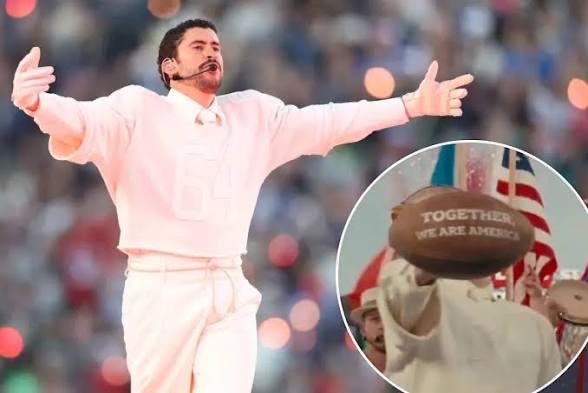
I was wrong.
Last night I posted that the Super Bowl halftime show was “unintelligible” and that I wished Bad Bunny would have sung in English to “make a connection to the world.” A few of you pushed back on that, and it made me stop and actually think about what I’d said. I’m grateful for that pushback, uncomfortable as it was.
Here’s what happened: The show was entirely in Spanish. I don’t speak Spanish. Bad Bunny’s music isn’t my style, and I didn’t know his work or his story. My ADD brain did what it does when it can’t find an immediate hook—it checked out. Within minutes, I was scrolling my phone, half-watching, fully disengaged. And then, because I was tired and not thinking clearly, I posted my dismissal as if it were thoughtful commentary.
I want to be clear: being tired doesn’t excuse what I said. Not knowing Bad Bunny’s music doesn’t excuse it. Having ADD doesn’t excuse it. These are explanations for why my brain went where it went, but they’re not justifications for opening my mouth—or worse, my keyboard—before taking time to understand what I was actually watching.
The progression was embarrassingly predictable: I didn’t understand it, so I dismissed it. I dismissed it, so I ignored it. I ignored it, so I felt justified posting a hot take. And now I regret it. I should have known better. I know better.
What I Missed While I Wasn’t Paying Attention
Here’s what was actually happening during that halftime show while I was checked out and scrolling:
Puerto Ricans are Americans. This seems obvious, but my reaction proved I’d forgotten it. Puerto Rico is a U.S. territory. People born there are U.S. citizens. They can’t vote for president, but they can be drafted to fight in our wars. They’ve served in every American conflict since World War I. Bad Bunny wasn’t singing in a “foreign language” to an American audience—he was singing in one of America’s languages to Americans. The fact that I called it “unintelligible” and wanted him to switch to English to “connect to the world” reveals an assumption I didn’t even know I was making: that English is the default, the center, the language that matters. That Spanish-speaking Americans should code-switch for my comfort.
The timing of this show matters immensely. While I was half-watching, ICE raids were happening across the country, targeting Hispanic communities. Families were being separated. Citizens were being questioned about their documentation. In that context, Bad Bunny taking the world’s biggest stage and celebrating Puerto Rican identity, history, and culture in Spanish was a defiant statement: We belong here. We are American too. You don’t get to decide that we’re foreign.
The symbolism was everywhere, and it was powerful. The show celebrated Puerto Rican history and explicitly highlighted how the United States has failed one of its own territories. Hurricane Maria devastated Puerto Rico in 2017, and the federal response was criminally inadequate. People died waiting for help that came too slowly or didn’t come at all. The show referenced that. It referenced the extraction of natural resources, the colonial relationship where Puerto Rico is controlled by a government its people can’t fully participate in, the decades of being treated as second-class while being told you’re equal. I didn’t catch any of this because I wasn’t looking. I’d already decided it wasn’t for me, so why pay attention?
Bad Bunny is one of the most significant artists in the world right now. He’s the most-streamed artist on Spotify globally multiple years running. His music addresses social justice, Puerto Rican identity, and political issues. Giving him the Super Bowl platform—and letting him use it entirely in Spanish, entirely on his terms—was itself a statement. The NFL didn’t ask him to water it down or translate it or make it more “accessible” to people like me. They let the art be what it was. And what it was, was a gift to millions of people who rarely see themselves celebrated on stages that big, who are constantly told to assimilate, to speak English, to make themselves smaller and more palatable.
When I said I wished he’d sung in English, what I was really saying was: “I wished he’d centered people like me instead of the people he was actually there to celebrate and honor.”
The Larger Lesson I’m Sitting With
This isn’t really about one halftime show or one Facebook post. It’s about a pattern I’m recognizing in myself: When I’m not the target audience for something, I have a choice. I can be curious, or I can be dismissive. Last night, I chose dismissive. I chose it quickly, easily, without even realizing I was choosing it.
The word “unintelligible” keeps coming back to me. Because here’s the thing: it wasn’t unintelligible. Millions of people understood it perfectly. It was only unintelligible to me, because of my limitations—linguistic, cultural, musical. But instead of owning that, I made it about the show itself, as if the problem was the art rather than my own unfamiliarity.
This is particularly dangerous when you have a platform, even a small one like a Facebook page. Our words have reach. When I post something dismissive, I’m not just expressing a personal opinion in a vacuum—I’m potentially giving permission to others to dismiss things they don’t immediately understand, reinforcing the idea that if something doesn’t center us, it’s somehow less valuable.
I needed to pause before posting. I needed to ask myself: Do I actually have something informed to say here, or am I just reacting to my own discomfort at not being the center of attention?
Moving Forward
I’m grateful to those of you who pushed back. It would have been easier to scroll past or privately roll your eyes at me. Taking the time to engage meant you thought I was worth the effort, even when I was being an idiot. Thank you for that.
I’m committing to doing better. To pausing before I post. To recognizing when my discomfort is about me, not about the thing I’m tempted to critique. To remembering that “I don’t understand this” and “this is unintelligible” are very different statements, and the first is honest while the second is arrogant.
I’m also committed to listening to more world musicians and to learn of their background and their culture’s history. I need more randomness like that in my life. I’m really not an old, grumpy man!
Beautiful!