

Standing on the Threshing Floor
If you’ve ever cleaned out a garage, you know there comes a moment when you stand in the middle of the mess and think, How did all of this get here? Boxes you never unpacked from three moves ago. Tools you forgot you owned. Things you meant to fix “someday” buried under layers of dust. Cleaning day is the day of reckoning—not because you hate your garage, but because you finally love order and space more than you love clutter.
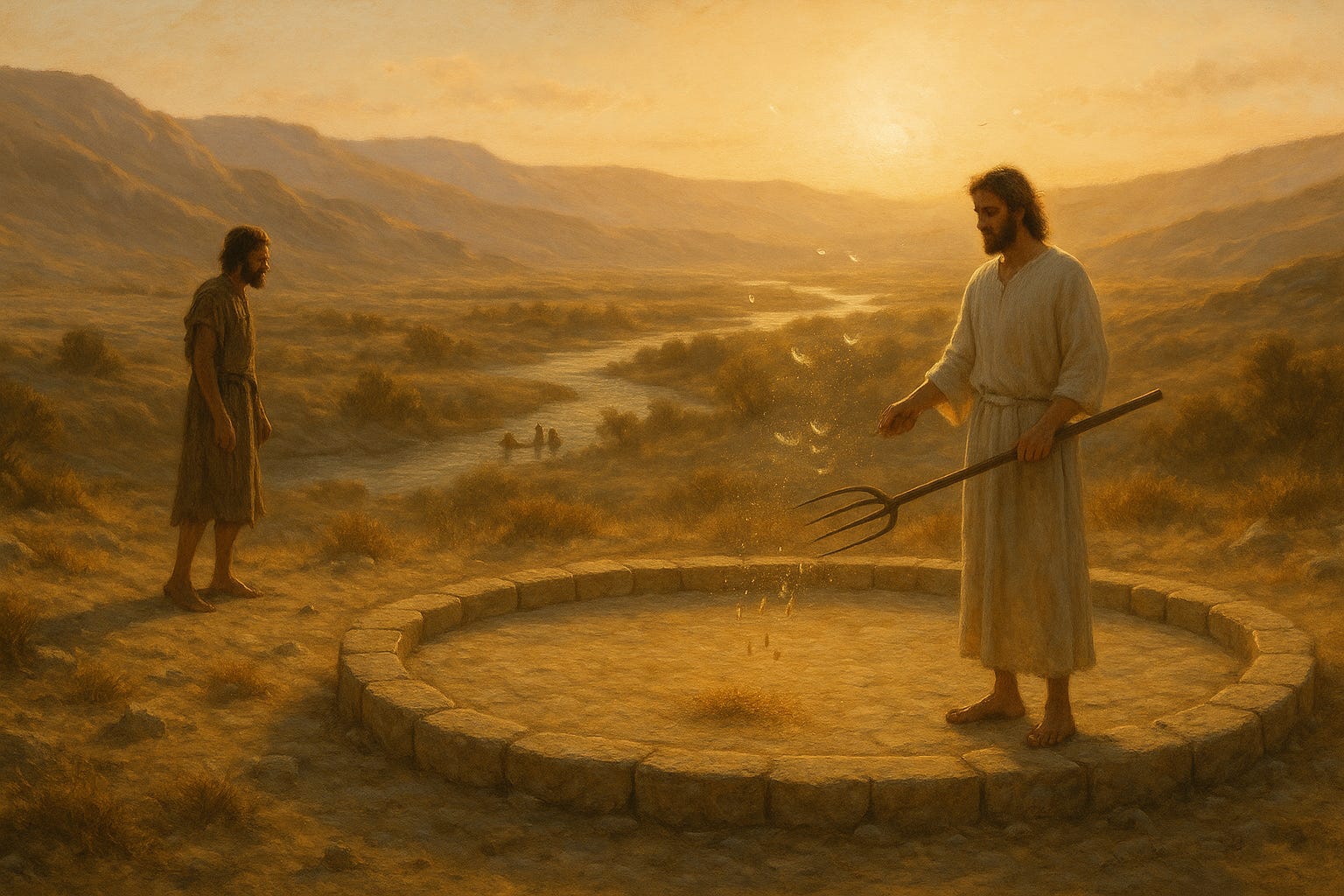
Matthew 3 takes us into God’s garage-cleaning moment with His people. But instead of a concrete floor and cardboard boxes, we find a threshing floor in the Judean wilderness. The air is dry and sharp. A rough prophet named John stands ankle-deep in dust by the Jordan River. The sun is dropping. A farmer walks onto the threshing floor, fork in hand, and begins to toss grain into the evening breeze. Heavy kernels fall and gather at his feet. Light, useless husks drift away, then are swept up and burned.
John borrows that picture to describe what happens when Jesus steps into a human life. The King is near, John says. His kingdom is pressing in. And when He comes, He will not simply give us a few tips for better living. He will stand on the threshing floor of the heart and separate wheat from chaff.
For many of us, that sounds frightening. We’ve seen religious versions of this that felt like humiliation, not healing. Some of us still hear the word repent in the tone of an angry preacher, not a grieving friend. Others of us have learned to dodge any serious talk of repentance at all. We prefer Jesus as gentle consultant, not holy winnower.
But Matthew 3 tells us a better story. It shows us that when Jesus comes with Spirit and fire, it is for the sake of freedom and fruitfulness, not shame and annihilation. On the threshing floor of the heart, His goal is not to throw us away, but to burn away what is slowly killing us so that the true wheat of His life can nourish the world.
Hearing the Voice in the Wilderness
Matthew tells us that “in those days John the Baptist came to the Judean wilderness and began preaching” (3:1 NLT). The wilderness is a loaded symbol. It’s where Israel was formed after leaving Egypt. It’s the place of manna and murmuring, of God’s voice and Israel’s restlessness. It’s where God taught His people to live by His word, not by Pharaoh’s rations.
Now, after centuries of prophetic silence, a voice rises again—not in the temple courts, but out where the land feels empty and exposed. John’s message is simple and sharp: “Repent of your sins and turn to God, for the Kingdom of Heaven is near” (3:2). The verb he uses means more than “feel bad about what you’ve done.” It means turn around. Rethink everything in light of a new reality. Reorient your life because a different Kingdom is arriving.
John dresses the part of a prophet—camel hair, leather belt, locusts and wild honey. He looks more like a wilderness herdsman than a priest. His very body is a protest against religious comfort and royal excess. If you want to hear God’s new word, Matthew suggests, you may have to leave the center of power and go out to the edges.
And people do. They come from Jerusalem, from Judea, from the villages along the Jordan. They wade into the river, confess sins, and let this wild prophet dunk them beneath the surface. The Jordan River, where their ancestors once crossed into the Promised Land, becomes a liquid doorway into a different kind of life. It is as if Israel is starting over, step by wet step.
Then the religious elites arrive. Pharisees and Sadducees—those who manage theological boundaries and maintain temple life—show up at the riverside. John sees them and does not roll out a red carpet. “You brood of vipers!” he says. “Who warned you to flee the coming wrath?” (3:7). The image is harsh: a nest of poisonous snakes slithering away from a brushfire.
It’s not their robes that anger him. It’s their reliance on religious appearance without inner change. They want the symbol of repentance without the substance. So John lays an axe at the root of their self-deception: “Prove by the way you live that you have repented of your sins and turned to God. Don’t just say to each other, ‘We’re safe, for we are descendants of Abraham.’” (3:8–9). Heritage is not enough. Titles are not enough. Correct doctrine, by itself, is not enough.
Then John says the words that bring us to the threshing floor:
“I baptize with water those who repent of their sins and turn to God. But someone is coming soon who is greater than I am… He will baptize you with the Holy Spirit and with fire. He is ready to separate the chaff from the wheat with his winnowing fork, then he will clean up the threshing area, gathering the wheat into his barn but burning the chaff with never-ending fire.” (3:11–12 NLT)
John’s water prepares; Jesus’ fire transforms. John can call out vipers; Jesus can make new hearts. John can put us into the river; Jesus can stand on the threshing floor of our interior world and begin to separate what is truly alive from what only looks like life.
The Threshing Floor of the Heart
What does that mean for us?
First, it means repentance is not spiritual self-harm; it is spiritual hospitality. When John calls us to repent because the Kingdom is near, he is saying: “Make room. Clear the road. Open the door to the One who loves you enough to tell you the truth.”
Think of the farmer on the threshing floor. He does not hate the grain. He has labored for it. He has waited through seasons. Now he wants the grain to be free from its husk so it can feed his household. The winnowing fork in his hand is a tool of care.
When Jesus comes to sift our lives—when He puts His finger on self-righteousness, on hidden addictions, on unforgiveness, on secret despair—He is not trying to humiliate us. He is trying to free the wheat. Repentance is agreeing with His assessment. It is stepping onto the threshing floor and saying, “Lord, I will not cling to my chaff. Separate what needs to go from what needs to stay.”
Second, it means identity is gift, not entitlement. The Pharisees and Sadducees leaned on Abraham. Many of us lean on other things: “I’m from a Christian family.” “I’m a church member.” “I’m theologically sound.” “I’m basically a good person.” These things are not bad in themselves, but they can become chaff if we use them to avoid deep surrender.
John says God can raise up children of Abraham from stones. In other words, God is not stuck with our self-protective games. In Jesus, He is creating a new family formed not by bloodline or performance but by grace. To repent is to lay down all the ways we try to prove ourselves and to receive our name as beloved sons and daughters in Christ.
Third, it means judgment is ultimately about restoration. The words “wrath” and “fire” carry a long history of misuse. They have been weaponized to control and terrify. But Scripture’s own story insists that God’s wrath is His opposition to everything that destroys His good creation. His fire is not random cruelty; it is the heat of holy love against all that deforms the beloved.
On the cross, that holy fire falls on Jesus. The Judge steps into the dock. The One with the winnowing fork in His hand is pierced for our transgressions. In Him, the fire that should consume us is borne by the Beloved, so that when His Spirit burns in our lives now, it is not the fire of condemnation but the fire of refining. It burns the chaff precisely because the wheat matters.
Joining Jesus on the Threshing Floor
So what might it look like for you to step onto the threshing floor of the heart this week?
Name your wilderness honestly.
Where, right now, do you feel stripped down, disoriented, or alone? A health crisis? A strained marriage? Vocational disappointment? The wilderness is not proof that God has abandoned you. It may be the very place He is positioning you to hear His voice again. Take that wilderness into prayer. Speak it plainly to God.Let confession become crossing.
Those crowds didn’t only think about their sins; they walked to the river and said them out loud. Is there a “Jordan River” step God is inviting you to take? Perhaps it’s scheduling a meeting with a counselor, confessing a secret habit to a trusted friend, or writing a letter of apology you’ve avoided. That act is not the price you pay for forgiveness. It is the way you step into what God has already made possible in Christ.Ask Jesus to show you the difference between wheat and chaff.
Not everything in your life that looks “religious” is wheat. Not everything that looks “ordinary” is chaff. Sit with the Lord and ask:What is the wheat you want to preserve in me—gifts, relationships, practices that truly give life?
What is the chaff—habits, resentments, illusions—that needs to be carried off by the wind of Your Spirit?
Then listen. The Spirit’s conviction is specific, not vague. It doesn’t just tell you “you’re terrible”; it puts its finger on particular patterns and invites change.
Take one concrete step of fruit-bearing.
John doesn’t let anyone off with vague intentions. “Prove by the way you live that you have repented of your sins and turned to God” (3:8). Choose one tangible act this week that would be impossible without repentance. Forgive a debt. Return something you took. End a compromising relationship. Re-engage a spiritual practice you have abandoned. Let there be some visible “fruit” that corresponds to the inner work God is doing.Trust that the One on the threshing floor loves you.
This may be the most important. The One who will baptize with Spirit and fire is the same One who will soon walk into the Jordan, stand in line with sinners, and be baptized Himself. He does not stand off at a distance yelling instructions; He joins us in the water, then carries our sin to the cross. If He is holding a winnowing fork over your life, it is because He intends to keep you, not to discard you.
BENEDICTION – Blessed on the Threshing Floor
Beloved, you do not stand alone on the threshing floor.
The wilderness you walk through is not God’s absence; it is often His workshop. The river you fear to enter is not your drowning; it is the place where old stories are washed away and new ones begin. The fire that touches your life is not random cruelty; it is the refining heat of a Love that refuses to let your chaff define you.
May the King who comes with Spirit and fire meet you at the river’s edge.
May He stand on the threshing floor of your heart with a winnowing fork in His hand, separating what is killing you from what will feed you and others.
May He give you courage to confess, grace to turn, and joy in the fruit that follows.
And as you go, may you know this deep in your bones:
The One who sifts you is the One who saves you.
The One who burns away your chaff is the One who treasures your wheat.
The One whose Kingdom is near is the One who will not let you go.
In the name of the Father, and of the Son, and of the Holy Spirit.
Amen.