

Text & Context
Matthew 11:2–11 sits at a crucial hinge in Matthew’s Gospel. Up to this point, Jesus has announced the nearness of the kingdom (Matthew 4:17), delivered the Sermon on the Mount (chapters 5–7), and authenticated His message with a series of powerful signs—healings, exorcisms, even raising the dead (chapters 8–9). In Matthew 10, He then commissions the Twelve, sending them out with authority to extend His ministry.
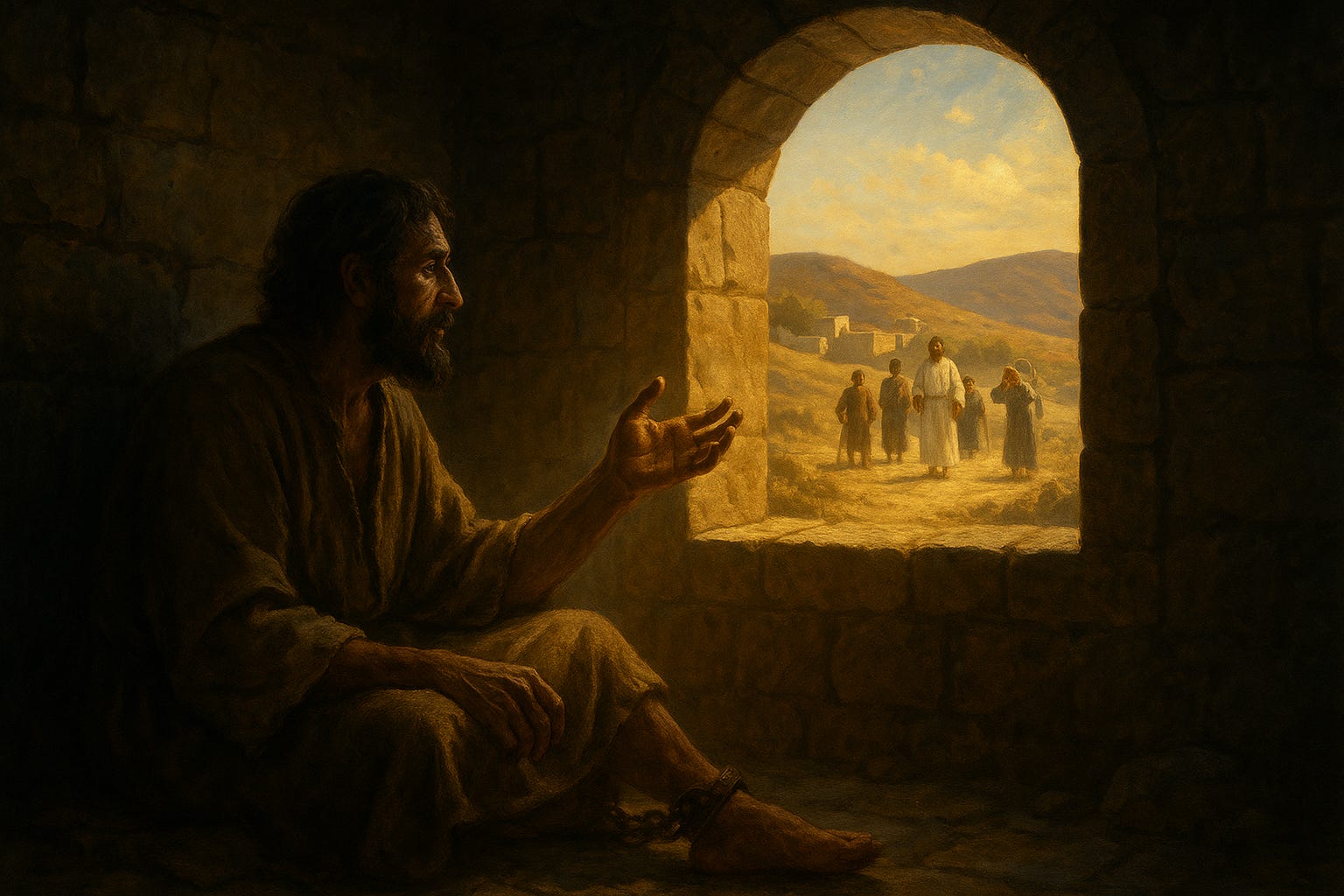
At the same time, the story of John the Baptist has moved from public wilderness ministry to political imprisonment. John, who once stood in the open air by the Jordan proclaiming repentance and expectation, has publicly rebuked Herod Antipas for his unlawful marriage. Herod responds with predictable force: John is arrested and confined in a fortress prison. The prophetic voice that thundered against kings is now behind stone walls.
It is from that confined context that Matthew tells us: “When John heard in prison about the deeds of the Christ, he sent word by his disciples” (v. 2). John’s world has shrunk to a narrow field of view. He depends entirely on secondhand reports brought to him by his disciples. The contrast here is sharp and intentional:
Outside the prison, Jesus is freely moving among villages, healing, teaching, and announcing good news.
Inside the prison, John is limited, powerless, and increasingly confused about how these reports square with his expectations of the Coming One.
Literarily, Matthew uses this scene to explore the tension between expectation and fulfillment. John had proclaimed a Messiah who would bring fiery judgment, clear the threshing floor, and lay the axe to the root of every fruitless tree (Matthew 3:10–12). Yet the deeds he hears about—healings, restorations, preaching to the poor—sound less like a strongman’s purge and more like a physician’s rounds. The contrast opens a question at the heart of Advent faith: if the kingdom has truly arrived in Jesus, why do so many signs of evil persist?
Historically and theologically, this episode also marks a transition in salvation history. John represents the climax of the prophetic expectation of Israel: he stands in the line of Elijah, Isaiah, and Malachi. Jesus will shortly say that among those born of women, none is greater than John, yet even the least in the kingdom is greater than he. John is the last great herald of the old era; Jesus inaugurates the new.
The structure of the passage moves in two movements:
John’s question and Jesus’ answer (vv. 2–6).
Jesus’ interpretation of John’s role and true greatness (vv. 7–11).
The central symbol that emerges is that of a prison window: John’s confined perspective versus the wider reality of the kingdom unfolding in Christ. That image will carry the homiletical weight of the sermon: our view of God is often framed by bars and thresholds we did not choose, while Christ’s work extends far beyond what we can immediately see.
Audience Analysis
This text is aimed at contemporary believers who live, functionally, much closer to John’s prison than to Jesus’ open-air ministry—even if their “cell” looks like a normal life.
The emotional profile of the audience includes:
People deeply familiar with Christian language but uneasy about their own interior life of faith. They have “heard about the deeds of the Christ” for years, but their present circumstances feel dissonant with those reports.
Men and women living under long-term pressure: chronic illness, unresolved family conflict, financial strain, workplace stress, or caregiving burdens. Their worlds have narrowed; they feel more confined than called.
Faithful servants of the church who are quietly wrestling with disappointment. They expected the Christian life—or ministry, or leadership—to look more victorious, more straightforward, less ambiguous than it feels.
The cultural context includes:
A constant digital stream of bad news, which reinforces the sense that evil is winning and that God, if present, is strangely passive.
A Christian subculture in which doubt is often stigmatized, leading many believers to hide their most painful questions rather than bring them into the open.
Widespread exhaustion: people are overcommitted, emotionally thin, and struggling to connect their theological confessions to their daily reality.
The spiritual context is characterized by a mixture of loyalty and confusion:
Many listeners have genuine affection for Jesus and a basic trust in Scripture, but they do not know what to do when Jesus’ actual ways and timing do not match the script they were taught.
Some have been shaped by “fire-first” visions of God—images of judgment, threat, and pressure—that make it difficult to recognize the Isaiah-shaped ministry Jesus highlights: healing, good news to the poor, restoration at the margins.
Others have experienced a therapeutic, optimism-heavy Christianity that has left them unprepared for prolonged seasons of confinement, ambiguity, or silence.
In that environment, Matthew 11:2–11 speaks with particular force. It presents:
A trusted believer (John) who is allowed to voice hard questions.
A Messiah who answers not with slogans but with evidence rooted in Scripture and lived reality.
A reframing of greatness that honors quiet, unseen participation in the kingdom more than platform visibility or emotional certainty.
Homiletically, the sermon must:
Normalize honest, God-directed questions as part of mature faith, not the opposite of it.
Broaden the congregation’s window, helping them “see” the Isaiah-signs of the kingdom even when their personal circumstances remain unresolved.
Reassure weary believers that Christ can both receive their questions and affirm their calling in the same breath.
The tone, therefore, should be gentle, clear, and invitational—offering solid theological framing without scolding, and presenting John not as a cautionary tale but as a companion.
Exegetical Exploration
Verse 2:
“Now when John heard in prison about the deeds of the Christ, he sent word by his disciples…”
The phrase “deeds of the Christ” points back to the miracle-laden ministry of chapters 8–9 and forward to the kingdom signs that define Jesus’ mission. Matthew uses the definite article—tou Christou—indicating not simply “a Christ-like figure” but the anticipated Anointed One. John’s information is theologically correct: the one he hears about is indeed “the Christ.”
Verse 3:
“…and said to him, ‘Are you the one who is to come (ho erchomenos), or shall we look for another?’”
The designation ho erchomenos (“the Coming One”) is drawn from Psalm and prophetic traditions, where it signals the expected figure through whom God will act decisively. John’s question is not about whether Jesus is a teacher or healer; it is about whether He is the eschatological agent of God’s kingdom. The verb “shall we look” implies ongoing searching; John is essentially asking whether he has misread his own role and Jesus’ identity.
Verses 4–5:
“And Jesus answered them, ‘Go and tell John what you hear and see: the blind receive their sight and the lame walk, lepers are cleansed and the deaf hear, and the dead are raised up, and the poor have good news preached to them.’”
Jesus’ response is built almost entirely from Isaian phrases (especially Isaiah 35:5–6 and 61:1). The Greek verbs are present tense—“are receiving,” “are walking,” “are being cleansed”—emphasizing ongoing activity. The catalogue of signs is both pastoral and polemical:
Pastoral, because it anchors John’s faith in observable reality that matches Scripture.
Polemical, because it implicitly corrects any expectation that Messiah’s primary work is immediate judgment rather than restorative mercy.
The final clause, “the poor have good news preached to them,” foregrounds the social and economic dimension of Jesus’ ministry. Those with least leverage are first in line for the kingdom’s arrival.
Verse 6:
“And blessed is the one who is not offended by me.”
The key verb (skandalisthē) can mean “to stumble, to trip, to be scandalized.” Jesus frames a beatitude around the willingness to trust Him even when His way of being Messiah conflicts with one’s expectations. The offense, in context, is not His weakness but His refusal to enact judgment in the timing and form some anticipated.
Verse 7:
“As they went away, Jesus began to speak to the crowds concerning John…”
The timing is significant: once John’s messengers leave, Jesus immediately interprets John to the crowd. The narrative moves from John’s question about Jesus to Jesus’ affirmation of John. There is no gap; the two belong together.
Verses 7–8:
“What did you go out into the wilderness to see? A reed shaken by the wind? … A man dressed in soft clothing?”
The imagery is vivid. A reed (kalamon) suggests instability, bending with every gust of opinion. Soft clothing evokes courtly life, compromise with royal power, and dependence on political favor. John was neither. The rhetorical questions highlight the solidity of John’s prophetic character; he is no spiritual opportunist.
Verse 9–10:
“Yes, I tell you, and more than a prophet. This is he of whom it is written, “Behold, I send my messenger before your face, who will prepare your way before you.”
Here Jesus cites Malachi 3:1, identifying John as the eschatological messenger. John is “more than a prophet” because he does not merely predict; he directly introduces and prepares for the Messiah’s arrival. He stands at the overlapping edge of two ages.
Verse 11:
“Truly, I say to you, among those born of women there has arisen no one greater than John the Baptist. Yet the one who is least in the kingdom of heaven is greater than he.”
The first clause places John at the summit of the old covenant story. The second clause introduces a paradox: even the least (ho mikros) in the kingdom is “greater.” The greatness is not moral superiority or superior courage; it is positional. Those who live on the resurrection side of the story, indwelt by the Spirit and incorporated into Christ’s body, participate in a reality John only heralded. The verse underscores both John’s honor and the privilege of discipleship in the age of fulfillment.
Semiotic Illumination
Matthew 11:2–11 is saturated with symbols and images that carry theological weight beyond their immediate narrative function. Several stand out as interpretive anchors.
1. The Prison and the Window
John’s imprisonment is more than a historical detail; it is a sign of constricted perspective. He is literally confined and metaphorically limited: his knowledge of Jesus’ ministry comes through reports that must pass through locked doors and narrow openings. The prison window thus becomes a symbol for all the ways our experience narrows our vision of God’s work.
We see a sliver; God is acting in a spectrum.
We feel immobilized; the kingdom is in motion.
This symbol allows the sermon to speak to listeners whose field of vision is narrowed by suffering, fatigue, or fear.
2. Wilderness, Reed, and Soft Robes
The contrast between wilderness and palace (vv. 7–8) functions semiotically:
Wilderness signals prophetic clarity, dependence on God, and freedom from courtly compromise.
Palaces and soft clothing symbolize accommodation to power, comfort purchased at the cost of truth.
The “reed shaken by the wind” image suggests a life swayed by every gust of opinion or threat, whereas John is presented as a stable, rooted figure. In a culture of constant digital “winds” – trends, outrage, fear – John embodies a counter-symbol: steadfastness in wilderness simplicity.
3. The Isaian Signs
Jesus’ list of miracles is not merely a report; it is a symbolic collage. Blind eyes, lame legs, cleansed lepers, raised dead, and evangelized poor together signify new creation breaking into the old. These are “kingdom glyphs”—visual markers that the age to come has begun to intrude into the present.
For a modern audience, these signs can be translated into contemporary semiotics:
Eyes opening as a symbol for people seeing truth they once ignored.
Lame walking as a symbol for lives previously stuck in destructive patterns beginning to move in new directions.
Good news to the poor as a symbol for God’s attention to those outside centers of power.
4. The Messenger Motif
By citing Malachi 3:1, Jesus positions John as a living signpost. John’s entire existence is semiotic: his clothing, diet, location, and message all function as signs that something—and Someone—greater is coming. He is a human arrow, pointing away from himself.
This carries forward into Christian vocation. To be “in the kingdom” is to become, in a real sense, a sign in the world: ordinary lives that point beyond themselves to the reality of Jesus.
5. Greatness Inverted
Finally, Jesus’ declaration about greatness (v. 11) redefines the symbol of importance. Greatness is decoupled from visibility, platform, or emotional certainty and attached instead to participation in Christ’s kingdom. The least—those who appear smallest, most hidden, least impressive—become the symbolic carriers of the age to come.
The sermonic central image, therefore, is the prison window: a frame that both reveals and restricts. The semiotic move is to help listeners recognize their own windows, see the Isaian signs beyond them, and accept the paradox that their small, faithful lives may be “greater” in kingdom terms than they imagine.
Big Idea
Big Idea:
When your life feels like a prison window, Jesus invites you to bring your questions to Him, trust the wider kingdom work you cannot yet see, and embrace the quiet greatness of simply belonging to His kingdom.
This thesis integrates three core theological movements in the text:
Faith Can Question Without Ceasing to Be Faith.
John models a kind of covenant loyalty that makes room for confusion. His “Are You the One?” rises not from cynicism but from fidelity under pressure. Theologically, this legitimizes lament and honest questioning as expressions of faithfulness rather than its negation. The God revealed in Jesus is not threatened by the questions of His friends.Jesus Fulfills Scripture in Ways That Disrupt Our Expectations.
By answering with Isaian images rather than a simple “yes,” Jesus insists on being understood on His own terms. He is the Messiah, but not necessarily the Messiah people sketched in their hearts. Theologically, this underscores the sovereignty of Christ over our projections. He is the Lord of Scripture’s story, not the mascot of our preferred narratives. The offense of Jesus often lies not in His weakness but in His refusal to wield power the way we want.Greatness in the Kingdom Is Measured by Participation, Not Performance.
John is the greatest of the old order, yet the least in the kingdom is greater. This does not diminish John; it elevates ordinary disciples. Theologically, it signals that union with Christ and participation in His Spirit-empowered community constitute a new kind of greatness. It relativizes all hierarchies based on visibility, gifting, or emotional certainty.
From these movements flow several pastoral implications that will shape the sermon:
Invitation to Honest Prayer: The passage invites hearers to send their own “disciples”—their questions, fears, and disappointments—directly to Jesus rather than nursing them in isolation.
Reframing of Evidence: It trains believers to interpret God’s work not primarily through personal circumstance but through the broader Isaian signs of the kingdom—wherever eyes are opened, captives are freed, and the poor hear good news.
Reassurance of Hidden Worth: It reassures those who feel “least” that their hidden fidelity in Christ is counted as greatness in the only kingdom that lasts.