
Out of Egypt, Into Hope: The Refugee Christ and the End of Herod’s Power
Lectionary Sermon for the First Week after Christmas

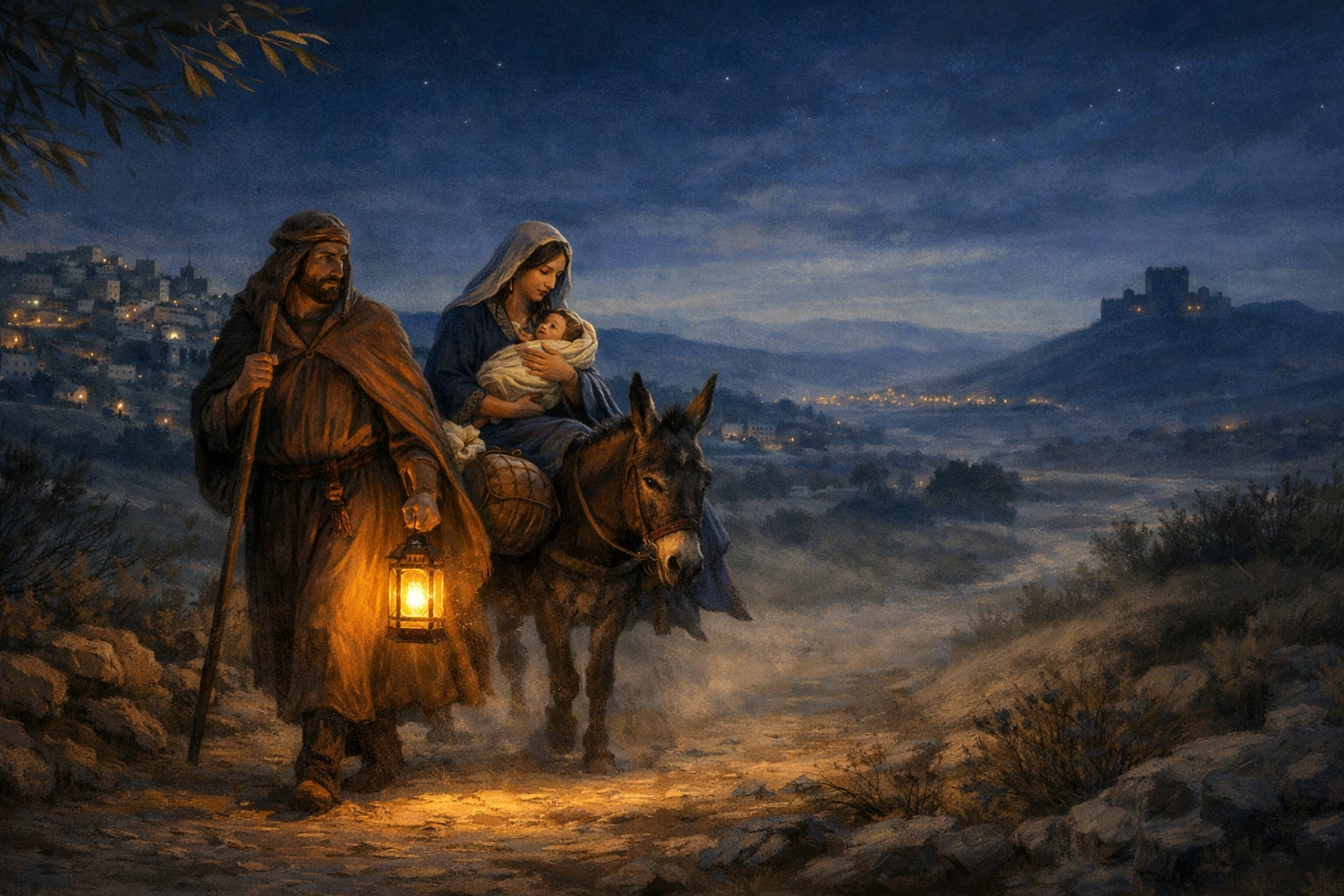
The Midnight Detour
There is a particular kind of tired you only learn at night.
Not the ordinary tired of a long day, but the hollow tired that comes when your life is interrupted by urgency. When sleep is broken by a thought that will not let you go back under. When the world is quiet, yet you can feel danger moving in the distance like weather.
Matthew tells the story that way.
“After the wise men were gone,” he says, “an angel of the Lord appeared to Joseph in a dream.” And the message is not poetic. It is direct. “Get up! Flee to Egypt with the child and his mother… Herod is going to search for the child to kill him.” (Matt 2:13, NLT).
This is not a Christmas card scene. There is no soft glow on the manger now. The lamps are low. The road is uncertain. And the first response to the arrival of the King is not applause but threat.
So Joseph gets up.
That is the first holiness in this passage. Not a speech. Not a strategy. Obedience at midnight. He gathers Mary. He gathers the Child. He gathers whatever can be carried, because that is what you do when the world turns sharp. “That night Joseph left for Egypt with the child and Mary, his mother” (Matt 2:14, NLT).
And just like that, the Son of God becomes a refugee.
Not as a metaphor. As a reality.
The gospel begins by telling us something many of us would rather not know: God does not wait to enter the world until it is safe. God enters the world as it is. And then he begins to redeem it from the inside.
The question is not whether we will face detours. The question is whether we will learn to recognize God on the detour road.
Following the Child Through Fear’s Territory
Matthew gives us three movements: flee, return, divert. Each one is guided. Each one is costly. Each one carries Scripture like a lantern.
1) Egypt: The strange mercy of a complicated place
Egypt is an odd refuge.
In Israel’s memory, Egypt is the house of bondage. It is the place where Pharaoh tightened his fist and demanded bricks without straw. But in Matthew’s telling, Egypt becomes the place where God keeps his Son alive. Matthew says the family “stayed there until Herod’s death,” and then adds: “This fulfilled what the Lord had spoken through the prophet: ‘I called my Son out of Egypt’” (Matt 2:15, NLT).
That line comes from Hosea 11:1. In Hosea, it is Israel who is called God’s son, brought out of Egypt in the exodus. Matthew is doing something profound: he is saying Jesus does not merely quote Israel’s story. Jesus carries it. He embodies Israel’s identity and brings it to completion.
And notice the tenderness: God calls his Son out of Egypt, but first God shelters his Son in Egypt.
Some of us need that mercy. We imagine God only works through clean chapters and tidy places. Matthew tells us God can protect us in complicated spaces, and later redeem the meaning of those spaces. The detour does not disqualify you. Sometimes the detour is the protection.
2) Bethlehem: When fear lashes out at the innocent
Then Matthew turns the camera back toward Herod.
Herod realizes he has been outmaneuvered. The Magi do not return. And fear, when it loses control, tends to punish the vulnerable. Matthew says Herod ordered the killing of the boys in Bethlehem two years old and under (Matt 2:16).
We need to speak about this carefully. Matthew is the only gospel to report this event, and many historians debate its historicity because it lacks independent corroboration in sources like Josephus. At the same time, the portrayal of Herod’s paranoia and brutality fits his broader reputation in the historical record, which is why the story has remained psychologically and theologically persuasive across centuries.
But whether you approach this as strict historical report or as Matthew’s theologically shaped memory of tyranny, the meaning remains: fear-based power makes children pay.
And Matthew refuses to spiritualize that. He refuses to rush past the crying. He quotes Jeremiah: “Rachel weeps for her children, refusing to be comforted— for her children are gone.” (Jer 31:15, NLT; echoed in Matt 2:18).
Rachel’s tears matter because they name what we often bury. They name the grief that belongs not only to individual mothers but to a people, a community, a land.
Yet Jeremiah’s lament is not the end of Jeremiah’s paragraph. The same passage continues: “Do not weep any longer… There is hope for your future… Your children will come again to their own land.” (Jer 31:16–17, NLT).
Matthew lets Rachel weep, and he also lets God speak. The gospel does not require you to deny sorrow in order to have hope. Biblical hope is brave enough to stand in the middle of grief and still say: the covenant is not broken. God is still speaking.
3) Return and divert: God’s guidance is often a reroute
After Herod dies, the angel returns in a dream: “Get up! Take the child and his mother and return to the land of Israel.” (Matt 2:20, NLT).
And then Matthew drops in a phrase that rings like a bell from Exodus: “Those who wanted to kill the child are dead” (Matt 2:20). It echoes God’s words to Moses: “Return to Egypt, for all those who wanted to kill you have died.” (Exod 4:19, NLT).
Matthew is saying: listen closely. God is playing an old rescue song in a new key. Jesus is being narrated as a new Moses figure, a bearer of a new exodus hope. Scholars have traced these Mosaic echoes in Matthew’s opening chapters with significant detail.
But then, just when you think the family is headed back to Bethlehem and Jerusalem, another political reality appears. Archelaus reigns in Judea, and Joseph is afraid. History supports the fear: Archelaus was Herod’s heir in Judea and was later deposed by Rome for instability and unpopularity (6 CE).
So God speaks again, and the family diverts again. They go north. They settle in Galilee. They land in Nazareth.
And Matthew says this too is fulfillment.
Why Nazareth Matters More Than We Think
Nazareth is easy to overlook because it looks like a footnote.
But Matthew ends the infancy narrative there on purpose: “He went and lived in a town called Nazareth… ‘He shall be called a Nazarene’” (Matt 2:23).
That fulfillment line is famously challenging. It is not a clean quotation from a single Old Testament verse, and serious scholarship suggests Matthew is invoking a broader prophetic theme rather than citing one text. The plural “prophets” hints at something general, something repeated: the Messiah will be marked by lowliness, misunderstood origins, and a name that does not sound impressive.
Nazareth itself reinforces that theme. Archaeology portrays early first-century Nazareth as a small, modest Jewish village, not a cultural center. If you were inventing a heroic biography, you would not choose Nazareth as your final line in the prologue. But Matthew chooses it because the gospel is not embarrassed by smallness.
This is where the detour finally reveals its deeper logic: God is not simply protecting Jesus from Herod. God is shaping the Messiah’s story into the shape of the people he came to save.
Jesus’ earliest geography is the geography of the vulnerable:
a threatened child,
a refugee road,
a grieving town,
an obscure home.
Matthew is telling you what kind of Savior this is.
Not the kind who floats above human trouble. The kind who enters it, and then outlasts it.
Learning to Walk the Detour Road With God
If Matthew 2 is true, then the question for us is not, “How do I avoid the Herods?” The question is, “How do I stay faithful when Herod’s kind of fear is in the air?”
1) Let God’s guidance be practical, not merely emotional
Joseph does not receive a ten-year plan. He receives the next faithful step.
Some of us postpone obedience until we have certainty. Matthew offers a different wisdom: when danger is real, God’s guidance is often immediate, concrete, and enough for today.
If you are in a season where the future feels unclear, do not despise “next-step guidance.” It is one of God’s ordinary mercies.
2) Refuse fear’s demand for control
Herod is what happens when fear becomes lord.
The gospel does not merely condemn Herod. It exposes the Herod impulse in us: the impulse to treat uncertainty as an enemy, the impulse to crush what we cannot control, the impulse to preserve our sense of safety at someone else’s expense.
Repentance here can be specific:
If your leadership style has become intimidation, return to gentleness.
If your parenting has become panic, return to presence.
If your spirituality has become anxious rule-keeping, return to trust.
The kingdom of Jesus does not need your control. It needs your faith.
3) Make room for Rachel’s tears without losing Jeremiah’s hope
Some of your people are not ready to be “cheered up.” They are ready to be seen.
Rachel refuses comfort because her children are gone. That is not weakness. That is honest grief.
But Jeremiah also says: “There is hope for your future.” Hope does not erase tears. Hope gives tears a horizon.
So if you are grieving, do not let anyone rush you. And do not let grief convince you that God has stopped speaking.
4) Trust the holiness of Nazareth
Many of us believe our life will matter when we finally arrive somewhere impressive.
Matthew ends with Nazareth to correct that lie.
Your “Nazareth” may be the small job, the quiet caregiving, the ordinary neighborhood, the repetitive rehab exercises, the unglamorous faithfulness no one applauds.
Do not despise it.
God raised the Messiah in a place like that. God may be forming you there too.
BENEDICTION — The God Who Guides at Night
The good news of Matthew 2 is not that the world is safe.
The good news is that Jesus has entered the unsafe world, and God has not abandoned the vulnerable in it.
Herod’s fear rages, but it does not get the final word. Rachel weeps, and God speaks hope. The Child grows, not in a palace, but in the hidden place.
So may you receive this blessing:
May the Lord who spoke to Joseph in the night speak to you with enough light for the next faithful step.
May the Savior who once fled as a child draw near to every displaced part of your life.
May God hold your grief honestly, and still plant hope stubbornly.
And may your Nazareth become holy ground, because Christ is not ashamed to meet you there.