

This morning I sat with Isaiah 42, and one word stopped me cold.
The verse is Isaiah 42:14. In the NLT it reads: “I have long been silent; yes, I have restrained myself. But now, like a woman in labor, I will cry and gasp and pant.” Most mornings a verse washes over me and I move on. This one grabbed me by the collar. Restrained myself. Two English words, tidy and polite. But underneath them sits a Hebrew word that is anything but tidy.
The Word Beneath the Word
The Hebrew is אַתְאַפָּק (et’appaq), from the root אפק (aleph-pe-qoph). It appears only seven times in the entire Old Testament, and every single occurrence is in the Hithpael stem—the reflexive form. That grammatical detail matters. It means the subject is acting on itself. No outside force is doing the holding. God is containing God.
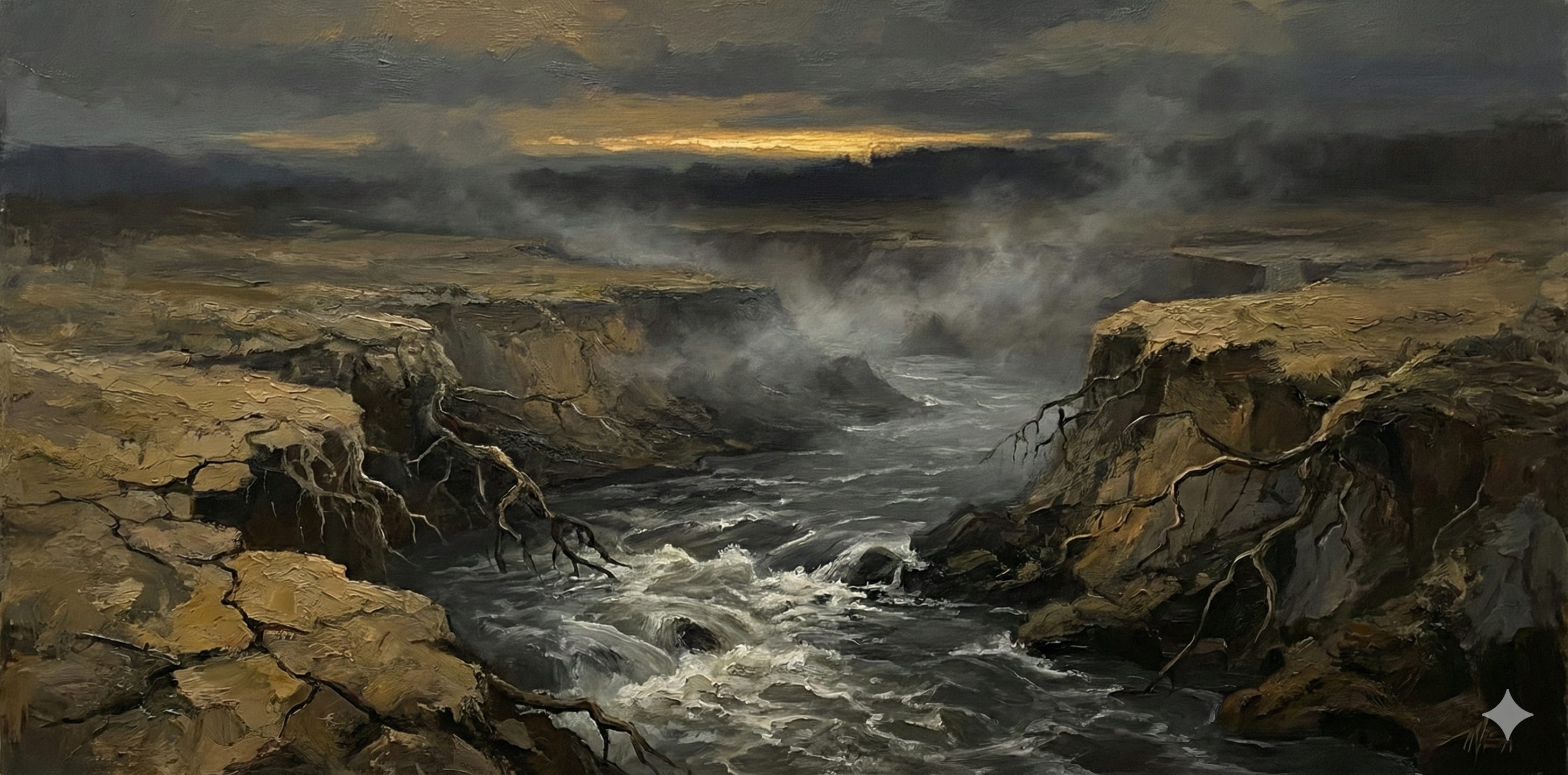
But here is what really arrested me. The noun derived from the same root is aphiq—a channel, a streambed, a riverbank. The concrete image behind this word is a riverbank straining to hold back a surging river. The bank contains the water, but the water is relentless, pressing, eroding. The restraint is real, but it is not passive. It is a wall under pressure.
When God says “I have restrained myself,” the picture is not of a disinterested deity sitting on his hands. It is of a God who has been holding back a flood—of justice, of compassion, of intervention—with the full force of his being. And in Isaiah 42:14, the bank is about to break. What comes next is not a trickle. It is the groaning, gasping cry of a woman in labor, bringing something new and alive into the world.
Joseph Knew This Word
The other places this verb shows up tell you everything about its emotional weight. In Genesis 43, Joseph sees his brother Benjamin for the first time in years and has to leave the room to weep—then he washes his face and “restrained himself.” Same word. In Genesis 45, the dam finally breaks: “Joseph could no longer restrain himself,” and he weeps so loudly that the Egyptians in the next room can hear him.
In Esther 5, Haman is seething with rage at Mordecai but “restrained himself” long enough to go home and brag to his wife instead. Every single time, this word describes the suppression of something enormous—love, grief, fury—that is building toward an inevitable release. It is never used for mild self-control. It is always a riverbank about to give way.
Where It Got Personal
I sat with that image for a while this morning, and then it turned on me.
I am not good at this. I am not good at the holy restraint that holds its tongue and waits for the right moment. I think about how I am with my kids—how quickly I react, how fast the correction comes, how rarely I pause long enough to let the riverbank do its work before the water spills everywhere. I think about how often my first response is the loudest one, when what my children actually need is a father who has held something back long enough for it to come out as wisdom instead of reflex.
And then there was the Super Bowl halftime show. I watched it and almost immediately called it “unintelligible.” Posted it, said it, let the opinion fly without a second thought. Was it my honest reaction? Sure. But honest and wise are not the same thing. There was no restraint in that moment, no riverbank holding the current, no pause to consider whether what I was about to release would bring life or just noise. I could have sat with it. I could have held my peace. I didn’t.
The uncomfortable truth is that divine restraint—the kind described in Isaiah 42:14—is not weakness. It is not silence born of apathy. It is the most intense kind of strength, the strength to hold back what is real and powerful inside you until the right moment for it to come forth. God held back for ages. Not because he didn’t care. Because he cared so much that the timing and the form of the release mattered.
What Breaks Through
Here is what I keep coming back to: when God finally stops restraining himself in Isaiah 42:14, what comes out is not destruction. It is labor. It is the agonizing, purposeful work of bringing something new to life. The restraint was never pointless. It was gestational. Everything that was held back was being shaped into something that, when it finally emerged, would be redemptive.
I want that for my words. I want the things I hold back to be held back not out of cowardice but out of purpose—so that when they do come, they arrive at the right time, in the right form, and they bring life instead of just volume. I want my kids to experience a father whose restraint feels like love building up rather than indifference or, worse, a dam that breaks in the wrong direction.
One Hebrew word, seven letters, tucked into a verse I have read dozens of times. This morning it taught me that the space between feeling something and saying something is not empty. It is a riverbank. And what you do in that space—whether you hold or whether you let it all rush out—determines whether what comes next brings life or just makes noise.
I am learning. Slowly. Like a riverbank that keeps getting reshaped by the current.