
The Midnight Detour: God’s Guidance in a World of Fear (Matthew 2:13–23)
Lectionary Text for the First Sunday after Christmas

Text & Contextual
Matthew 2:13–23 sits at the hinge of Matthew’s infancy narrative. The Magi have come, worship has happened, and then the story turns abruptly: the Child who is confessed as King is immediately treated as a threat. Matthew’s point is not subtle. From the beginning, the kingdom of God collides with the kingdom of fear.
Historically, the backdrop is the late reign of Herod the Great, a client king under Rome with a reputation for ruthless consolidation of power. The precise year of Herod’s death is debated (many date it to 4 BCE, while some argue for a later date), but the broader portrait is consistent: this is a volatile moment in Judea, heavy with political anxiety and succession uncertainty.
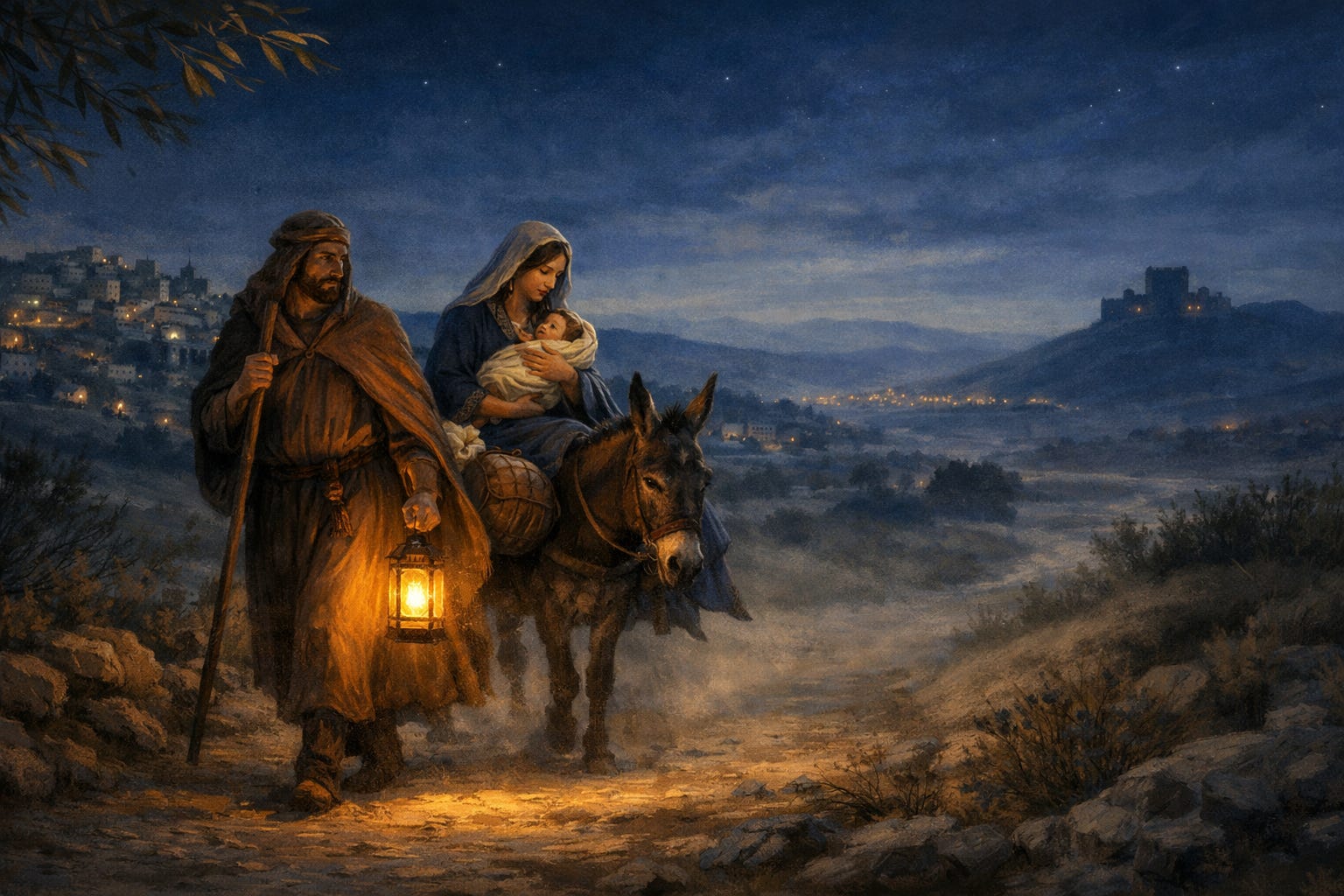
Literarily, Matthew frames these verses as a “detour story” guided by dreams. Three times Joseph is directed in a dream: flee to Egypt, return after Herod’s death, then divert away from Judea because Archelaus reigns there (Matt 2:13, 19, 22). The plot moves like a nighttime map: God’s guidance does not remove danger, but it routes the vulnerable through it.
And Matthew is doing more than narrating travel. He is narrating Israel. He presents Jesus as the true Son who recapitulates Israel’s story: down into Egypt and out again (Hosea 11:1), through tears at the border (Jeremiah 31:15), and into an unlikely town that carries the scent of obscurity (Nazareth).
This is why the geography matters. Egypt is not merely a place-name; it is the memory of bondage and the birthplace of exodus hope. Ramah is not merely a location; it is the sound of exile grief. And Nazareth is not a strategic choice; it is a humble setting, archaeologically attested as a small Jewish village in the early first century, not the kind of hometown one invents to impress anyone.
Matthew’s climax line is striking: “He went and lived in a town called Nazareth… ‘He shall be called a Nazarene’” (Matt 2:23). The fulfillment formula is plural (“prophets”), and scholars debate what Matthew intends here, but the thrust is clear: Jesus’ story will be marked not by prestige but by holy lowliness and contested identity.
The text places Jesus in the world as a pursued Child, guided by God through peril, fulfilling Israel’s Scriptures not as proof-texts but as a re-lived story.
Audience Analysis
Most congregations hear Matthew 2:13–23 in one of two emotional keys.
First, many hear it as distant tragedy: a “biblical event” that happened long ago, adjacent to Christmas, quickly eclipsed by sentimental nativity scenes. That distance can become a shield. If the story stays safely ancient, it never touches the ways fear still governs our decisions.
Second, many hear it as painfully near. People live with Herod-like pressures in ordinary clothes: the boss who punishes vulnerability, the system that rewards intimidation, the family pattern that demands silence, the inner voice that believes control is the only way to survive. Some carry personal histories of displacement: a move they did not choose, a divorce, a job loss, a medical diagnosis, a season where life became a suitcase.
In late modern life, “home” is unstable. People are mobile, digitally connected yet emotionally exhausted, and often quietly afraid: afraid of losing what they have built, afraid for their children, afraid of the next headline, afraid of being small. Matthew meets that fear without pretending it is not there. He does not offer denial. He offers direction.
This passage also meets a congregation living amid global “Rachel weeping” realities. Forced displacement is not an abstract concept for our era: UNHCR reported 117.3 million forcibly displaced people worldwide as of the end of June 2025. Even when people are not personally displaced, they are spiritually affected by a world where the vulnerable regularly pay the bill for the powerful.
So the pastoral need is twofold:
To name fear truthfully without letting fear become lord.
To locate God’s presence not only in peaceful manger scenes but also in midnight departures, uncertain routes, and quiet obedience.
This congregation needs a gospel that can speak in the dark: guidance, presence, and hope that does not require naïveté.
Exegetical Exploration
Matthew 2:13–15 — The commanded escape and the “Egypt” fulfillment
“An angel of the Lord appeared to Joseph in a dream” (2:13). Matthew normalizes divine guidance through dreams in this infancy cycle. The guidance is directional, not merely inspirational: Get up… flee… stay…
NLT captures the urgency: “Get up! Flee to Egypt with the child and his mother… because Herod is going to search for the child to kill him.” The threat is explicit. The holy family becomes a refugee family.
The move to Egypt is historically plausible: Egypt lay outside Herod’s jurisdiction and had long-standing Jewish communities, and it was reachable by established routes. Matthew does not narrate logistics, but he narrates the spiritual meaning of the route.
Fulfillment citation (2:15): “Out of Egypt I called my Son.” Matthew invokes Hosea 11:1, which in its original context refers to Israel as God’s son called out of Egypt. Matthew’s method here is not “prediction → event” in a simplistic sense. It is typology: Jesus embodies Israel’s story and brings it to completion.
Matthew 2:16–18 — Herod’s violence and Rachel’s lament
Herod’s rage (2:16) follows the Magi’s noncompliance. The story is only in Matthew; many modern scholars question its historicity because it lacks independent corroboration (notably in Josephus), yet it coheres with Herod’s well-attested brutality and paranoia. A responsible reading holds both: the event is historically disputed and the narrative’s portrayal of tyrannical fear is historically credible.
The target group: boys two years and under in Bethlehem and its vicinity (2:16). Bethlehem was a small village; the implied number of victims could be limited, which partly explains why it might not appear in broader historical accounts, though that remains an argument, not proof.
Jeremiah citation (2:17–18): Matthew quotes Jeremiah 31:15: “Rachel weeping for her children… refusing to be comforted.” Crucially, Jeremiah 31 does not end with weeping. The very next lines speak of restraint of tears and future hope: “There is hope for your future… your children will come again to their own land.” Matthew is not weaponizing despair. He is locating the sorrow of Bethlehem inside the wider “book of consolation” arc.
Matthew 2:19–21 — Return guidance and an Exodus echo
After Herod’s death, the angel appears again in a dream: “Get up! Take the child and his mother and return to the land of Israel.”
The phrasing “those who wanted to kill the child are dead” (2:20) echoes Exodus 4:19 (“Return to Egypt, for all those who wanted to kill you have died.”). This is one of Matthew’s strongest signals that Jesus is being narrated in a “new Moses / new exodus” key. Dale Allison’s classic work details this mosaic typology threaded through Matthew’s opening chapters.
Matthew 2:22–23 — Political caution, Galilee, and the “Nazarene” line
Joseph learns Archelaus reigns in Judea and is afraid (2:22). Historically, Archelaus ruled Judea after Herod and was later deposed by Rome (6 CE) due to unpopularity and instability.
Joseph is again warned in a dream and withdraws to Galilee, settling in Nazareth (2:22–23). Nazareth was a small early first-century Jewish settlement; archaeological work supports habitation in this period and portrays it as modest and obscure.
“He shall be called a Nazarene” (2:23). This is famously difficult to map to a single Old Testament text. Jared M. August argues Matthew does not intend a direct quotation but a broader prophetic theme (hence “prophets” plural). In other words: Nazareth functions theologically as a marker of hiddenness, social insignificance, and contested identity.
The passage is built from three movements (flee, return, divert), stitched to Israel’s Scriptures as a re-lived story: exodus, exile-lament, and lowly settlement.
Semiotic Illumination
This text is a gallery of symbols that carry meaning across time.
1) The Dream as a Sign of Guidance for the Vulnerable
In Matthew 2, dreams do not exist to make Joseph feel spiritual. They exist to keep a child alive. The dream is a sign that God’s guidance often arrives as next-step clarity rather than full-map certainty. Semiოტically, the dream functions as a “liminal channel,” a border-space between heaven’s intent and earth’s threat. In anxious cultures, we want God to remove the threat; Matthew shows God rerouting the faithful through the threat.
2) Egypt as Both Refuge and Memory
Egypt is double-coded. It is refuge in the present and bondage in the past. That double-coding matters. It means salvation can come through places with complicated histories. God does not wait for pristine settings. He meets his Son in an ambiguous place and turns the old wound into the site of new preservation. Matthew’s Hosea citation presses this: the “Son” is called out of Egypt as Israel once was.
3) Herod as the Sign of Fear-Driven Power
Herod is more than a villain; he is the sign of a system that interprets vulnerability as threat. A baby becomes an enemy. Worshipers become risks. Rumor becomes justification for violence. Historically, Herod’s reputation for brutality is widely recognized, even as the specific Bethlehem episode remains debated.
Semiotically, Herod represents the logic of control: “If I cannot control the future, I will eliminate what I cannot control.”
4) Rachel Weeping as the Sign of Communal Grief that God Refuses to Ignore
Rachel is a matriarch figure; her tears are not private but representative. Matthew borrows Jeremiah’s image, and Jeremiah’s larger context refuses to let grief be the last word. Rachel weeps, and then God speaks: “Do not weep… there is hope for your future.”
So Rachel’s tears become a sign that biblical hope is not optimism. It is covenantal insistence that God remains present in the aftermath.
5) Nazareth as the Sign of Holy Insignificance
Nazareth is a semiotic reversal. In status-driven worlds, origins matter. Matthew ends the infancy narrative by anchoring Jesus in a place of smallness. Archaeology underscores this modest reality: a backwater village, not a prestigious city.
Nazareth is the sign that God’s redemption does not require impressive packaging.
Big Idea
God leads his Son through a midnight detour, not to avoid suffering, but to bring salvation into the very places fear tries to rule.
Matthew’s theology here is profoundly Christocentric and deeply realistic.
Christocentric: Jesus is not merely protected; he is positioned as the true Israel, the new-exodus Son who carries Israel’s story into fulfillment. Hosea’s “son” is reread through the Son. Jeremiah’s lament is gathered into the Messiah’s early life.
Realistic: God’s plan does not bypass tyrants. It outlasts them. Herod is not converted; he is endured. The holy family is not spared inconvenience; they become displaced. The kingdom arrives, and immediately it is contested.
Hopeful: Matthew refuses despair-as-finality. Jeremiah’s Rachel weeps, but Jeremiah’s God speaks hope. And Matthew’s narrative implies the same: evil is loud, but it is not ultimate.
God’s guidance often looks like obedience at night.
Joseph’s holiness is practical: he gets up, he takes, he leaves. Faith is not spectacle here; it is responsiveness.The Messiah identifies with refugees before he preaches a sermon.
Jesus’ solidarity is not an add-on. Before he teaches the poor, he is carried as the poor.The kingdom threatens fear-based power simply by existing.
Herod’s rage is a mirror: when control is god, peace becomes impossible.God plants the Savior in obscurity on purpose.
Nazareth is a theological statement: the Holy One can be hidden without being absent.
Stage 5 Output: The “detour” becomes the governing image: God’s salvation advances by guided, faithful movement through danger, not by denial of danger.