

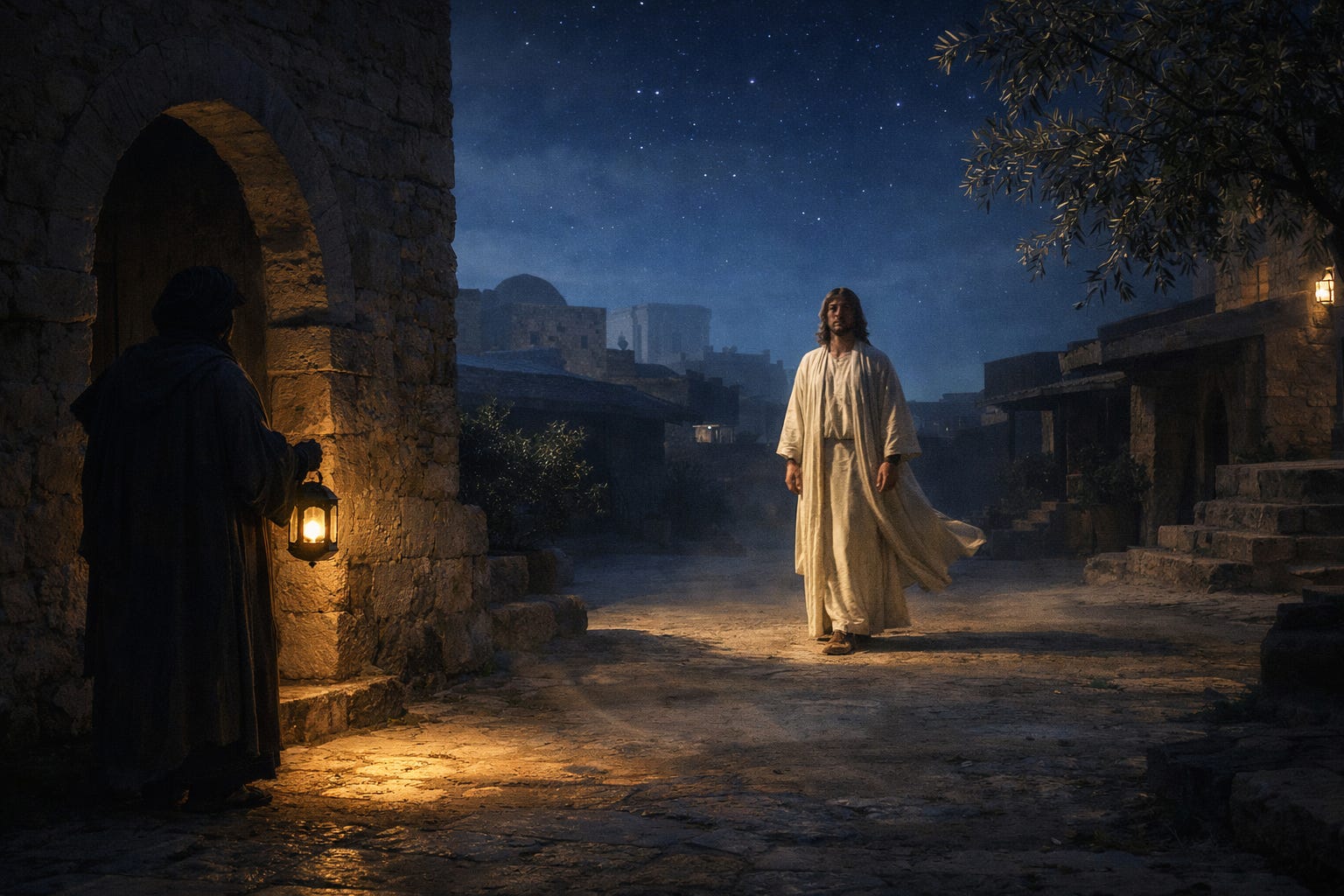
Nicodemus comes to Jesus the way many of us come to God—quietly.
Not with a microphone. Not with a polished testimony. Not with the confident posture that says, I’ve got this figured out. He comes at night.
Night is when the house finally goes still. Night is when the day’s noise stops demanding answers and the soul starts asking its own questions. Night is when your best “fine” collapses into the truth beneath it: I don’t know what to do with this grief. I don’t know how to change. I don’t know why I keep repeating the same patterns. I don’t know if God still wants me.
Nicodemus is not a beginner. He is trained, respected, credentialed. He has spiritual vocabulary, institutional responsibility, and a reputation to protect. And still—something in him cannot ignore Jesus.
So he goes looking.
John tells us he comes “by night,” and in this Gospel, that detail is never merely about the clock. It is a spiritual atmosphere. Nicodemus arrives inside a darkness that is cautious and curious at the same time—darkness disturbed by the strange brightness of Christ.
And Jesus meets him there.
Not with flattery. Not with vague encouragement. Not with religious small talk.
Jesus meets him with an announcement so disruptive it feels like wind through a locked room:
You need a new beginning.
Nicodemus opens with what he can measure.
“Rabbi,” he says, “we know you are a teacher who has come from God, because of the signs.”
That word—signs—matters. In John, signs are never the destination. They are arrows. They point beyond themselves. Working Preacher notes that Nicodemus can recognize the signs and still miss what they signify. A person can be impressed by Jesus and yet untouched by Jesus. A person can applaud holiness from a distance and still not enter the kingdom.
Jesus replies without answering Nicodemus’ opening argument. He goes deeper than debate.
“Amen, amen… unless you are born anōthen, you cannot see the kingdom of God.”
That little Greek word—anōthen—is part of the mercy and part of the disruption. It can mean “again,” and it can mean “from above.” Major translation notes make the ambiguity explicit. Nicodemus hears “again” and imagines a second physical birth. Jesus means something closer to “from above”: a life that begins in God, sourced in the Spirit, not manufactured by human effort.
Nicodemus responds exactly the way a careful, literal mind responds: How can this be? He tries to fit Jesus’ words into biological categories—back into the womb, back into the start, back into what can be diagrammed.
And Jesus refuses that framework.
He speaks of water and Spirit—cleansing and renewal—echoing the prophetic promise that God would wash his people and give them a new heart, placing his Spirit within them. This is not about religious self-improvement. This is about divine re-creation.
Then Jesus turns to the wind.
“The wind blows wherever it wishes…”
In Greek, the same word—pneuma—can mean “wind” or “spirit.” The NET Bible note highlights this directly. Jesus is not being poetic for poetry’s sake; he is doing theology with creation’s grammar.
You cannot see wind itself. But you can see what it does.
Leaves move. Trees bend. Waves rise. Sails fill. Doors rattle. A sound travels through the air and you cannot tell where it began. Wind is real, undeniable—yet uncontainable.
“So it is,” Jesus says, “with everyone born of the Spirit.”
This is both comfort and confrontation.
Comfort, because the Spirit does not wait for you to master the system. Confrontation, because the Spirit will not be managed by your system.
Nicodemus is stunned. “How can these things be?”
And Jesus presses him: “You are the teacher of Israel, and you don’t understand?”
In other words: the Scriptures you love have always been hinting at this. The covenant was never merely about rule-keeping. It was about God creating a people from within—turning stone to flesh, fear to faithfulness, deadness to life.
Then Jesus moves from wind to the cross.
“As Moses lifted up the serpent in the wilderness, so must the Son of Man be lifted up…”
This is one of those biblical images that refuses to be domesticated. In Numbers 21, the people are afflicted, and God instructs Moses to lift a bronze serpent so that those who look will live. John’s Gospel uses “lifted up” with layered meaning: it is crucifixion, and it is exaltation—shame transformed into saving glory.
And then the line so famous that we sometimes forget it was spoken into the night, to one careful man who wanted a manageable religion:
“God so loved the world…”
Not God so tolerated the world. Not God so waited for the world to improve. God so loved the world that God gave.
And why?
Not to condemn, Jesus says, but to save.
If you follow the thread of this midnight conversation, you can feel the Spirit’s logic:
Nicodemus arrives with signs—what he can observe and defend.
Jesus answers with birth—what only God can give.
Nicodemus wants a faith he can categorize.
Jesus offers a life that begins “from above.”
Nicodemus is trying to approach God by mastery—by knowing enough, doing enough, controlling outcomes.
Jesus speaks of wind—real, powerful, experienced, but never controlled.
And then Jesus anchors the whole invitation in the strangest, brightest mercy of all: the lifted Son.
The point is not that you must achieve moral perfection before you can approach God. The point is that you must stop treating the kingdom like a ladder and receive it like a birth.
A birth is not earned. It is given.
That is why Lent is not mainly a season for religious heroics. Lent is a season for surrender—the surrender that makes room for the Spirit’s midnight wind.
And John 3 refuses to let us reduce salvation to a private improvement project. God’s love is aimed at the world—the whole creation God refuses to abandon. That includes your life in the places you have labeled “beyond repair.”
APPLY
Nicodemus gives us a holy permission: you can come to Jesus in the night.
You do not have to wait until you feel brave enough for daylight faith. You can bring your questions before you have answers. You can bring your fear before it becomes courage. You can bring your tangled motives and your half-formed hope.
The question is not whether you come in the night.
The question is whether, once you come, you will let the Spirit move.
Come honestly—without pretending you are fine
Some of us avoid prayer because we think prayer requires the right mood. Nicodemus shows the opposite: prayer begins with truth. You can say, “I don’t understand.” You can say, “I’m afraid.” You can say, “I don’t know how to change.”
Jesus does not shame Nicodemus for coming at night. He speaks to him there.
Release the illusion of control
The wind image is not sentimental. It is a direct challenge to religious control.
Many of us want the Spirit as a predictable assistant: Bless what I already planned; strengthen what I already decided; confirm what I already prefer. But Jesus says the Spirit is wind. The Spirit is God.
The clearest sign that you are being born from above is not that your life becomes easier to manage—it is that you become more willing to be led.
Turn your gaze toward the lifted Christ
The bronze serpent story is unsettling because it makes salvation so simple it feels offensive: look and live.
Not look and prove. Not look and perform. Look and live.
To look is to trust. To look is to admit you cannot heal yourself. To look is to stop negotiating with your sin and stop bargaining with God and simply receive mercy.
And in John, “lifted up” means the cross is not merely tragedy—it is God’s love made visible in the very place we expect God to be absent.
Practice stepping into the light
John will go on to speak about light and darkness. But even here, the movement is implied: the night conversation is meant to lead somewhere.
Lent gives you a simple practice: choose one place where you have been hiding, and bring it into prayerful light.
Not into public spectacle. Into honest communion with Christ.
Night is not your home.
It is the place you begin the journey.
BENEDICTION
If you came here today carrying night—questions you cannot solve, habits you cannot break, grief you cannot explain—hear what Jesus says to Nicodemus, and hear it as a word for you:
God is not offering you a better technique.
God is offering you a new beginning.
May the Spirit of God move through your midnight like a quiet, holy wind—unseen, unmanageable, unmistakably real. And as you lift your eyes toward the lifted Christ, may you receive the life that comes from above: forgiven, remade, unafraid to step into the light.
In the name of the Father, and of the Son, and of the Holy Spirit. Amen.