

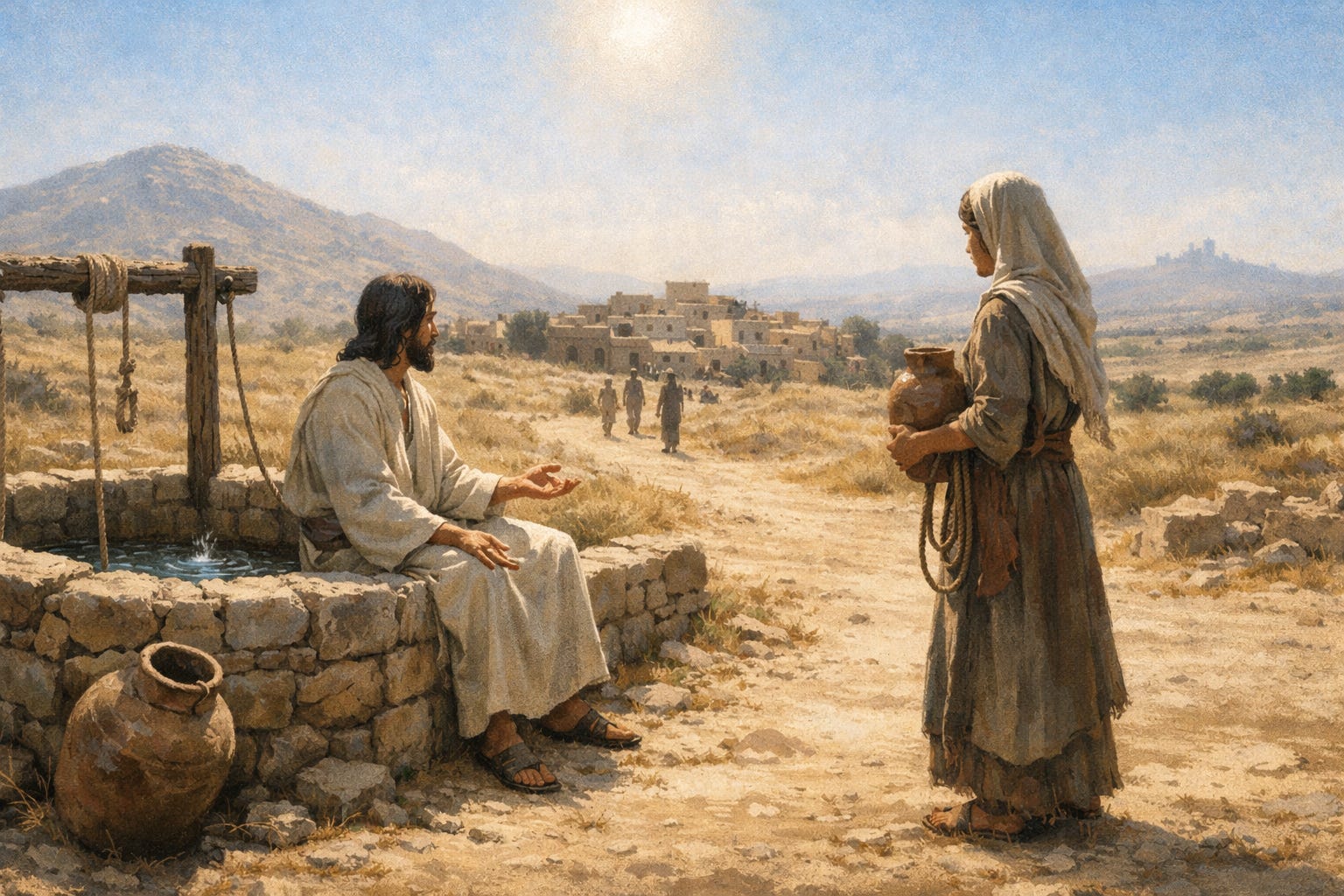
John 4:5–42 is the Gospel reading appointed for the Third Sunday in Lent (Year A) in the Revised Common Lectionary. The placement is spiritually strategic: Lent is the season when the Church tells the truth about hunger and thirst—not only of the body (fasting, fatigue, limits), but of the soul (need, desire, longing, shame, the ache to be made clean).
The scene is disarmingly ordinary: a well, a traveler, a request for water. Yet John’s Gospel consistently turns ordinary things into sacramental signs—water, bread, light, vines—so that the everyday becomes a doorway into the kingdom. Jesus is traveling through Samaria and stops near a town John names “Sychar,” close to land associated with Jacob and Joseph (John 4:5). The narrator anchors the moment at “Jacob’s well,” a site with long-standing geographic and devotional association near ancient Shechem/Nablus. Whether every coordinate can be proven beyond dispute is less important than what John is doing literarily: he is placing Jesus inside Israel’s memory—inside covenant ground, ancestral story, contested worship, and inherited wounds.
It is “about noon” (the sixth hour). In the Mediterranean world, that matters. Noon is not the hour of pleasant errands; it is the hour of exposure—heat, glare, and minimum cover. John is already shaping the symbolism: this encounter happens in full light. Whatever is hidden will not remain hidden. Whatever is thirsty will name its thirst.
Then comes the social shock: Jesus, a Jewish man, speaks to a Samaritan woman, alone, in public. The text itself foregrounds the ethnic fault line: “Jews refuse to have anything to do with Samaritans” (John 4:9, NLT). That friction is not a minor detail; it is part of the spiritual architecture of the story. Samaria represents a shared ancestry and a contested identity—neighbors who know each other’s Scriptures, resent each other’s sanctuaries, and carry centuries of distrust. The woman will voice the deepest dispute in one sentence: Where is worship located? “This mountain” (Gerizim) or Jerusalem?
Yet Jesus begins with something smaller than theology: “Please give me a drink.” He enters through need. He does not begin by accusing her, correcting her, or recruiting her. He begins by receiving—by placing himself, voluntarily, in a posture of dependence. The Maker of oceans asks for a cup.
The conversation will spiral outward: from literal water to “living water,” from personal history to communal worship, from moral exposure to missionary vocation, from one woman’s testimony to an entire village’s confession: “He really is the Savior of the world” (John 4:42). The well becomes a threshold where thirst tells the truth, and truth becomes a spring.
Audience Analysis
For a contemporary congregation in Lent, this passage meets at least four lived realities.
1) Many people are tired in the most spiritual sense of the word. Not merely busy, but inwardly dehydrated: too much information, too little meaning; too many demands, too little delight; too much performance, too little presence. Thirst is a fitting diagnostic because thirst is not primarily a moral category—it is a creaturely one. You can be faithful and still thirsty.
2) Shame is common, even when it is hidden. John’s narrative suggests that this woman carries social weight—whether through her relational history, her community standing, or both. Modern hearers also manage complicated histories: divorce, pornography, addiction, abortions, betrayals, private griefs, financial collapse, faith wounds, and the silent terror of being found out.
3) Polarization has trained people to treat difference as danger. Ethnic, denominational, political, and class divisions often feel absolute. Many listeners assume that God’s work only happens “on our side” of the boundary. John 4 confronts that assumption gently but directly.
4) Religious arguments often function as avoidance. People who do not want to speak about their own pain can speak endlessly about the “right mountain.” The text names that impulse without ridiculing it. Jesus neither flatters the argument nor shames the arguer; he redirects toward the heart of worship.
In Lent, then, the pastoral aim is not to weaponize the woman’s story as a morality tale. It is to present Jesus as the one who crosses distance, dignifies the thirsty, exposes without crushing, and offers a life that rises from within.
Exegetical Exploration
John 4:5–6 — Place, fatigue, and timing
Jesus sits by the well “tired from the long walk.” John is unafraid of Jesus’ real humanity. The Word made flesh is not pretending. That matters: the offer of “living water” does not come from a detached deity, but from an incarnate Savior who knows thirst from the inside.
John 4:7–9 — The request that breaks taboos
“Please give me a drink.” The woman’s surprise is both social and theological: why would you speak to me? In John, small requests are never small. The request is a key that opens the larger revelation.
John 4:10–12 — “Living water” and the double meaning
Jesus answers with layered language. In Greek, “living water” is ὕδωρ ζῶν (hydōr zōn) (John 4:10). The phrase can mean running/fresh water (as opposed to stagnant water in a cistern) and also life-giving water in a deeper sense. John loves this kind of wordplay: misunderstanding becomes the stage on which revelation clarifies itself.
The woman’s logic is practical: you have no bucket; the well is deep. John wants us to feel the “surface-level” reading before we can be led below the surface.
John 4:13–15 — From recurring thirst to a spring within
Jesus contrasts two kinds of drinking. The first yields a thirst that returns; the second becomes “a fresh, bubbling spring within them, giving them eternal life” (John 4:14, NLT). John’s imagery is dynamic—water that moves upward. This is not merely “more religion”; it is a new interior source. Working Preacher rightly notes John’s shorthand here: “eternal life” in John often means a new quality of life—life of the age to come breaking into the present.
John 4:16–18 — Exposure without spectacle
“Go and get your husband.” Jesus is not pivoting to shame; he is pivoting to truth. The woman’s life is complicated, and Jesus names it accurately. In John’s narrative logic, this is part of the water: truth is not a club; it is cleansing. The astonishing thing is the tone—no mockery, no voyeurism, no contempt. Accurate knowing becomes a form of mercy.
John 4:19–24 — The “mountain” question and worship redefined
She shifts to theology: “Our ancestors worshiped here on this mountain…” (Gerizim) versus Jerusalem. Behind her words is real history: Samaritan worship centered on Mount Gerizim, and Jewish worship centered on Jerusalem, with centuries of dispute and rupture.
Jesus does not deny history, but he relativizes location: “the time is coming… when it will no longer matter whether you worship the Father on this mountain or in Jerusalem” (John 4:21). Worship is being re-centered around the Father and marked by “Spirit and truth.” The Greek verb for worship, προσκυνέω (proskyneō), carries the sense of reverent devotion—orientation of life, not mere correct geography.
John 4:25–26 — The Messiah named
“I know the Messiah is coming…” Jesus replies: “I am the Messiah!” (John 4:26, NLT). In Greek, the phrase is ἐγώ εἰμι (egō eimi)—“I am.” The most careful reading here is contextual: he is answering her messianic expectation directly, even if John’s Gospel also uses “I am” with deeper resonances elsewhere.
John 4:27–30 — The abandoned jar
The disciples return, shocked. The woman leaves her water jar and goes to the town. John is not wasting detail: the jar is the symbol of her old mission—draw, carry, survive. She leaves it behind because she has encountered a different source.
John 4:31–38 — Food, will, and harvest
Jesus speaks of another nourishment: “My nourishment comes from doing the will of God.” He then turns the moment outward: “Look… the fields are already ripe for harvest.” The village is coming. The mission is not an interruption of spirituality; it is the fruit of it.
John 4:39–42 — From testimony to confession
Many believe “because of the woman’s testimony,” then more believe “because he stayed there.” The end is communal and expansive: “Savior of the world.” John places that confession on Samaritan lips—outsiders to Jerusalem’s system—signaling the widening horizon of salvation.
Semiotic Illumination
The well is a boundary place: public yet intimate, ordinary yet loaded with memory. In biblical imagination, wells are often sites of encounter and future—places where identity shifts and stories turn.
Noon is exposure. The light is unflattering, which is precisely why grace is powerful here: Jesus meets her when hiding is hardest.
Thirst is the body’s honest sermon. You can rationalize many things; thirst resists denial. In Lent, thirst becomes a spiritual metaphor for what is real but unmet.
“Living water” is a double sign: (1) water that moves and therefore stays fresh, and (2) life that originates in God and therefore does not run out. John’s semiotics insists that the sign is not the thing; the sign points beyond itself.
The jar is the symbol of managed life—coping systems, routines, survival strategies, even respectable religion that never reaches the wound. Leaving the jar behind is not irresponsibility; it is conversion: a new center of gravity.
“This mountain… Jerusalem” is the symbol of displaced hope. When pain is too close, we argue about locations, methods, and systems. Jesus does not despise the question; he completes it by relocating worship into Spirit-and-truth reality—into the presence of the Father.
The Samaritan woman herself becomes a sign: a person treated as suspect becomes the first evangelist to her town. The story says, without slogans: the gospel is not managed by gatekeepers; it moves through the thirsty who have met mercy.
Big Idea
Jesus meets us at the point of our thirst—crossing boundaries and telling the truth—so that what once only sustained us (a jar at a well) becomes a witness to a new source: life from within, the Spirit’s spring, for the healing of many.
Supporting theological movements:
Incarnation: Jesus is tired and thirsty—God comes close enough to ask.
Revelation as mercy: Jesus knows the truth of her life and speaks it without crushing her.
Worship re-centered: sacred space is no longer “our mountain vs their mountain,” but the Father sought in Spirit and truth.
Mission as overflow: living water becomes communal—testimony multiplies into confession: “Savior of the world.”