

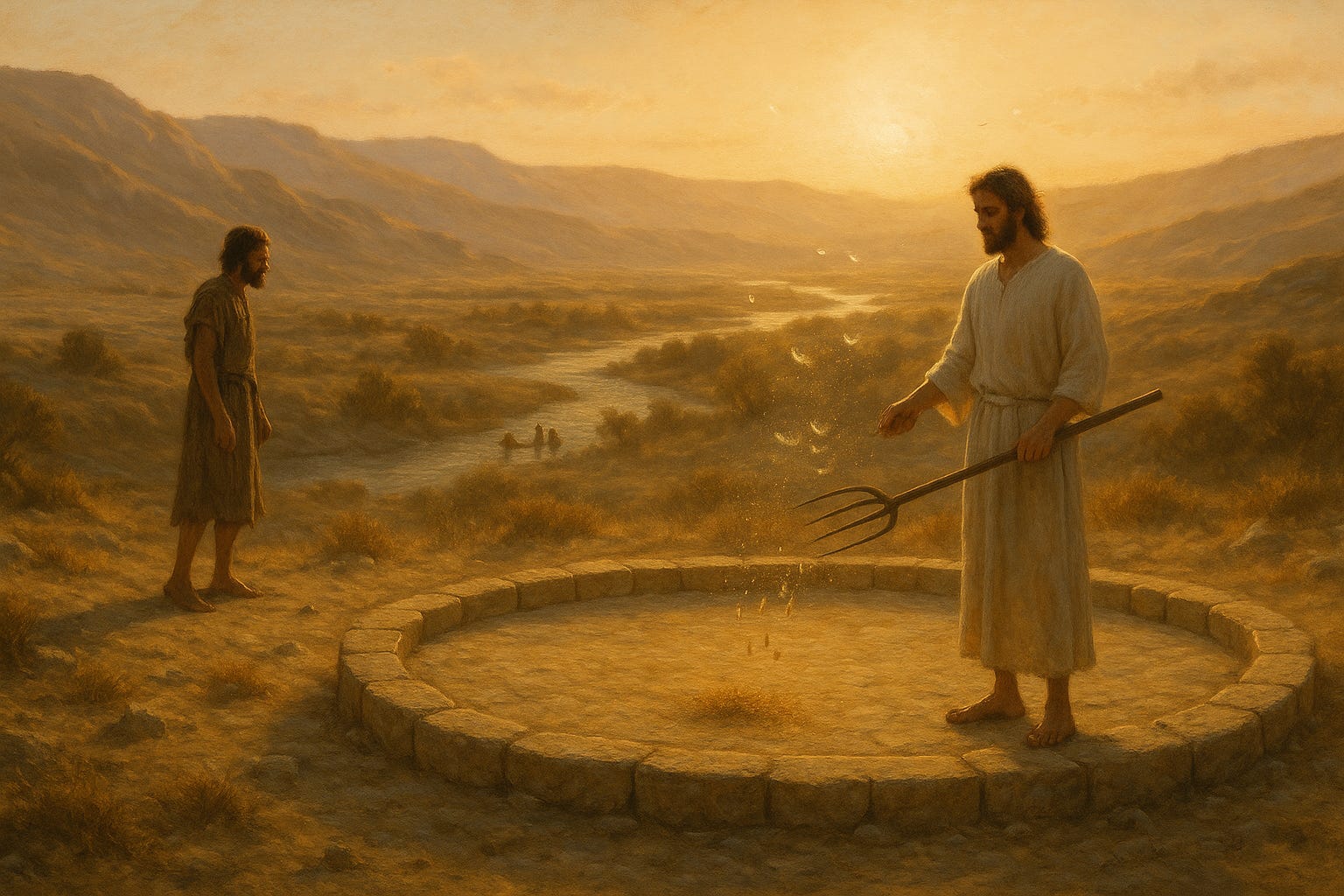
Matthew 3 stands at a hinge in the Gospel story. Chapters 1–2 have introduced Jesus through genealogy, birth, and early life: the promised Son of David, the Emmanuel child preserved through flight and return. Now, before Jesus speaks a single word in Matthew, another voice breaks the long silence: “In those days John the Baptist came to the Judean wilderness and began preaching” (3:1).
The setting is the Judean wilderness, a rocky, arid region stretching between Jerusalem and the Jordan River. In Israel’s memory, the wilderness is never just a backdrop. It is the place of Exodus, testing, and God’s formative speech. Israel met God there as slaves-turned-sojourners, learning to live not on Pharaoh’s bread but on God’s word. By situating John “in the wilderness,” Matthew signals a new Exodus moment: God is about to act again, and He starts not in the temple or palace but in the empty places on the edge of things.
John’s message is concise and explosive: “Repent of your sins and turn to God, for the Kingdom of Heaven is near” (3:2). The phrase “Kingdom of Heaven” (basileia tōn ouranōn) is Matthew’s preferred way of speaking of God’s rule breaking in. It is not about people escaping earth for heaven, but about heaven’s reign drawing near to earth in decisive, personal ways. John’s call to repent (metanoeō) is literally a call to “change one’s mind,” but in biblical idiom it reaches into the whole self: desires, loyalties, habits, and public life.
Matthew identifies John as the one foretold in Isaiah 40:3—“a voice shouting in the wilderness, ‘Prepare the way for the Lord’s coming! Clear the road for him!’” (3:3). In Isaiah, this voice heralds God’s return to His people after exile, as a royal road is cleared through desert terrain. By applying this text here, Matthew presents John as a royal road-builder: he levels the inner landscape so that the true King—Jesus—may arrive.
John’s wardrobe and diet are not random color. Dressed in camel hair with a leather belt, eating locusts and wild honey (3:4), John evokes the prophet Elijah (cf. 2 Kings 1:8). Elijah confronted corrupt rulers and called Israel back to covenant loyalty. John takes up that mantle in a new age of occupation, where Rome rules and Herod sits as a client king. The people who flock to him from Jerusalem, Judea, and the whole region (3:5–6) live under layers of political pressure and spiritual weariness. They come into the Jordan waters confessing sins, reenacting in their own bodies a kind of new entry into the Land—as if Israel were starting again from the river.
The sharpest edge of the passage appears in verses 7–12, where John confronts religious elites—Pharisees and Sadducees—as a “brood of vipers,” warns of “coming wrath,” and announces that the axe is already at the root of the trees. His images escalate: fruitless trees cut down, chaff burned in unquenchable fire. Yet even here, the note is not mere threat; it is urgency. Someone greater is coming, one whose sandals John is unworthy to carry. This Coming One will immerse people “with the Holy Spirit and with fire” (3:11), and with a winnowing fork in hand He will clear His threshing floor, gathering wheat and burning chaff (3:12).
Literarily, Matthew 3:1–12 introduces the voice that prepares for the Word. Historically, it locates Jesus’ ministry within Israel’s prophetic stream and under Roman occupation. Theologically, it positions us at the threshing floor of decision: a moment where God’s long-promised reign presses close, and people are summoned to a repentance that bears visible fruit.
The likely listeners for this sermon live far from the Judean wilderness but not far from inner wilderness. Many are:
Overloaded and distracted. They carry glowing screens, full calendars, and an unspoken exhaustion. Their days are a blur of obligations: work deadlines, family logistics, relentless news cycles. Silence feels foreign; wilderness sounds like a romantic idea, not a real place.
Suspicious of religious harshness. Some grew up in churches where “repent” was shouted with more anger than tears, where sermons felt like scolding, and spiritual life was measured in moral performance. The language of “wrath” and “fire” can trigger memories of fear-based religion.
Haunted by both shame and complacency. There are those who quietly wonder if they’ve disqualified themselves—too many failures, too much compromise—and others who assume they are fine because they have Christian heritage, church involvement, or “good person” status. Both groups may be resistant to John’s call for fruit that shows repentance.
Hungry for authenticity and cleansing. Beneath the fatigue and suspicion there is a longing: for a faith that is honest, for a life that feels clean on the inside, for a way out of cycles of anger, addiction, or apathy. They want God to be real, not merely a concept. They want a fresh start that is more than a self-help reset.
Culturally, these listeners inhabit a world where identity is often inherited or curated—last name, political tribe, social media image—more than deeply transformed. John’s confrontation of those who say “Abraham is our father” (3:9) presses into this: it challenges nominal Christianity, inherited religiosity, and superficial markers of faith.
Spiritually, many of them:
Believe in Jesus but keep Him safely at the edge of their practical decision-making.
Carry unresolved guilt or secrets that have never been named before God or trusted community.
Confuse repentance with either self-loathing or a one-time decision in the past.
For this audience, the preacher must:
Reclaim repentance as grace, not punishment—a doorway into freedom rather than a club of shame.
Frame John’s severe imagery (axes, fire, winnowing) as the fierce mercy of a God who refuses to leave us tangled in our own self-destruction.
Lift up the central symbol—the threshing floor of the heart—as a hopeful image: Jesus separates wheat from chaff not to obliterate us, but to rescue the true self He intends and burn away what keeps us bound.
Exegetical Exploration
3:1–2 – The voice in the wilderness
John appears “in the Judean wilderness,” preaching: “Repent of your sins and turn to God, for the Kingdom of Heaven is near” (NLT). The verb metanoeite is present imperative: keep turning, keep reorienting your life. It is not simply feeling sorry; it is a decisive change of mind and direction. The reason is the nearness of the kingdom of heaven—Matthew’s reverent way of saying “kingdom of God,” highlighting God’s kingship rather than a place we go after death. God’s sovereign, saving rule is drawing near in Jesus.
3:3 – Isaiah’s voice and the highway of God
Matthew cites Isaiah 40:3, aligning John with a prophetic tradition of preparing a road for God Himself. In Isaiah, the imagery is of a highway through the desert, making straight what was crooked so that God’s glory may be revealed to His exiled people. John’s ministry, then, is not the main event but preparation: he levels moral and spiritual terrain—crooked loyalties, rough habits, proud hills—so people can welcome the coming King.
3:4 – Camel hair and wild honey
John’s clothing—camel hair garment and leather belt—matches the description of Elijah as a “hairy man” with a leather belt (2 Kings 1:8). Matthew implies John as a new Elijah figure, fulfilling expectations that Elijah would come before the Day of the Lord (Mal 4:5). His diet of locusts and wild honey underscores his wilderness identification: he is not part of the temple establishment nor dependent on elite patronage. His life is an enacted sign that God’s word often comes from the margins.
3:5–6 – Confession in the river
People from “Jerusalem and all of Judea and all the region around the Jordan” come to John, confessing sins and being baptized in the Jordan. The Jordan River carries symbolic weight: it was the boundary Israel crossed to enter the Promised Land (Josh 3–4). To step into the Jordan now is to enact a fresh crossing—a symbolic re-entry into covenant life. Confession here is public and embodied: they do not merely think repentant thoughts; they wade into water, admitting they need a new beginning.
3:7–9 – Brood of vipers, wrath, and false security
When Pharisees and Sadducees appear, John’s tone shifts: “You brood of vipers! Who warned you to flee the coming wrath?” The “brood of vipers” image evokes dangerous deceptiveness—snakes that can kill, sometimes hidden under rocks or grass. John suspects they want the appearance of piety without genuine turning.
He demands “fruit that shows you have repented” (3:8). In biblical imagery, fruit is the observable output of an inner root (cf. Matt 7:16–20). Repentance that remains invisible and unchanging is suspect.
John then attacks their theological safety net: “Don’t just say to each other, ‘We’re safe, for we are descendants of Abraham.’ That means nothing, for I tell you, God can create children of Abraham from these very stones!” (3:9 NLT). Physical descent from Abraham is not sufficient; God can raise up a new covenant family from lifeless stones if necessary. The true children of Abraham are those who respond in faith and obedience (cf. Rom 9:6–8).
3:10 – Axe at the root
The image intensifies: “Even now the axe of God’s judgment is poised, ready to sever the roots of the trees.” The “even now” signals that this is not a remote possibility; the moment of evaluation has arrived. Placing the axe at the root indicates a decisive judgment—not a light pruning, but a question of whether the whole tree remains. Trees that do not produce good fruit are thrown into the fire. This is not about perfection but about reality: if the root is truly turned toward God’s kingdom, some fruit will appear.
3:11 – Water, Spirit, and fire
John distinguishes his ministry from the Coming One’s: “I baptize with water those who repent of their sins and turn to God. But someone is coming soon who is greater than I am… He will baptize you with the Holy Spirit and with fire” (3:11 NLT). John’s baptism is preparatory, external, symbolic; Jesus’ baptism in Holy Spirit and fire is internal, transformative, and eschatological.
“Spirit and fire” can be read as a single complex image: the purifying, powerful presence of God poured out on His people (cf. Acts 2). Fire in Scripture can signify both judgment and purification—burning away what is false so that the true remains (Mal 3:2–3; 1 Cor 3:13–15).
3:12 – Winnowing fork and threshing floor
The final image is agricultural: a farmer with a winnowing fork on the threshing floor. After grain was threshed, forkfuls would be tossed into the air; the heavier wheat would fall to the floor, while the lighter chaff blew away and was later burned.
Here the Coming One “will separate the chaff from the wheat with his winnowing fork. Then he will clean up the threshing area, gathering the wheat into his barn but burning the chaff with never-ending fire” (3:12 NLT). This is separation with purpose: the goal is not destruction for its own sake, but the preservation of the valuable grain. The chaff is what encases and clutters; it must be removed for the wheat to feed.
Taken together, these images—axe, fire, Spirit, winnowing—portray Jesus’ arrival as a moment of holy sorting. He does not merely observe; He discerns, purifies, and divides. But in kingdom logic, judgment always serves restoration: to save the wheat, to free the tree to truly live, to form a people fit to bear the King’s presence.
Semiotics
This passage is saturated with symbols. Each sign points beyond itself to a deeper reality, and together they form a coherent semiotic field.
Wilderness – Not just empty land, but a liminal space where old supports are stripped away. In Scripture, wilderness is where God reclaims His people from slavery-forms of life and teaches them dependence. For modern hearers, wilderness symbolizes seasons when familiar certainties fall apart—burnout, transition, loss. The text invites us to see such seasons not as abandonment but as preparation spaces where God’s voice becomes clearer.
Jordan River – A border between wandering and home, between promise-heard and promise-lived. In Joshua, Israel crosses the Jordan into inheritance; here they step into the same water to confess and start again. The river becomes a liquid threshold, a sacramental line where one era ends and another begins. In our context, it can symbolize moments of honest naming—therapy appointments, hard conversations, confession before trusted friends—where we wade into vulnerability and let God rewrite our story.
Clothing and diet of John – Camel hair, leather belt, locusts, wild honey: John embodies a protest sign against religious comfort and royal luxury. He is a walking billboard declaring, “God’s new thing will not be managed from the center of power.” In a culture of curated images and spiritual branding, John’s rough appearance and simple diet semiotically critique a faith more interested in optics than obedience.
Brood of vipers – Snakes communicate hidden danger and poisonous influence. John’s phrase suggests that some forms of religiosity are not neutral; they actively infect communities with fear, hypocrisy, and hardness of heart. It warns modern churches that we can be well-versed in theology yet function like venom—biting and paralyzing rather than healing.
Trees, fruit, and axe – A tree is a life-system; fruit is visible outcome. The axe at the root indicates that God’s evaluation goes below appearances to what sustains us. The symbol speaks to our tendency to manage optics instead of letting God address our root attachments—hidden resentments, unconfessed sins, idols of control.
Spirit and fire – Fire destroys and purifies; the Spirit animates and indwells. Together they form a symbol of holy intensity: God’s presence that burns away what dehumanizes and ignites true life. This is not the fire of abuse or manipulation but the fire of a Love too strong to leave us enslaved.
Winnowing fork and threshing floor (central symbol) – Here we find the heart of the passage’s semiotic power. The threshing floor is a space of sorting. Wheat and chaff are not two different plants; they are two layers of the same harvest. The act of winnowing discerns and separates what feeds from what only takes up space.
For our purposes, the threshing floor of the heart becomes the central image. Jesus, the Coming One, stands on this inner terrain with winnowing fork in hand. He is not indifferent. He is not a distant inspector. He is intimately involved in sifting our motives, habits, and loves—preserving the wheat of grace, faith, and obedience; exposing and burning the chaff of pretense, self-justification, and lifeless ritual.
In a culture of blurred lines and endless tolerance for spiritual clutter, this image communicates both tenderness and severity. The fork in His hand is not for show. It is His commitment to make us truly whole. The barn is His desire to keep us; the fire is His refusal to let our chaff keep choking the life out of us.
Theology & Big Idea
At the river’s edge, Jesus comes to the threshing floor of our hearts, separating chaff from wheat by the fire of His Spirit, so that repentance becomes the doorway into a freer, fruitful life.
Three key theological movements flow from this:
Repentance is grace, not self-punishment.
John’s call to repentance is urgent, but it is not an invitation to self-hatred. The God who sends John is the God who is already coming in Jesus to bear our sins. Repentance is the grace-enabled response to a kingdom that is drawing near. It is agreeing with God’s diagnosis and stepping into His healing.Identity is received in Christ, not inherited or assumed.
John refuses the religious leaders’ reliance on Abrahamic descent. The new people of God are not defined by bloodline, family tradition, or religious label, but by their relationship to the Coming One. In Christ, identity becomes a gift—children of God by grace—not an entitlement.Judgment serves redemption, not annihilation of the beloved.
The axe and fire imagery can sound purely destructive, but within the wider biblical story, God’s judgment is aimed at vindicating the oppressed and healing His creation. On the threshing floor, the goal is to save the wheat. In Jesus, the Judge becomes the One who bears judgment for us, so that what is burned is not our truest self but the chaff that keeps us from life.