
Wednesday of Holy Week -- April 1, 2026

Season: Lent / Holy Week Liturgical Year: A (2025-2026) Readings:
Old Testament: Isaiah 50:4-9a
Psalm: Psalm 70
Epistle: Hebrews 12:1-3
Gospel: John 13:21-32
“The Lord God has given me a trained tongue, that I may know how to sustain the weary with a word. Morning by morning he wakens, wakens my ear to listen as those who are taught.” -- Isaiah 50:4
“After receiving the piece of bread, he immediately went out. And it was night.” -- John 13:30
“The Sign and the Signified” -- Semiotic Analysis
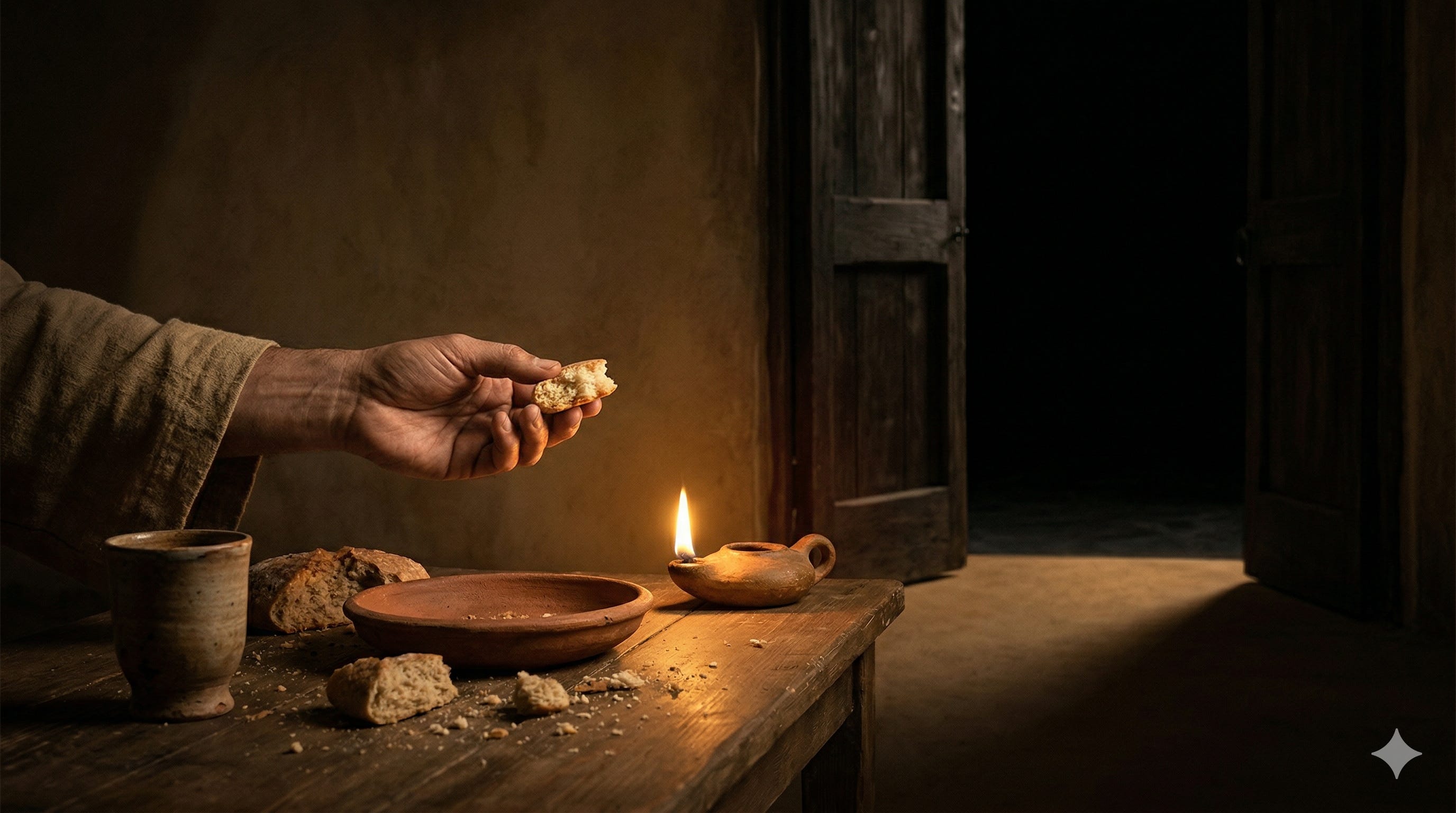
There is a table, and it is evening. There is bread, and it is being broken. There is a hand dipping into a common dish, and the gesture that should mean communion becomes the hinge on which betrayal turns. If you want to understand what Wednesday of Holy Week means, don’t start with a doctrine. Start with the image of a hand reaching into a bowl.
Leonard Sweet has argued that the gospel is not primarily a set of propositions to be believed but a set of images to be inhabited. He is right, and never more so than here. The Fourth Gospel stages the Passion not as a legal proceeding or even a moral drama but as a sensory event -- the feel of bread between fingers, the sound of sandals on stone as Judas leaves, the sudden cold of a door opening into the night. John wants you to taste this moment before you interpret it. That is the EPIC logic of the kingdom: Experiential before explanatory, Participatory before passive, Image-driven before idea-driven, Connected before isolated.
Start with the tongue. Isaiah’s Servant has been given a “trained tongue” -- in Hebrew, the leshon limmudim, the tongue of disciples, a tongue shaped by being woken morning after morning to listen before it speaks. This is not the tongue of the rhetorician or the debater. It is the tongue of someone who has learned that words are born in silence. The Servant’s first act of speech is not proclamation but sustenance: “that I may know how to sustain the weary with a word.” The tongue exists not for the speaker but for the one who is falling.
Now set that image beside the bread. At the table in John 13, Jesus takes a morsel -- the psomion, a small piece, an intimate gesture -- and gives it to Judas. In the ancient Near Eastern world, to share bread from one’s own hand was an act of deep friendship. The morsel is a word made physical. It is the Servant’s trained tongue translated into gesture. And yet the morsel that should sustain becomes the morsel that marks. The sign of friendship becomes the sign of treachery. The bread speaks two languages at once.
Sweet’s semiotic imagination would linger here, because this is exactly how the gospel works: not by stripping images down to a single meaning but by letting them vibrate with surplus. The bread is friendship and it is betrayal. The night is darkness and it is the stage on which glory enters. The hand that dips is love reaching out and it is love being refused. The gospel does not resolve these tensions. It holds them, the way a poem holds contradictions in a single line and dares you to sit with both.
Consider the image of the face. Isaiah’s Servant says, “I have set my face like flint.” The Hebrew is shatam -- to set, to make firm, to render unyielding as stone. The face that is set like flint is the same face that does not hide from insult and spitting. This is not Stoic impassivity. It is directional resolve. The Servant’s face is aimed somewhere, and neither violence nor humiliation will turn it aside. Luke’s Gospel borrows this image explicitly: “He set his face toward Jerusalem.” The face is a compass needle pointed at the cross.
Now see Judas’s face. John says that after receiving the bread, Judas “immediately went out.” We do not see his face again. He turns it away -- from the table, from the light, from the one who offered him bread. The Servant’s face set like flint and the betrayer’s face turned toward the door: these are the two faces of Wednesday, the two possible responses to the offered morsel.
And then there is the night. “And it was night.” Three of the most devastating words in the New Testament. John has been building his light-and-darkness metaphor since the Prologue -- “the light shines in the darkness, and the darkness did not overcome it” -- and now the darkness is given a body. It walks out of the room with sandals on. The night is not merely a time of day. It is an image of the alternative to glory: the world that refuses the bread, the face turned from the light, the tongue that will not be trained.
Sweet would say that the gospel always traffics in these multi-layered images because the gospel is trying to create an experience, not merely convey information. The table, the bread, the face, the night -- these are not illustrations of a theological point. They are the point. They are the sensory architecture of salvation. You do not understand the cross by thinking about it. You understand it by sitting at the table, feeling the bread break, watching the door close behind someone who chose the dark.
The Psalmist’s cry -- “Be pleased, O God, to deliver me! O Lord, make haste to help me!” -- is the cry of someone who knows what it means to be in the night. Psalm 70 is one of the shortest psalms, and its brevity is its theology. When you are in the night, you do not have breath for long prayers. You have breath for five words: “Make haste to help me.” The image here is urgency compressed into a gasp, prayer reduced to its most elemental form. This is what Hebrews means by “the sin that clings so closely” -- the weight that takes your breath, that leaves you with nothing but the capacity to cry out.
And yet the letter to the Hebrews reframes all of this with one stunning image: the “cloud of witnesses.” The Greek is nephos -- not a single cloud but a vast atmospheric presence, the way fog fills a valley or mist covers a mountain. The witnesses are not spectators in bleachers. They are a weather system. They surround. And in that surrounding, the runner who has no breath left finds that the air itself is composed of those who ran before. The atmosphere you breathe when you are weary is made of the faithfulness of the ones who went ahead.
This is the EPIC logic of Holy Week: it is experiential (you must sit at the table), participatory (you must extend your hand for the bread), image-driven (you must see the face and the night), and connected (you must breathe the cloud). Wednesday stands in the middle of the Passion, and its images ask you one question: Will you stay at the table, or will you walk into the night?
“Hearing the Ancient Voice” -- Exegetical Analysis
The Third Servant Song of Isaiah -- 50:4-9a -- has long been recognized as the hinge between the Servant’s call and the Servant’s suffering. John Walton’s approach to ancient Near Eastern context illuminates something that many Western readers miss: the “trained tongue” of verse 4 is not merely a literary gift. In the functional ontology of the ancient world, the tongue that has been given by God is a tongue that has been assigned a cosmic role. It exists within the ordered world that God is sustaining. Walton would remind us that in the ancient Near East, speech was understood as a creative act -- to speak was to participate in the ordering of reality. When the Servant says that God has given him a tongue to “sustain the weary with a word,” the sustenance is not metaphorical encouragement. It is participation in God’s ongoing work of holding creation together against the forces of chaos. The Servant speaks, and in speaking, he pushes back the darkness.
Tremper Longman reads this passage through its literary-canonical placement, noting the progression from the Second Servant Song (49:1-6) to the Third. In the Second Song, the Servant has a mission to Israel and to the nations but expresses frustration: “I have labored in vain.” In the Third Song, the frustration has been replaced by resolution -- not because the mission has succeeded, but because the Servant has learned a posture. The key word is “morning by morning.” Longman sees this as a disciplined rhythm of receptivity. The Servant’s resolution is not born from willpower but from a practice of listening that has become habitual. The flint-face of verse 7 is not the face of someone who has gritted his teeth but of someone who has listened so long and so deeply that turning away has become unthinkable.
Walter Brueggemann’s category of “counter-testimony” is essential here. Brueggemann argues that Israel’s testimony about God is not monolithic; it contains a genuine tension between the core testimony (God is faithful, sovereign, just) and the counter-testimony (God is hidden, slow, seemingly absent). The Servant Songs live precisely in this tension. In Isaiah 50, the Servant testifies to God’s faithfulness -- “The Lord God helps me” -- but does so from a position of insult, spitting, and physical violence. The testimony is not offered from a place of safety. It is offered from the belly of the counter-testimony. Brueggemann would say this is what makes the Servant’s speech prophetically powerful: it does not deny the darkness. It speaks the name of God inside the darkness, and that is an entirely different thing than speaking it from the light.
John Oswalt contributes a crucial theological layer. His emphasis on the uniqueness of Israel’s God -- the absolute holiness and otherness of YHWH -- reframes the Servant’s suffering. In the surrounding cultures, suffering was typically understood as punishment or divine disfavor. The gods were powerful, not vulnerable; glorious, not shamed. But Israel’s Servant suffers not because God has abandoned him but because God has commissioned him. Oswalt would insist that this reversal -- the chosen one of a holy God being struck, spat upon, and shamed -- is without parallel in ancient Near Eastern religion. The holiness of God, in Isaiah’s vision, does not protect the Servant from suffering. It sends him into it.
Psalm 70 functions as the Servant’s prayer from inside the suffering. Brueggemann’s psalm typology places this firmly in the category of disorientation -- the raw cry of someone whose ordered world has collapsed. It is notable that Psalm 70 is nearly identical to the closing verses of Psalm 40, which Brueggemann reads as a psalm of orientation that has already moved toward disorientation. The extraction of these verses into their own psalm, standing alone, intensifies the desperation. There is no preamble, no reflection, no liturgical framing. It is pure cry. Longman’s literary reading observes the chiastic structure: the psalm opens and closes with the Psalmist’s need (”deliver me” / “do not delay”) while the center contrasts those who seek harm with those who seek God. The literary architecture mirrors the theological reality: God’s people are surrounded by enemies but centered on praise.
The letter to the Hebrews takes us from the Servant’s individual suffering into the communal meaning of that suffering. N.T. Wright’s inaugurated eschatology provides the crucial framework. For Wright, the “cloud of witnesses” in Hebrews 12:1 is not a metaphor for general inspiration. It is an eschatological claim. The witnesses of Hebrews 11 -- Abel, Enoch, Abraham, Moses, Rahab -- are participants in the single story of God’s redemption that has now reached its climax in Jesus. They “surround” the present community because the new creation, inaugurated in Jesus’s resurrection, has already begun to gather all of God’s faithful into one people. The “race set before us” is not a private spiritual journey. It is the vocation of the new-creation people of God running together toward the consummation of all things.
Nijay Gupta deepens this communal dimension. His work on Pauline community formation, applied to the Hebrews context, would emphasize that “laying aside every weight” is not an individualistic instruction. The image is of a community stripping down together for a shared race. The “sin that clings so closely” -- the euperistaton hamartian -- is better understood as the sin that entangles the community, that trips up the body. Gupta would read this as an ecclesial exhortation: the community must identify and shed whatever impedes its collective witness. This resonates with the table scene in John 13 -- the community gathered, and in the midst of the gathering, one is being entangled by a sin that will tear the community apart.
Patrick Schreiner’s biblical-theological synthesis connects Hebrews 12:2 -- Jesus as “the pioneer and perfecter of faith” -- to the larger narrative arc. The Greek archegos (pioneer, founder, trailblazer) echoes the theme of Jesus as the new Moses, the new Joshua, leading the people into a promised land that is nothing less than the new creation itself. Schreiner would trace this title back through the Servant Songs: the one with the trained tongue, the face set like flint, is the archegos -- the one who goes first into the suffering so that others can follow. The “perfecting” of faith is not moral improvement. It is teleological completion -- faith brought to its intended goal, which is the full realization of God’s purposes for creation.
Michael Gorman’s theology of cruciformity and theosis ties the entire fabric together. For Gorman, the cross is not merely something that happened to Jesus; it is the pattern of existence into which believers are drawn. “Looking to Jesus” in Hebrews 12:2 is not simply gazing at a historical figure. It is allowing the cruciform pattern to become the shape of one’s own life. Gorman would read the phrase “for the sake of the joy set before him” not as Jesus enduring the cross to get to something better beyond it, but as Jesus finding in the cross itself the joy of perfect self-giving love. This is theosis -- becoming God-like -- and it looks nothing like what the world calls divine. It looks like a face set like flint, a back given to those who strike, a morsel of bread offered to the one who will betray.
John 13:21-32 is the pivot. The statement that “Jesus was troubled in spirit” uses the Greek etarachthe -- the same word used of Jesus at Lazarus’s tomb and in John 12:27 (”Now my soul is troubled”). This is not calm omniscience distributing bread with clinical detachment. This is agitation, disturbance, grief. Wright insists that John’s Jesus is not a docetic figure floating above human emotion. He is the incarnate Word whose spirit is troubled because betrayal is a real wound, even when it is foreseen. The giving of the bread to Judas is love persisting through grief -- the trained tongue sustaining even the one who will refuse to be sustained.
And then: “It was night.” The exegetical tradition rightly sees this as theological commentary, not merely chronological notice. But the scholars converge here in a remarkable way. Walton would note that in the ancient Near Eastern worldview, night is the domain of non-order, the time when the forces held at bay during the day reassert themselves. Brueggemann would call it the hour of counter-testimony, when God’s faithfulness is most hidden. Wright would see it as the moment before the dawn of new creation. Gorman would name it the hour of cruciformity, when the shape of God’s love is most fully revealed in its most fully hidden form. And Schreiner would trace it to the narrative arc of Scripture: from the darkness over the face of the deep in Genesis 1, to the darkness at noon on Golgotha, to the empty tomb at dawn.
The night is not the absence of God. It is the place where God’s presence takes the form of a morsel of bread offered to a betrayer. That is the exegetical heart of Wednesday.
“Feet on the Ground” -- Practical / Missional Analysis
Wednesday of Holy Week is the day the church has historically called “Spy Wednesday” -- the day of Judas’s deal with the chief priests, the day the betrayal moves from intention to arrangement. It is, in other words, the day when the failure of the inner circle becomes undeniable. And it is precisely here, in the wreckage of community, that the missional theologians have their sharpest word.
Alan Hirsch’s APEST framework -- Apostles, Prophets, Evangelists, Shepherds, Teachers -- was never meant to be an organizational chart. It was meant to describe the fivefold gifting that the Spirit distributes to the whole people of God for the sake of the world. But what Hirsch often emphasizes, and what Wednesday illuminates, is that the APEST framework only functions within a community of trust. Judas was at the table. He had been sent out with the Twelve to heal and proclaim. He had participated in the apostolic mission. And yet the mission was not enough to hold him. Hirsch’s deepest insight is not about leadership structures but about the “communitas” that mission requires -- the deep, forged-in-the-fire bond that comes from shared risk and shared dependence on God. When communitas breaks down, the mission doesn’t just stall. It becomes vulnerable to betrayal from within. The church that is merely organized for mission but not bonded in communitas is always one Judas away from collapse.
This is why Hirsch insists that movemental Christianity cannot be built on programs alone. Programs create roles. Mission creates bonds. The table in John 13 is the image of what communitas looks like at its most vulnerable: a group of people who have left everything to follow a rabbi, gathered in an upper room, sharing bread, and discovering that one of them has been hollowed out by a different allegiance. Hirsch would say that the modern church’s greatest missional failure is not lack of strategy but lack of bonded community -- the kind of community where betrayal is devastating precisely because the intimacy was real.
Michael Frost takes this in an incarnational direction. Frost’s theology of “sent-ness” begins with the conviction that God’s people are not gathered out of the world but sent into it. The church does not have a mission; God’s mission has a church. But Frost is equally insistent that being “sent” does not mean being invulnerable. The incarnation itself is the pattern: God enters the world not in power but in exposure, not in control but in availability. The Servant of Isaiah 50 -- back given to those who strike, cheeks to those who pull out the beard -- is the incarnational missionary. And the morsel offered to Judas is incarnational mission at its most radical: love offered with full knowledge that it will be refused.
Frost’s concept of the “radical ordinary” is essential for Wednesday. The radical ordinary is the conviction that mission happens not in spectacular events but in mundane faithfulness -- meals shared, neighborhoods inhabited, presence sustained over time. The upper room is a meal. The morsel is bread. The setting is a rented room in a city under imperial occupation. There is nothing glamorous about this. And yet it is the hinge of history. Frost would push back against any missional theology that requires extraordinary circumstances. The most profound missionary acts are often the most ordinary: staying at the table when you know the night is coming, offering bread to someone who may or may not receive it, being present in a room where everything is about to fall apart.
Eugene Peterson would slow us down. Peterson’s great contribution to practical theology is his insistence on the “long obedience in the same direction” -- the refusal of hurry, of the programmatic, of the seductive lie that faithfulness can be manufactured through technique. Wednesday is a day for Peterson’s pastoral wisdom because it is the day before the worst day. It is the day of waiting, of knowing, of carrying the weight of what is coming without yet being in it. Peterson would say that most of pastoral life happens on Wednesday -- not on the dramatic day of crisis but on the day before, when you sit with someone who is dying and the death has not yet come, when you counsel a couple whose marriage is failing and the decision has not yet been made, when you prepare a sermon knowing it will be preached into a room full of people carrying griefs you cannot name.
Peterson’s resistance to the “programmatic” is particularly sharp here. The temptation of Holy Week for the pastor and the church leader is to turn it into a production -- to manage the emotion, to stage the drama, to treat the Passion as content to be delivered. Peterson would call this a betrayal of its own kind: the betrayal of turning the living Christ into a program. The Servant’s tongue is trained not by technique but by morning-by-morning listening. The Servant’s face is set not by willpower but by long-cultivated trust. Peterson would insist that the most important thing the pastor does on Wednesday of Holy Week is not plan the Maundy Thursday service but sit in silence with the text and let the text do its work.
Bob Roberts Jr. brings the glocal perspective. Roberts’s conviction is that the church exists for the blessing of the city -- not as a self-contained community that occasionally does outreach, but as an institution whose fundamental orientation is toward the flourishing of the place where it lives. His “multi-domain engagement” means that the church engages not just in spiritual matters but in education, health, economic development, arts, governance -- every domain where human life unfolds.
Roberts would read Wednesday of Holy Week through the lens of what it means to be a blessing in the midst of betrayal. The city of Jerusalem on this Wednesday is a city preparing for Passover -- a city full of pilgrims, commerce, political tension, and religious expectation. The upper room is not detached from the city. It is embedded in it. And the drama of the bread and the night is not a private religious event. It has consequences for the city: by Friday, the religious establishment will have collaborated with the imperial power to execute a man, and the reverberations will reshape the world.
Roberts would push the modern church to ask: What does it mean to be a missional community in a city where betrayal happens -- where institutions fail, where leaders fall, where the powerful collude with violence? It means staying at the table. It means offering the bread. It means refusing to retreat into a privatized faith that protects itself from the mess of public life. It means being present in every domain -- education, health, justice, art -- not because the church has all the answers but because the church has a Servant with a trained tongue who knows how to sustain the weary with a word.
The integration of these four voices produces a vision of missional life on Wednesday that is neither triumphalist nor defeatist. Hirsch reminds us that mission requires real communitas, not just organizational structure. Frost reminds us that incarnational presence means vulnerability, not control. Peterson reminds us that the deepest faithfulness happens in the ordinary and the unhurried. Roberts reminds us that the church exists for the city, not for itself. Together, they describe a community that stays at the table, offers the bread, and faces the night -- not because it knows how the story ends (though it does) but because the morning-by-morning listening has trained its tongue and set its face.
What does this look like on an ordinary Wednesday? It looks like the pastor who visits the hospice room without an agenda. It looks like the small group that gathers even when attendance is thin and the conversation is hard. It looks like the church that partners with the school, the clinic, the shelter -- not for PR but because the Servant’s tongue is trained to sustain the weary. It looks like the believer who offers kindness to a colleague who has been undermining them -- the morsel to the one who may betray. It looks like the community that refuses to abandon the neighborhood when the neighborhood is struggling, that stays incarnate in the place, that resists the programmatic urge to optimize and instead commits to the long, slow, unglamorous work of presence.
This is Wednesday faith: bread in hand, face set, night falling, and the refusal to leave the table.
“A Word for the Day” -- Devotional Integration
You wake on a Wednesday and the world is still intact. The coffee brews. The news cycles. The obligations of the day line up like soldiers awaiting orders. It is the middle of the week, the middle of the story, the place where nothing dramatic seems to happen and yet everything is already in motion.
Wednesday is the day of the trained tongue.
There is a particular kind of grace that belongs to the middle of things. We celebrate beginnings -- the burst of new creation, the first day, the clean start. We mark endings -- the cross, the final breath, the stone rolled across the mouth of the tomb. But Wednesday gets no hymns. It is the day between, the day of preparation and dread, the day when the Servant wakes again and listens again and speaks again and none of it looks like victory.
And yet.
Isaiah says the Lord wakens him “morning by morning.” Not once-for-all. Not in a dramatic conversion. Not in a single revelatory moment that settles everything forever. Morning by morning. This is the spirituality of the repeated alarm clock, the daily return to the practice that has not yet borne visible fruit, the act of opening the ear when the ear would rather remain closed. Eugene Peterson called this “a long obedience in the same direction,” and he meant it as a rebuke to every spirituality that depends on intensity rather than fidelity. The Servant’s tongue is not trained in a weekend seminar. It is trained in the daily discipline of listening, in the quiet accumulation of mornings that no one will remember, in the unglamorous work of showing up.
Calvin Miller once wrote that the spiritual life is not a ladder but a spiral -- you return to the same truths again and again, but each time at a different altitude. Wednesday is the day you return. You have been here before. You have sat at this table, in this season, with these readings. The bread is familiar. The night is familiar. The face of the betrayer is -- and this is the part that catches in the throat -- familiar. You know it. You have worn it. Not Judas’s specific treachery, perhaps, but the smaller betrayals that share its DNA: the promise unkept, the loyalty abandoned when it became inconvenient, the face turned toward the door when the room got too honest.
The Servant does not hide his face. That is the line that undoes us. “I did not hide my face from insult and spitting.” We spend our lives hiding our faces -- behind competence, behind busyness, behind the careful curation of an image that can withstand scrutiny. The Servant’s face is unprotected. It is set like flint, yes, but flint is hard and exposed. It does not wear armor. It does not construct walls. It faces forward, into the wind, into the insult, into the night, because it is aimed at something beyond the night, and turning away would mean losing the direction.
The Psalmist cries, “Make haste to help me!” and if you have been paying attention to your own life, you know this prayer. You know it not from the dramatic crises but from the Wednesday moments -- the moments when the weariness accumulates, when the morning-by-morning discipline feels like morning-by-morning futility, when the bread you have been offering does not seem to sustain anyone, least of all yourself. The Psalmist does not offer a theology of suffering. He offers five words and a gasp. And the five words are enough.
Hebrews tells us to look to Jesus, and the word “look” is aphorontes -- to look away from everything else in order to look at one thing. It is the gaze of the runner who has found a fixed point and will not be distracted. On Wednesday, the fixed point is a man at a table, troubled in spirit, holding a piece of bread, offering it to the one who will destroy him. This is what the pioneer and perfecter of faith looks like in the middle of the week: not triumphant, not serene, but troubled and still offering. Still at the table. Still holding the bread.
The cloud of witnesses is not watching you the way a crowd watches a performance. They are around you the way air is around a body -- invisible, essential, sustaining. Abel is in the room. Abraham is in the room. Moses and Rahab and the unnamed others who “were tortured, refusing to accept release, in order to obtain a better resurrection.” They are not cheering from a distance. They are breathing with you, their faithfulness mingled with the atmosphere of your ordinary Wednesday, their long obedience woven into the fabric of the morning you are living right now.
And Judas goes out. And it is night.
Here is the thing about the night: it comes whether you are ready or not. The Servant did not choose the insult and the spitting. The Psalmist did not choose the enemies who surround him. Jesus did not choose Judas’s betrayal. The night is not a consequence of failure. It is the territory through which the Servant’s path runs. And the question of Wednesday is not whether you can prevent the night but whether you can remain at the table while it falls.
There is a morsel of bread with your name on it today. Not a dramatic morsel, not the bread of the Last Supper with all its freight of theology and tradition, but the ordinary bread of your ordinary Wednesday -- the task you must do, the person you must see, the word you must speak, the kindness you must extend to someone who may not receive it. This is the trained tongue in action. This is the face set like flint. This is the long obedience that no one will celebrate because it happens in the middle of the week, in the middle of the story, in the middle of a life that does not yet see how it ends.
Stay at the table.
The night will come. It always does. But the night is not the last word. The night is the canvas on which “Now the Son of Man has been glorified” is spoken. The darkness that swallows Judas is the same darkness over which the Spirit hovered in the beginning, the same darkness that will cover the earth on Friday afternoon, the same darkness that the dawn of Sunday will split open like a seed. The night is real, but it is not ultimate. And your Wednesday -- your ordinary, undramatic, middle-of-the-story Wednesday -- is the place where you practice believing that.
Morning by morning, he wakens. Morning by morning, the ear opens. Morning by morning, the tongue is trained. And on this particular morning, on this Wednesday in the middle of Holy Week, in the middle of your life, the Servant holds out a piece of bread and says: This is for you. Even now. Even here. Even in the night.
Take it.
A Prayer for Wednesday of Holy Week
Lord of the trained tongue and the unflinching face, we come to your table on this Wednesday with our own small betrayals tucked into our pockets, our own faces turned half toward the door. Waken our ears this morning, as you have wakened them before. Sustain us with a word -- not a word of explanation but a word of bread, of presence, of your relentless refusal to leave the table. Set our faces toward whatever night is coming, not because we are brave but because you have gone ahead, the pioneer who runs the course through darkness into glory. Make haste to help us. We are weary, and we are yours. Amen.
Meditation for the Day
Stay at the table; the bread is still being offered, and the night is not the end of the story.