
When Faith Looks Through Bars
John’s Prison Window and Jesus’ Kingdom Work (Matthew 11:2–11) Lectionary Text for Advent Week 3

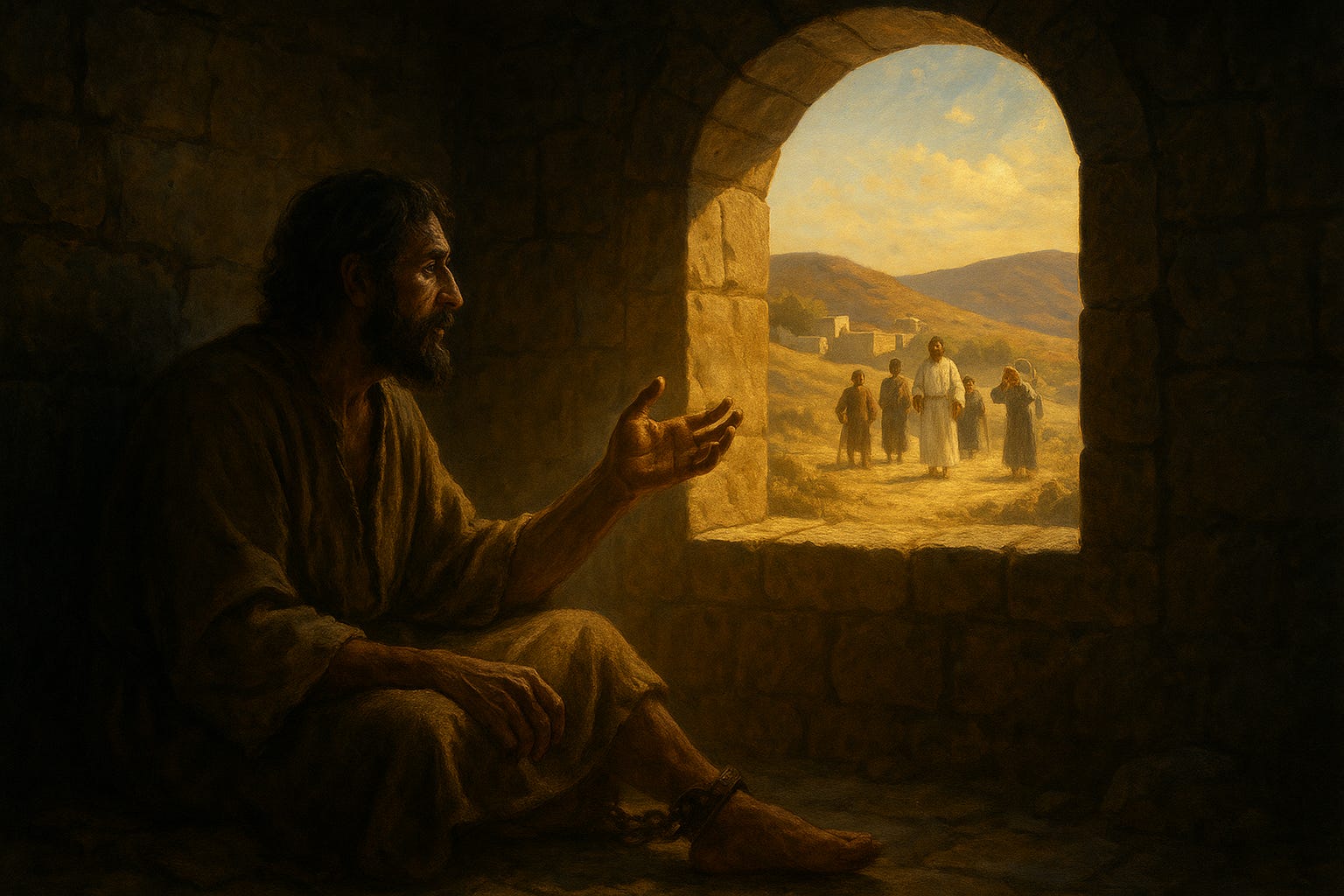
When the Window Is Too Small
There are seasons when life feels like a waiting room with no clock.
You sit in a hospital corridor outside an operating room. The double doors swing shut, and suddenly everything that matters most to you is happening in a space you cannot see. Nurses and doctors move in and out, but they do not stop to explain. You are left with secondhand reports, half-sentences, and your own swirling thoughts.
In that place, even strong faith can sound like a question: “Lord, are You really here? Are You really who we thought You were?”
Matthew 11 gives us a scene like that, not in a hospital but in a prison. John the Baptist – the fiery prophet who once thundered in the wilderness and pointed at Jesus with certainty – is now locked away behind thick stone walls. His world has shrunk to a cell, a narrow window, and whatever news his disciples can carry in from outside.
From that confined place, John sends Jesus a question that echoes across centuries:
“Are you the one who is to come, or should we look for another?” (Matthew 11:3)
This is not a skeptic’s jab from the sidelines. This is the question of a believer in chains. And Jesus’ answer – and what He then says about John – becomes a deep word of grace for anyone whose faith is real, but tired; sincere, but confused; devoted, and yet wondering.
In this text, God invites us to look again at our doubts, our expectations, and our picture of what it means to be “great” in the kingdom of heaven. And He does it through a prison window.
Setting the Scene: A Prophet in a Fortress
By the time we reach Matthew 11, Jesus’ public ministry is in full motion. He has preached the Sermon on the Mount, healed the sick, raised the dead, and sent out His disciples. Crowds follow Him; opposition is stirring. The kingdom has arrived – but it does not look the way many expected.
Meanwhile, John the Baptist is no longer preaching by the Jordan. For publicly challenging Herod Antipas’ unlawful marriage to Herodias, John has been arrested and locked away. Josephus and later tradition locate his imprisonment at Machaerus, a hilltop fortress east of the Dead Sea – a palace-prison complex perched above deep ravines, where political prisoners could be held out of sight and out of mind.
It is important to remember who John is.
He is the prophetic forerunner promised in Isaiah and Malachi, the voice crying in the wilderness, “Prepare the way for the Lord.”
He has already identified Jesus as the Lamb of God and has seen the Spirit descend at Jesus’ baptism.
Jesus Himself will soon say that among those born of women, no one has arisen greater than John (Matthew 11:11).
If anyone should be certain about Jesus, surely it is John.
And yet, from his cell, John hears reports about “the deeds of the Messiah” (Matthew 11:2). The reports are good – healings, sermons, crowds – but something is missing. John had preached that the Coming One would bring unquenchable fire, clear the threshing floor, and burn chaff with judgment (Matthew 3:11–12). He expected decisive intervention, the axe at the root of corrupt trees.
Instead, Herod is still on his throne. The oppressive system is intact. And John is still behind bars.
Matthew intentionally frames this moment as an Advent question – a question of timing and fulfillment. Is Jesus already the One Isaiah promised, or are we still waiting for another? This tension between “already” and “not yet” – between what has begun in Christ and what has not yet been completed – is at the heart of Christian hope.
From his narrow window in a fortress, John is trying to make sense of a Messiah who is not behaving like his expectations.
So he sends his disciples with the question many of us know by heart: “Are You the One, or should we look for someone else?”
The Walkthrough
1. John’s Question (vv. 2–3): Doubt Inside Faith
“When John heard in prison about the deeds of the Christ, he sent word by his disciples and said to him, ‘Are you the one who is to come [ho erchomenos], or shall we look for another?’”
The phrase “the one who is to come” is not generic. It echoes messianic expectation shaped by the Psalms and prophets – a Coming One who embodies God’s reign. The Greek ho erchomenos carries that weight: this is the expected figure who brings God’s decisive action.
John’s problem is not lack of information; he has heard about Jesus’ deeds. His problem is interpretation. “If You are doing all this, why am I still here? Why is Herod still here? Where is the fire?”
Notice what John does with his crisis:
He does not turn inward into silent resentment.
He does not turn outward to look for a new Messiah.
He sends his questions directly to Jesus.
This is a crucial pastoral point. Matthew refuses to pretend that great believers never waver. John’s doubt rises inside his calling, not outside it. As one commentator notes, even “the one whom Jesus calls greater than all the prophets” wrestles with whether Jesus is acting as he expected.
2. Jesus’ Answer (vv. 4–6): Isaiah’s Pictures, Not a Slogan
“Jesus answered them, ‘Go and tell John what you hear and see: the blind receive their sight, the lame walk, lepers are cleansed, the deaf hear, the dead are raised, and the poor have good news preached to them. And blessed is the one who does not fall away [skandalisthē] on account of me.’”
Jesus does not send back a simple “Yes.” He answers with a collage of Scripture-in-action.
The list He gives – blind seeing, lame walking, deaf hearing, dead raised, good news to the poor – is a deliberate echo of Isaiah 35 and 61, where God’s coming is described as eyes opened, ears unstopped, the lame leaping like a deer, and good news proclaimed to the poor and captives.
In Isaiah, these are signs of God’s saving presence, of a new creation breaking into the wilderness. By pointing to His actual deeds that line up with Isaiah’s vision, Jesus is effectively saying:
“John, the Scriptures are being fulfilled – just not in the sequence or style you imagined. Look at what is actually happening outside your window.”
The last line is a gentle warning and blessing:
“Blessed is the one who does not stumble over me” – skandalisthē en emoi – who does not trip over the gap between their expectations and My methods.
Semiotically, Jesus is reshaping John’s mental picture of Messiah:
Not only axe and fire, but also bandages and open eyes.
Not only overthrowing Herod, but also raising the forgotten and poor.
Not only political upheaval, but also bodily restoration and good news at the margins.
Jesus’ miracles are not random acts of compassion; they are signs that the age Isaiah imagined has begun in Him. The prison window is small, but the kingdom landscape outside is large.
3. Jesus’ Questions About John (vv. 7–9): Not a Reed in the Wind
As John’s disciples depart, Jesus turns to the crowd and asks three rhetorical questions:
“What did you go out into the wilderness to see? A reed shaken by the wind? … A man dressed in soft clothing? … A prophet?”
Each question narrows the options.
John was not a reed – he did not sway with opinion polls or royal pressure.
He was not a courtier in soft robes – those belong in palaces, not wilderness pulpits.
He was a prophet – indeed “more than a prophet.”
Jesus quotes Malachi 3:1: “See, I am sending my messenger ahead of you, who will prepare your way before you” (v. 10). John is that messenger, the hinge-figure between the prophetic anticipation of Israel and the arrival of the kingdom in Jesus.
Here is the tenderness: Jesus defends John’s identity precisely while John is struggling to understand Jesus’ identity. He refuses to reduce John to his question.
Theologically, this is rich. The greatest Old Testament-style prophet, the very herald of the kingdom, is allowed to ask hard questions without having his faithfulness revoked.
4. Greatness Reframed (v. 11): The Least and the Kingdom
“Truly I tell you, among those born of women no one has arisen greater than John the Baptist; yet the least in the kingdom of heaven is greater than he.”
This is not a backhanded compliment. Jesus is naming two realities:
John’s greatness – He stands at the climax of the prophetic tradition. In terms of calling, courage, and clarity, he is unmatched.
The greater privilege of those “in the kingdom” – Even the smallest disciple, who lives on the far side of the cross and resurrection and participates in the Spirit-filled community, stands in a different era of God’s work than John did.
John points to the dawn from the night; disciples live in the day that has begun to break. The greatness here is not about spiritual heroics but about where and when we stand in the story.
Semiotically, Jesus shifts the symbol of greatness from podiums and platforms to proximity and participation:
Greatness is not prophetic volume but nearness to Christ.
Greatness is not visibility but union with the One who brings the kingdom.
In other words, the quiet woman in a small congregation who clings to Jesus in suffering may be “greater” in kingdom terms than the boldest preacher in camel hair.
When Jesus Does Not Meet Your Expectations
Matthew 11 is not only an Advent text for John; it is one for us.
Many of us carry some version of John’s tension. We have heard the reports about Jesus: His cross, His resurrection, His presence by the Spirit, His promise to make all things new. And yet:
The diagnosis does not change.
The conflict in the family deepens.
The unjust system stays unjust.
The cell door, in whatever form, remains closed.
From that place, our prayers may sound less like polished statements and more like John’s blunt question: “Are You really the One?”
This passage does several gracious things for us.
1. It normalizes honest questions inside real faith.
John does not lose his identity because he asks. Jesus does not say, “How dare he?” He answers John with Scripture embodied in real life, and then He publicly honors John’s calling.
For pastors and leaders, this is vital. Faith communities that treat questions as betrayal end up training people either to fake certainty or to leave. Jesus shows a better way: bring your questions to Him; let Him answer them on the ground of His deeds, not your projections.
You might imagine your own “prison window”: a narrow field of view shaped by pain, fatigue, or fear. What would it mean, this week, to send your real questions through that window toward Jesus, rather than holding them in the dark?
2. It calls us to read our circumstances through the lens of Jesus’ Isaiah-shaped mission.
When Jesus answers John, He essentially says: “Look again at the Scriptures, and look again at what I am already doing.” The fix for John’s confusion is not a new Messiah but a new way of seeing the Messiah he already has.
We are invited to do the same:
Where are eyes being opened, lives being restored, and the poor hearing good news in ways we might have overlooked?
Where is the Spirit quietly at work beneath the headlines and the noise?
Jesus may not be fulfilling our hopes of quick judgment or instant vindication. But He is doing the Isaiah work – healing, freeing, proclaiming – often at the margins first.
Our task is not to write His job description, but to recognize His signature.
3. It warns us gently not to stumble over a Messiah who refuses our scripts.
“Blessed is the one who does not stumble on account of me.”
The stumbling, in this context, is not generic unbelief but the offense of a Messiah who refuses to meet our expectations of power, speed, and spectacle. Some will trip over the fact that Jesus spends Himself on the poor instead of courting the palace. Some will trip over His patience with sinners or His refusal to wield the sword.
Matthew 11 asks: Will we trust Jesus when His way of being Messiah conflicts with our preferred plan? Will we let Him be the kind of Savior He actually is, rather than holding out for the one we imagined?
4. It reframes greatness as quiet participation in the kingdom.
John is praised as the greatest “among those born of women,” yet the least in the kingdom is greater.
This does not diminish John; it elevates the seemingly small Christian who quietly follows Jesus. The retiree who mentors a teenager, the exhausted parent who whispers prayers over a child, the employee who refuses to lie to make numbers look better – in kingdom terms, this is greatness.
You may never stand in a pulpit or have a wilderness crowd. But if you cling to Christ and join His Isaiah-shaped mission in small acts of faithfulness, you are already living in the new age John could only herald.
In that sense, every kitchen table, every workplace, every hospital room can become a “prison window” through which the light of the kingdom both enters and shines outward.
BENEDICTION – For Those Asking, “Are You the One?”
Beloved,
may the Lord who met John in his prison
meet you in yours.
May the questions you are afraid to ask
find their way, like John’s disciples,
straight to the feet of Jesus.
May the Spirit open your eyes
to see where the blind are given sight,
where the lame begin to walk,
where the poor hear good news—
even while some doors remain closed.
And when Jesus refuses to fit your scripts
or move on your timetable,
may you be kept from stumbling over Him,
and instead learn to rest on Him.
Go now as citizens of the kingdom
that has already begun and is yet to be completed,
content to be “least” if only you may belong to Him.
In the name of the Father, and of the Son,
and of the Holy Spirit.
Amen.