

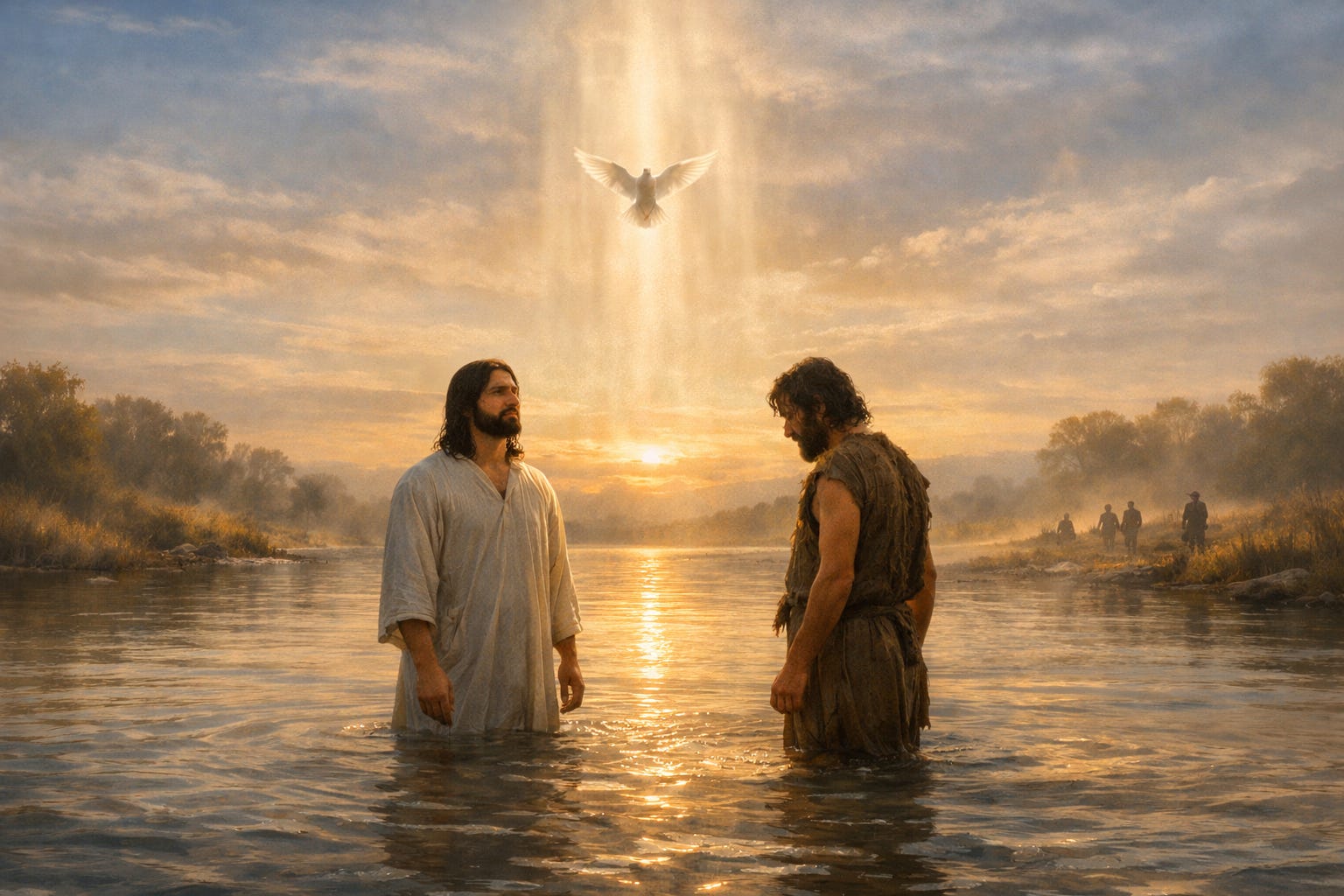
When the Sky Feels Shut
Some mornings feel like living under a low ceiling.
Nothing dramatic happened. No catastrophe. No scandal. Just the steady, quiet sense that you are pushing through life with your shoulders slightly hunched, as if the air itself is heavy. You make breakfast, answer messages, keep your promises, carry your responsibilities. But somewhere inside you there is a wordless question you would be embarrassed to say out loud:
Is God pleased to be with me, or merely willing to tolerate me?
For many of us, faith becomes a kind of spiritual weather report. We watch for signs. We look for a break in the clouds. We hope for a moment when the sky opens and we can finally feel certain that heaven is not closed for business.
And then Matthew brings us to a river.
Not a cathedral. Not a throne room. A river. The Jordan. Ordinary water moving through an ordinary landscape, while extraordinary expectations gather on its banks. John the Baptist is there with his wilderness voice and his uncomfortably honest message. People are stepping into the water like a confession: I need God. I need change. I need mercy.
And into that line—into that crowd—Jesus steps.
That is where this story begins: not with Jesus above us, but with Jesus among us.
Jesus Steps Into the Line
Matthew says, “Then Jesus went from Galilee to the Jordan River to be baptized by John” (Matt 3:13, NLT).
John can’t accept it. He tries to talk him out of it: “I am the one who needs to be baptized by you… so why are you coming to me?” (v. 14, NLT). John’s protest makes sense. His baptism is a baptism of repentance. It is a sign for people who know they need to turn. Jesus does not come to the river as a sinner looking for a moral upgrade.
So why does he step into the water?
Jesus gives an answer that is both simple and deep: “It should be done, for we must carry out all that God requires” (v. 15, NLT). In Greek, Matthew’s language is about what is “fitting” and about “fulfilling all righteousness” (plērōsai pasan dikaiosynēn).
That word “righteousness” can sound like pressure—another demand, another performance review. But in Matthew, righteousness is not merely private moral achievement. It is covenant-faithfulness. It is God’s will, God’s saving purpose, arriving in embodied form.
So Jesus is not saying, “I need to get cleaner.” He is saying, “This is how God’s faithfulness will be completed.”
And look where it is completed: not in separation from messy people, but in solidarity with them.
Jesus steps into the line. He enters the water as if to say, I will begin my work by standing where you stand.
That is the first mercy of this passage: the gospel begins with Jesus’ humility, not our improvement.
The Open Heavens Over Ordinary Water
Then Matthew says: “After his baptism, as Jesus came up out of the water, the heavens were opened and he saw the Spirit of God descending like a dove and settling on him” (v. 16, NLT).
The heavens were opened.
That sentence is easy to read and hard to feel. Because many of us have learned to live as if the heavens are closed. We believe in God, but we brace ourselves emotionally as if we are mostly on our own. We pray, but we do not expect the sky to tear. We sing, but sometimes the ceiling feels low.
Matthew does not say the heavens opened in a temple. They opened over a river where repentant people had been standing. They opened over the place of confession and need. And they opened because Jesus stepped into that place.
The Spirit descends “like a dove.” The point is not that the Spirit is fragile; the point is that God’s presence comes with gentle authority. Not coercion. Not panic. Not violence. The Spirit rests on Jesus as a sign of anointing—commissioning for the work ahead.
And then—if the opened heavens were not enough—Matthew gives us a voice:
“And a voice from heaven said, ‘This is my dearly loved Son, who brings me great joy’” (v. 17, NLT).
This is not a private whisper. It is a public naming.
Scholars often note that the voice echoes two major Old Testament streams: Psalm 2’s royal Son language and Isaiah 42’s servant language. In other words, heaven is declaring: this is the King, and he will reign as the Servant. This is the beloved Son, and he will save not by crushing enemies but by carrying burdens.
Jesus is named before he performs.
Beloved before he proves.
Joy before accomplishment.
If you want to understand the heart of God toward you in Christ, start there. The Father’s delight rests on the Son at the beginning of the story. The work flows out of love, not toward love.
What “Fulfill All Righteousness” Really Means
Now we need to return to Jesus’ phrase: “we must carry out all that God requires.”
Because if we misunderstand it, we will miss the gospel and inherit only spiritual anxiety.
In Matthew’s telling, righteousness is not a ladder we climb to reach God. It is God’s faithful purpose coming down to reach us. Jesus fulfills righteousness by walking the path of obedience that will carry him all the way through Israel’s story and beyond it—into the wilderness, into proclamation, into healing, into confrontation, into the cross, and into resurrection.
This is why Jesus begins here: at the Jordan.
The Jordan is a threshold river in Israel’s memory. It is where a people crossed into calling. When Jesus steps into that water, he is stepping into Israel’s story, into our story, at the place of beginning.
If you have ever felt like you live under a shut sky, hear this carefully:
The heavens open not because you finally cleaned yourself up, but because Jesus stepped into the water in your place.
And that does something profound to the way we read our own lives.
The Voice You Live Under
Every life has a voice over it.
Sometimes it is the voice of your past: “You are what happened to you.”
Sometimes it is the voice of comparison: “You are behind.”
Sometimes it is the voice of shame: “If they really knew you…”
Sometimes it is the voice of fear: “Stay small. Stay safe.”
Sometimes it is even a religious voice: “Try harder, and maybe God will approve.”
Matthew gives us another voice. Not the crowd’s voice. Not John’s voice. Not the Pharisees’ voice. God’s voice.
“This is my beloved Son.”
In Christ, that voice becomes the foundation of the Christian life. Not because we are the Son in the way Jesus is the Son, but because the Son shares his standing with us. What he receives by nature, we receive by grace.
And that leads to the invitation at the heart of Baptism of the Lord: you do not have to live under a closed heaven when the Son has opened it.
Living Under Open Heavens
So what do we do with this?
We do not “apply” this passage by trying to recreate the spectacle. We cannot manufacture open heavens. We receive them. We live into what Christ has done.
Here are three ways this text reshapes ordinary discipleship.
1) Step into the line you keep avoiding
Jesus steps into the line of repentant people. Many of us try to avoid lines—especially the lines that require honesty.
The line of confession.
The line of apology.
The line of asking for help.
The line of naming what is true.
We fear that if we step into that water, God will be disappointed.
But Matthew shows us a Savior who meets people precisely there. The river is not the place God despises. It is the place God chooses for revelation.
If repentance has felt like humiliation, hear the gospel: repentance is the doorway where heaven opens because Jesus stands with you.
2) Receive belovedness before you rehearse your plans
Notice the order: the Father’s pleasure is declared before Jesus’ public ministry unfolds.
If you are waiting to feel loved by God until you fix your habits, stabilize your emotions, conquer your temptations, or achieve your goals, you will spend your life under a low ceiling.
In Christ, God’s love is not the paycheck at the end of spiritual labor. It is the ground beneath your feet at the beginning.
3) Let your calling be commissioned by love, not driven by fear
Think about commissioning moments we understand.
In an adoption finalization, a judge signs the decree and publicly declares belonging. The child does not earn the family name through performance; the family gives it.
Fred Rogers was ordained with a charge to minister through mass media—an identity and mission spoken over him that shaped decades of faithful work.
Firefighters mark transitions with visible signs—moving from “rookie” status to full belonging and responsibility.
These are imperfect analogies, but they help us see the shape: identity is bestowed, then mission unfolds.
So if your “calling” has become frantic—driven by fear, insecurity, or the need to prove—you may need to return to the river and listen again to the voice that names the Son.
Because the Christian life is not: “Work so God will be pleased.”
It is: “Because God is pleased with the Son, and you are in the Son, you can work from rest.”
BENEDICTION — The Sky Opened at the River
Here is the quiet wonder of Matthew 3:
The heavens opened over ordinary water because Jesus stepped into the line.
He did not begin by separating himself from sinners. He began by standing with them. He did not begin with thunder against you. He began with a voice of delight over him—and, in him, a promise over all who will come to him.
So if you have felt like you live under a closed sky, you do not have to guess what God is like.
Look at Jesus in the Jordan.
Look at the Spirit descending.
Listen to the Father’s voice.
And then come to Christ—again, or for the first time—not to earn a place, but to receive it.
May the God who opened heaven over the Son open your heart to trust the Son.
May the Spirit who rested on Jesus rest on you with gentle power.
And may the voice that names Jesus beloved teach you to live, at last, as one held in the mercy of God.