

From the series: Economy, Conflict, AI, Climate, Democracy: Five Worries Shaping 2026
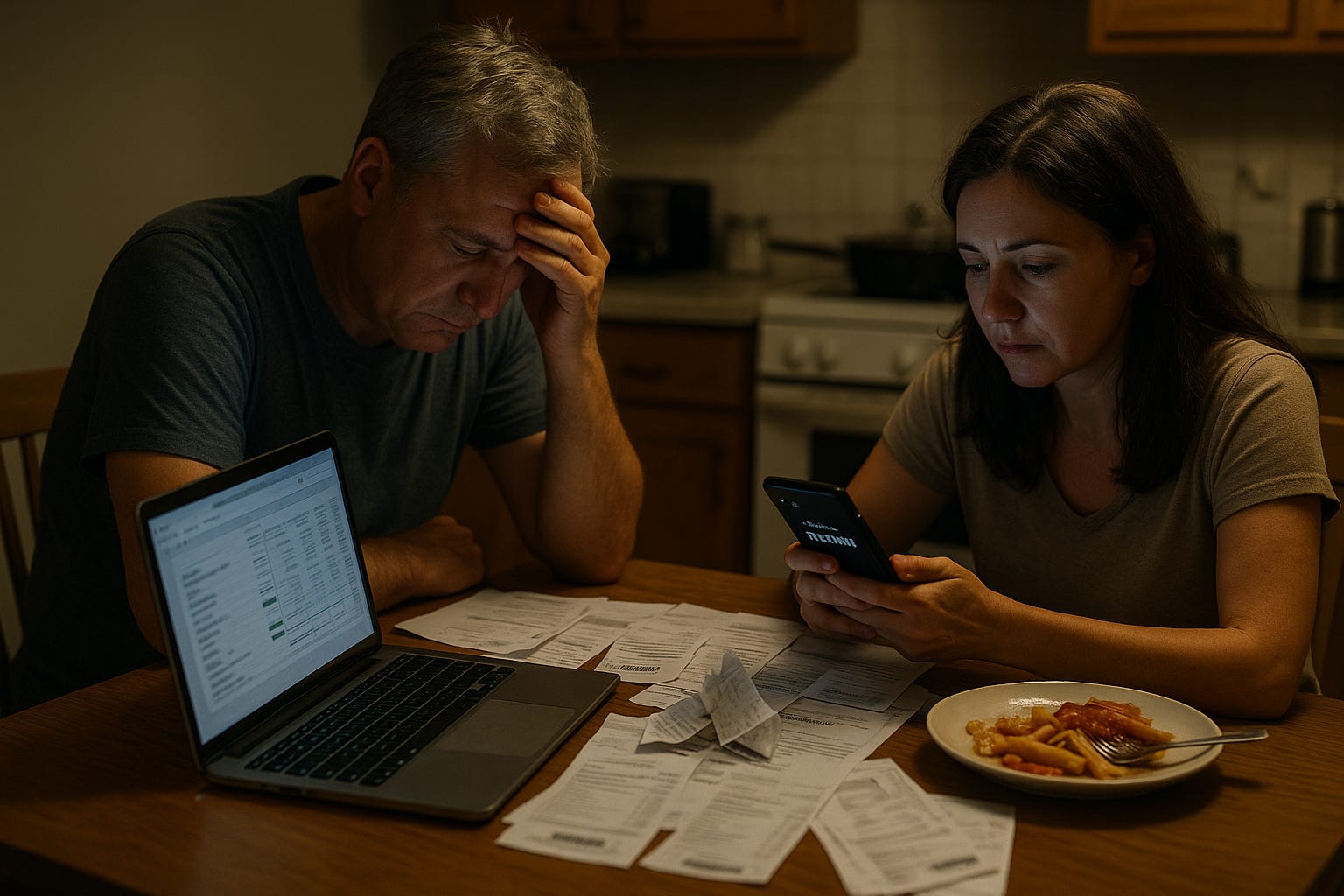
Picture a household in early 2026.
Groceries cost more than they did a few years ago. Rent or the mortgage payment is higher. Insurance premiums have gone up. Child care, transport, student loans, and medical bills all press against the same paycheck.
Official reports say inflation has fallen from its peak. Central banks talk about “cooling price pressures.” Yet the total monthly bill feels heavier, not lighter. Many readers live in that tension. The headlines mention recovery. The bank account tells a different story.
Surveys confirm this gap. In early 2025, 63 percent of Americans said inflation is a “very big problem,” similar to 2024 and only slightly below the 2022 peak (Pew Research Center). A separate 2025 survey found that 29 percent name inflation as their top financial problem, with housing costs and lack of money next at 12 percent each (Gallup.com). When people describe why they rate the economy as poor, 42 percent point first to rising prices and personal expenses (Pew Research Center).
Globally, experts still view economic pressures as part of a wider risk picture. The 2025 Global Risks Report notes that while pure economic risks have slipped in ranking, cost pressures remain intertwined with broader shocks such as geopolitics, aging populations, and climate disruption (World Economic Forum).
The result is a shared feeling. The formal economy reports progress. Households feel squeezed. That tension shapes politics, social trust, mental health, and leadership decisions as we move toward 2026.
WHAT THE DATA SAYS ABOUT THE SQUEEZE
Price levels versus inflation rates
Inflation often refers to the rate of change. The rate has come down in many countries. But the level of prices remains high.
In the United States, annual inflation dropped from 9.1 percent in June 2022 to about 2.5 percent in August 2024. Yet prices in all metro areas stood higher than before, and analysts noted that these prices will likely stay elevated unless a deep downturn hits (Pew Research Center). That pattern repeats across the OECD. Inflation has fallen from its 2022 peak but remains above the 2 percent targets in most member states (DevelopmentAid).
Households do not buy “inflation.” They buy food, rent, and services at today’s price. When prices rise quickly and then slow, the level can remain out of reach, even when economists say “inflation is under control.”
Wages recovering, but still behind
Wage data tells a mixed story. Real wages, which adjust for inflation, are finally growing again in many OECD countries. An OECD report in March 2025 notes positive annual real wage growth in 31 of 34 countries, averaging 3.4 percent in the third quarter of 2024. At the same time, real wages remain below their early 2021 level in about two thirds of these countries (OECD).
In short, many workers are still catching up from the inflation shock of 2021 to 2023. Some lower wage workers have seen a stronger recovery, since minimum wages rose in real terms between 2021 and 2025 in most countries with national minimums (OECD). Yet middle income households often sit in the gap. Their paychecks rise, but not enough to rebuild lost ground.
Housing and food under pressure
Housing remains a major pressure point. A recent U.S. poll found that almost three quarters of respondents believe housing has become less affordable in their community in recent years (CBS News). High interest rates have pushed up mortgage costs, while tight supply keeps rents high.
Food prices also remain volatile. A 2025 report linked climate driven shocks such as heatwaves and droughts to major food price spikes across multiple countries (The Guardian). Examples range from higher potato prices in the UK to sharp jumps in onion and cocoa prices in India and West Africa. The poorest households bear the greatest burden. Food absorbs a higher share of their income, so a jump in staples often forces tradeoffs in health, education, or savings.
Expectations and policy choices
Inflation expectations also influence lived experience. A 2025 analysis by the Bank for International Settlements reported that households in 29 economies expect inflation around 8 percent over the next year, while actual inflation averages about 2.4 percent (Financial Times). When people expect higher prices, they adjust wage demands and spending plans, which can keep pressure alive.
Policy choices contribute as well. An AP NORC poll in 2025 found that around half of U.S. adults expect renewed tariffs to push prices up in a significant way, while another 30 percent expect moderate price increases (AP News). Trade disputes, energy shocks, and geopolitics all feed into household budgets.
From a data view, the story is clear. Inflation has cooled in many places. Real wages are starting to recover. Yet many households feel locked into a higher cost world, with income still behind. That gap drives economic insecurity.
ECONOMIC LENS: A STRAINED SOCIAL CONTRACT
Modern economies rest on a basic promise. If you work, learn skills, and plan, you move toward greater stability. When prices outrun wages for several years, confidence in that promise weakens.
Economic data now points in three directions at once.
First, macro indicators show growth and falling headline inflation in many advanced economies. Central banks discuss rate cuts. Stock markets respond to AI and other technologies with optimism. Reuters
Second, real wages remain below their pre-shock levels in many countries. Household budgets have not recovered from the price surge (OECD).
Third, basic costs such as housing, food, health care, and child care remain high in relation to incomes, especially in large cities and for younger cohorts. CBS News
This combination reshapes the social contract. People who did everything “right” face a future that feels more fragile. The path from education to stable middle class life looks less secure. Savings goals such as retirement or a first home push farther away.
POLITICAL LENS: AFFORDABILITY AND TRUST
Economic insecurity does not stay in private life. It flows into politics.
Surveys show that the economy ranks near the top of voter concerns. In late 2024, 52 percent of U.S. registered voters said the economy is an “extremely important” issue for their presidential vote, with another 38 percent calling it “very important” (Gallup.com). Inflation and the broader economy have stayed near the top of concern lists since 2022 (Gallup.com).
When people feel squeezed, trust in institutions tends to fall. Citizens judge leaders not by macro charts but by rent, groceries, and wages. If public messages stress recovery while daily life feels worse, many assume leaders are out of touch or dishonest.
Policy debates over tariffs, housing regulation, and social spending become charged because they touch that pressure. Tariff policies that raise import prices, for example, may align with trade goals but also add to household costs. The AP NORC poll suggests growing public skepticism toward tariff driven strategies, especially among younger adults (AP News).
In some countries, affordability worries feed support for parties that promise quick relief, even if their programs carry long term risks. Debates over rent control, energy subsidies, or tax cuts sit inside this deeper worry. People want a sense that the system works for them and their children.
SOCIOLOGICAL LENS: STRAINED COMMUNITIES
Economic insecurity reshapes social patterns.
Households delay decisions about marriage, children, or home purchase because budgets feel tight. Younger adults often move back with parents or share housing for longer periods. Community organizations see higher demand for food banks and financial counseling.
Ipsos surveys show that across 29 countries, about half of respondents believe their country is in recession, even when official data shows growth. Many expect inflation to rise and their disposable income to fall (Ipsos). These expectations shape social behavior. When people assume ongoing hardship, they focus on short term survival. Time, attention, and energy for civic engagement shrink.
Economic stress also interacts with inequality. Those with assets such as homes or stocks may benefit from price and asset inflation. Those without such assets face higher barriers to entry. Communities fragment along lines of income, education, and geography. Shared public spaces weaken when those in higher income brackets retreat into private services and those with lower incomes lack margin for participation.
PSYCHOLOGICAL LENS: ANXIETY AND EXHAUSTION
The cost of living squeeze is not only about numbers. It affects minds and relationships.
When essential expenses rise faster than income, families experience ongoing stress. Disputes over money are a frequent source of conflict in relationships. Parents worry about feeding children, paying for school activities, or caring for aging relatives.
Survey data links financial stress to lower life satisfaction and higher anxiety. The 2025 Global Risks Report notes that societal and mental health risks are tied to economic pressures, inequality, and rapid technological change. World Economic Forum
Chronic stress often leads to a sense of learned helplessness. People feel that effort does not change outcomes. They withdraw from planning and choose short term relief over long term goals. Debt rises. Health behaviors suffer.
For leaders in churches, businesses, and civic groups, this background matters. When people arrive at a Sunday service, a team meeting, or a community event, they often carry financial worry in the background. Their capacity to engage in new initiatives or volunteer projects depends on whether they feel secure enough to look beyond the next bill.
LEADERSHIP LENS: HOW INSTITUTIONS RESPOND
Economic insecurity reveals the character and strategies of leaders.
Some leaders respond with denial. They emphasize positive macro indicators and avoid mention of hardship. This approach deepens distrust. People do not forget their own grocery receipts.
Other leaders respond with fear narratives. They amplify worst case scenarios to mobilize support or attention. This may increase engagement in the short term but raises anxiety and division.
A healthier response starts with clear acknowledgment. Leaders name the squeeze in concrete terms and connect public statements with lived experience. They avoid policy slogans and focus on specific examples such as housing costs, medical debt, or child care burdens.
In organizations, leaders review pay structures, benefits, and workloads in light of cost of living shifts. OECD data suggests that targeted support for lower wage workers, such as higher minimum wages and tax relief for single parents, has helped some households regain ground (OECD). These lessons apply inside firms and ministries as well.
Leaders in public and nonprofit sectors review which programs deliver the best support per dollar. Food security, housing stability, and basic health care often have strong long term payoffs in community resilience.
For those in Christian leadership, the analysis variant still matters. Sound theological response depends on honest reading of economic reality. Sermons and pastoral care that ignore cost pressures risk sounding detached.
SIGNALS TO WATCH HEADING INTO 2026
Several signals deserve close attention over the next 18 to 24 months.
First, real wage growth relative to underlying inflation. As long as pay growth trails price levels, economic insecurity will persist. Watch especially the middle of the wage distribution, not only minimums (OECD).
Second, housing affordability metrics. Ratios of rent or mortgage payments to income, especially for younger households and families with children, shape long term demographic and social trends (CBS News).
Third, food and energy price volatility. Climate linked shocks and geopolitical tensions will influence these categories. The 2025 report on climate driven food price spikes is an early sign (The Guardian).
Fourth, public perceptions of recession and inflation. If large shares of the population believe their country sits in recession, despite official growth, political and social strain will grow (Ipsos).
Fifth, trust indicators toward governments, central banks, and employers. When people stop believing in the fairness and competence of institutions, economic stress multiplies into social instability.
PRACTICAL IMPLICATIONS FOR LEADERS AND ORGANIZATIONS
Leaders who take economic insecurity seriously focus on concrete steps in four areas.
Pay, benefits, and workload
They review salary structures against local cost of living data, not only national averages. Where increases are limited, they explore non-wage supports such as flexible work arrangements, child care stipends, or targeted help with transport or meals. They communicate transparently about constraints and tradeoffs.Financial literacy and support
They offer basic, respectful teaching on budgeting, debt, and savings, without shame. Churches, schools, and employers partner with trustworthy counselors rather than predatory lenders.Policy engagement
They engage policy debates with a focus on long term household resilience. That includes support for affordable housing supply, reliable public transport, and fair access to education and health care. They avoid slogans and ask which policies enhance or weaken real household security over a decade.Organizational culture
They recognize that money pressure affects performance and participation. Leaders give people space to speak about financial stress without fear. They reduce unnecessary costs of participation in community life, such as expensive program fees or expectations of frequent paid events.
A REALISTIC BUT HOPEFUL HORIZON
Economic insecurity and cost of living pressures will remain central worries heading into 2026. The data does not promise a quick reset to pre-2020 conditions. Prices have ratcheted up. Wages still need time to recover in real terms. Housing and food face ongoing structural challenges (OECD).
Yet the situation is not fixed. Policies matter. Leadership choices matter. Community practices matter. Real wage gains, targeted support for the most exposed households, and investments in housing and food resilience all reduce insecurity over time (OECD)
For readers who lead teams, churches, companies, or families, the path forward starts with clear sight. Look honestly at the pressures your people face. Align your decisions with that reality. Resist both denial and panic.
The next articles in this series will explore other top worries heading into 2026. All of them intersect with economic insecurity in some way. Understanding the cost of living squeeze is a first step toward wise, grounded action.
SOURCES & FURTHER READING
Gallup. (2025, April 30). Inflation still top U.S. financial problem, but fewer cite it. Gallup.com
Pew Research Center. (2025, February 20). Americans continue to view several economic issues as top national problems. Pew Research Center
Pew Research Center. (2025, October 3). Most Americans continue to rate the U.S. economy negatively as partisan gap widens. Pew Research Center
Pew Research Center. (2024, October 7). Prices are up in all U.S. metro areas, but some much more than others. Pew Research Center
OECD. (2025, March 13). Real wages continue to recover. OECD
OECD. (2024, July 22). Wages rise in OECD countries as inflation drops and labor markets remain tight. DevelopmentAid
World Economic Forum. (2025). Global Risks Report 2025. World Economic Forum
Guardian / Energy & Climate Intelligence Unit et al. (2025, July 21). Rising food prices driven by climate crisis threaten world’s poorest, report finds. The Guardian
AP NORC. (2025). Most Americans expect higher prices as a result of Trump’s tariffs, a new AP NORC poll finds. AP News
CBS News. (2025). America’s deepening affordability crisis summed up in 5 charts. CBS News