

From the Series: Economy, Conflict, AI, Climate, Democracy: Five Worries Shaping 2026
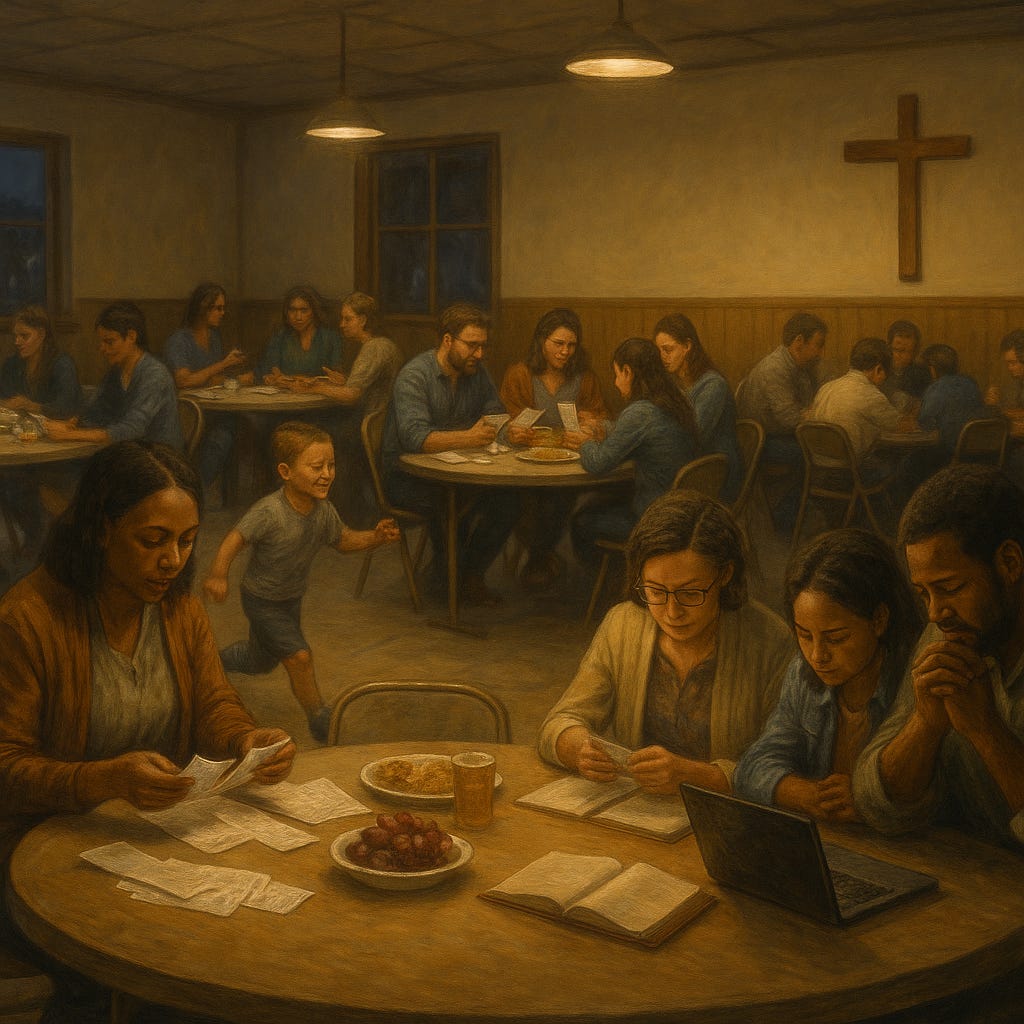
A KITCHEN TABLE LITURGY
Most of us do not experience the economy in charts and forecasts.
We experience it at a kitchen table.
The laptop is open to the budget spreadsheet. A small stack of envelopes sits to the side—rent or mortgage, utilities, medical, a credit card that carried last month’s shortfall. Groceries in the pantry feel thinner than they did a few years ago. One partner stares at the numbers, rubbing their forehead. The other scrolls their phone and sees another headline about inflation, interest rates, or tariffs.
It is not simply that “things are expensive.” It is the gnawing sense that we are working as hard as we know how, yet the numbers do not bless our effort. Anxiety arrives like a third presence at the table.
Across the Global North, many households tell this story. In early 2025, roughly two-thirds of Americans said inflation is a “very big problem,” about the same level of concern as the year before (Pew Research Center). Around three-quarters say the economy is “only fair” or “poor,” despite low unemployment and decent growth (Pew Research Center). Global reports note that cost-of-living pressures continue to strain middle-class purchasing power and public services, especially in developed countries (World Economic Forum).
At the same time, wages have not fully caught up. Across most OECD countries, real wages are growing again—but in about half of them they still sit below early-2021 levels, before the surge of post-pandemic inflation. OECD Many people feel as though they are constantly running uphill on a moving treadmill.
For followers of Jesus, the question is not only, “How do we survive this?” but, “How do we live faithfully, generously, and hopefully when the bills seem to preach a different gospel about what is secure and what is possible?”
WHAT WE KNOW SO FAR: THE COST OF LIVING AS A SPIRITUAL PRESSURE
Even in a pastoral article, it helps to name the landscape. The economic crisis is not abstract; it presses on hearts and bodies.
Inflation has cooled, prices have not. Global headline inflation is expected to keep drifting down, but prices for everyday goods—from rent to groceries—remain much higher than before 2021 (IMF).
Wages are recovering, unevenly. Real wages are finally rising in most advanced economies, yet many households are still digging out of the hole dug by 2021–2023 (OECD).
People are postponing life. Surveys show many are delaying major life decisions—buying a home, going to college, retiring—because they do not trust that their finances will hold (New York Post).
Confidence is low. Consumer confidence indices in 2025 fell to their lowest levels in more than a decade, as households worry that their financial future is worsening (AP News).
For pastors and Christian leaders, this means that a church staff meeting, a community group, or a youth ministry planning night is populated not simply by “busy people” but by people whose nervous systems are quietly braced around money.
The spiritual impact is subtle but profound. Economic insecurity often moves us toward:
Fear: constant background anxiety about making it to the end of the month.
Shame: embarrassment over debt, unpaid bills, or reliance on assistance.
Isolation: the sense that everyone else is coping better, so we keep quiet.
Cynicism: suspicion that promises of “flourishing” or “abundance” apply only to the lucky or privileged.
The cost-of-living crisis is not just about what we can buy. It is about who we believe God is, what kind of world we live in, and whether love really has anything to say when numbers do not line up.
SCRIPTURE IN A HIGH-PRICE WORLD
Our temptation is to grab a single verse—“Do not worry about tomorrow” (Matt. 6:34)—and paste it over the spreadsheet like a religious Post-it. But Jesus’ words about money and worry were never meant to be a slogan. They were an invitation into a different way of seeing reality.
Two anchor passages can help us here.
1. Matthew 6:19–34 – From Scarcity Scripts to Kingdom Vision
In the Sermon on the Mount, Jesus speaks to people under real economic pressure. Many of his hearers were day laborers and tenant farmers living under Roman taxation and local elites. He does not deny their needs. Instead, he reframes their world:
“Look at the birds of the air… Consider the lilies of the field…”
Jesus challenges what we might call scarcity scripts—the internal stories that say, “You are on your own. There will not be enough. You must cling, hoard, or hustle endlessly to be safe.”
He does this by:
Pointing to the Father’s care in creation. The world is not a closed system of competition alone; it is held in the generosity of God.
Reordering loves. “Seek first the kingdom of God and his righteousness, and all these things will be added to you as well.” The question is not whether food and clothing matter, but which desire becomes first in our imagination.
Calling us out of corrosive worry. Jesus does not say, “Ignore your bills.” He says, in effect, “Do not let tomorrow’s uncertainty occupy today’s trust.”
For a household under cost-of-living strain, this passage does not magically lower prices. It does, however, name a real contest for worship. Will we let anxiety sit at the center of the table, or will we stubbornly place the kingdom of God there instead—sometimes with trembling hands?
2. Acts 2:42–47; 4:32–37 – The Economics of Shared Belonging
The early church met in a world without social security, health insurance, or wage protections. Economic shock—sickness, famine, persecution—could quickly become catastrophe.
In that world, the Spirit formed a community in which “no one claimed that any of their possessions was their own, but they shared everything they had” (Acts 4:32). Barnabas sells a field to resource the community. Needs are met because the church refuses to see wealth as a private fortress.
This is not a simplistic call for every church member to sell their house. Acts is descriptive, not a single binding policy. But it does reveal a kingdom economy of belonging:
Possessions are seen as gifts held in trust.
The community takes responsibility for one another’s basic needs.
Generosity is not an optional “extra” after spiritual things; it is a spiritual thing.
In a high-price world, Acts does not promise that the church can fully shield people from economic harm. But it does suggest that no one should face that harm alone.
SPIRITUAL TENSIONS IN A COST-OF-LIVING CRISIS
If we listen beneath the numbers and the texts, several tensions emerge that shape discipleship in 2026.
Fear vs. Trust
Fear says, “You are one missed paycheck away from collapse; there is no safety but your own hustle.” Trust does not deny risk. It remembers that the God who feeds ravens and dresses wildflowers is not indifferent to rent and medical bills. Trust does not always feel calm, but it keeps turning its face toward God instead of spiraling inward.Self-Protection vs. Mutual Care
Under pressure, we tighten our circles. We cut giving, avoid hospitality, and say, “I have to look out for my own.” The gospel invites a different reflex: to ask, “Who else is straining under this, and how can we shoulder the load together?” Mutual care does not mean reckless generosity that ignores our limits; it means refusing to let fear be the only voice that plans our budgets.Cynicism vs. Lament and Hope
Cynicism shrugs: “The rich will always win. Nothing changes. Kingdom language is just religious branding.” Scripture offers lament instead—a way to tell the truth about injustice, to cry, “How long, O Lord?”—and then to stand up again in hope that God is not finished with the story.
These are not abstract tensions. They play out in staff meetings choosing a church budget, in elders debating whether to take on debt, in families deciding whether to keep sponsoring a child or supporting a missionary.
IMPLICATIONS FOR LEADERS AND COMMUNITIES
For pastors, elders, ministry leaders, and Christian managers, economic insecurity is not simply “background noise.” It is a discipleship environment.
1. Name the pressure from the pulpit and in meetings.
When surveys show that 63 percent of adults see inflation as a “very big problem,” (Pew Research Center). silence can feel like abandonment. Without turning every sermon into an economic lecture, leaders can occasionally say aloud: “Many of us are worried about money right now. God sees that.”
2. Re-examine budgets with compassion and creativity.
Churches and Christian organizations can:
Review benevolence funds and criteria in light of higher housing and food costs.
Consider sliding-scale fees for events, or cap the number of “paid” activities in a year.
Adjust staff expectations around giving; those on modest salaries may be more stretched than before.
Business leaders who follow Jesus might explore wage reviews, one-time cost-of-living adjustments, or flexible work arrangements that reduce commuting costs—within the real constraints of their sector.
3. Teach money as formation, not merely management.
Financial literacy classes are valuable, but discipleship goes deeper. How do we talk about savings and retirement in light of trust in God? How do we discern the line between prudent planning and idolatrous control? How do we resist advertising’s catechesis that tells us we are what we can purchase?
Replacing shame with invitation is key. Instead of, “Why did you get into debt?” try, “We all live in a system that pushes us toward certain choices. What would it look like to help one another live differently?”
4. Cultivate micro-economies of grace.
Acts-style generosity may look like:
Quiet grocery vouchers for families between jobs.
A “shared tools and talents” network in the church—people offering car repairs, tutoring, or legal advice at minimal cost.
Households with relative margin setting aside a specific “hospitality budget” to include others at their table, not just their peers.
Such practices will not fix structural problems by themselves. But they embody the kingdom story at street level.
PRACTICES FOR THIS MOMENT
For individuals and households, spiritual practices in a cost-of-living crisis cannot be purely “internal.” They must be bodily and financial, not only emotional. Here are several that communities can commend and model.
1. The Practice of Honest Praying Over Numbers
Many Christians pray abstractly about “provision” yet never bring the actual spreadsheet into the conversation with God. Try this: once a month, lay out the bills, open the budget, and slowly pray through each line. Name gratitude where you can. Name fear where you must. Ask for wisdom more than rescue.
2. The Practice of Shared Discernment
Invite one or two trusted friends to be a small “financial discernment circle.” Share major decisions—taking on new debt, changing jobs, big purchases. Ask not only “Can we afford this?” but “How does this align with our sense of calling and God’s kingdom?”
3. The Practice of Pre-Decided Generosity
When money is tight, giving often becomes whatever is left over, which usually means “not much.” Consider choosing a modest, realistic percentage or amount that you will give first, even if it is smaller than past seasons. This is not about guilt but about resisting the story that you are only a consumer and never a giver.
4. The Practice of Sabbath from Financial Anxiety
Choose a weekly window—perhaps a portion of Sunday—when you will not check your banking apps, run numbers, or doom-scroll economic news. This is not denial; it is a deliberate act of trust: “For these hours, I will let God be God, even if my budget is unresolved.”
5. The Practice of Community Storytelling
Create spaces—home groups, adult education hours, podcasts—where people can share testimonies of God’s faithfulness in seasons of financial strain: unexpected help, wise decisions, new contentment. Stories of small miracles and quiet endurance counter the narrative that only big success counts as blessing.
A HOPEFUL HORIZON
There is no guarantee that 2026 will suddenly become an easy year. Global forecasts point to ongoing economic uncertainty, tariff-driven price pressures, and uneven wage recovery (IMF) The world’s systems may stay choppy for some time.
But Christian hope has never rested on stable systems. It rests on a crucified and risen Lord who knows what it is to live without a fixed income or a secure pension, who spent much of his ministry among people calculating whether there would be enough bread for tomorrow.
The kitchen table, then, can become an altar. The spreadsheet can become part of our liturgy. When we bring our fear and frustration into honest prayer, when we open our budgets to mutual counsel, when we dare to keep practicing generosity in small and wise ways, we are refusing the lie that scarcity gets the last word.
In Acts, the Spirit did not eliminate economic risk. Yet in that fragile community, a different story took root: “There were no needy persons among them” (Acts 4:34). The promise is not that the church can perfectly reproduce that sentence in every context, but that the same Spirit is still at work, even now, teaching us how to be human together in a high-price world.
As we continue this series on the top worries heading into 2026, economic insecurity will keep hovering in the background of every other concern—political volatility, technological disruption, social fragmentation. For now, it is enough to say: God has not abandoned the kitchen table. The kingdom of God can still be sought first, even when the numbers do not yet add up.
Sources & Further Reading
Gallup. (2025, April 30). Inflation still top U.S. financial problem, but fewer cite it. Gallup.com
Pew Research Center. (2025, February 20). Americans continue to view several economic issues as top national problems. Pew Research Center
Pew Research Center. (2025, October 3). Most Americans continue to rate the U.S. economy negatively as partisan gap widens. Pew Research Center
OECD. (2025, March 13). Real wages continue to recover. OECD
OECD. (2025, July 9). OECD employment outlook 2025: Bouncing back, but on uneven ground. OECD
International Labour Organization. (2024). Global wage report 2024–25. International Labour Organization
World Economic Forum. (2025). Global risks report 2025. World Economic Forum
AP-NORC. (2025, April 24). Most Americans expect higher prices as a result of Trump’s tariffs, a new AP-NORC poll finds. AP-NORC
The Conference Board / AP News. (2025, March). Consumer confidence is sliding as Americans’ view of their financial futures slumps to a 12-year low. AP News
Northwestern Mutual. (2025). Planning & progress study: Inflation as Americans’ top financial concern. Investopedia
Wells Fargo. (2025). Survey on delayed life plans amid economic uncertainty. New York Post